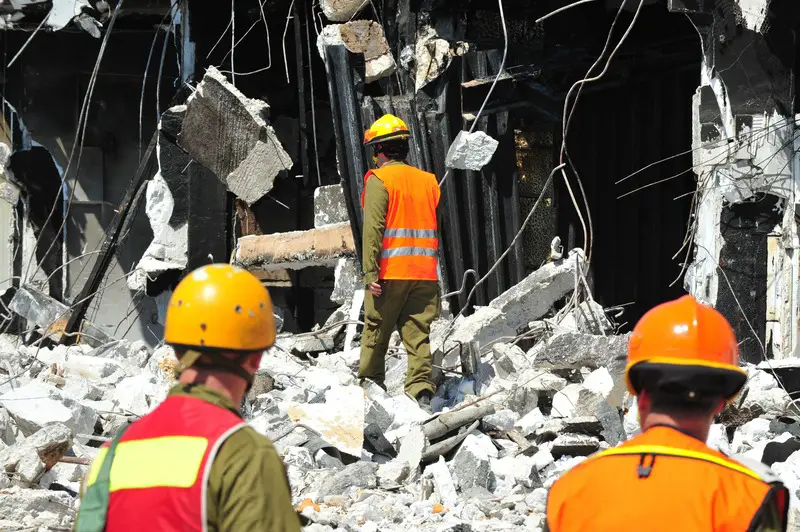
At least 22 people died and 16 others suffered injuries when two adjacent four-story buildings collapsed in the Moroccan city of Fez on Wednesday, Dec. 10, 2025. The structures, located in the densely populated Al-Mustaqbal neighborhood in the western section of the city, housed eight families at the time of the collapse.
According to local authorities, witnesses reported hearing loud cracks late Tuesday night into Wednesday before the buildings came down. One of the structures was unoccupied when it collapsed, triggering the failure of the adjacent inhabited building. The second building was hosting a traditional Aqiqah celebration, a ceremony marking the birth of a child, when disaster struck. Many women and children were among the dead.
Emergency services rushed to the scene immediately after receiving reports of the collapse. The injured were transported to the university hospital center in Fez, where some remained in serious condition. Search and rescue operations continued through the night as crews worked to locate anyone still trapped beneath the rubble, using diggers and other heavy machinery in their efforts.
The prosecutor’s office opened an investigation under judicial police supervision to determine what caused the collapse. Preliminary findings revealed that both buildings were constructed in 2006 as part of self-construction schemes designed for residents of the Ain Smen area. These structures were developed under the “Fez, City Without Slums” program, an initiative aimed at providing housing to residents previously living in informal settlements.
Local media outlets spoke with residents who indicated the buildings had displayed signs of cracking for some time before the collapse occurred. One male survivor described his devastating loss, telling a local television station, “I lost my wife and three children.” Rescue teams managed to recover one body, but he remained at the scene waiting for news of his other family members.
An older woman who lived in the area recounted the moments before the collapse. “My son who lives upstairs told me the building is coming down. When we went out, we saw the building collapsing,” she said.
This incident marks one of the deadliest building failures in Morocco since a minaret collapsed in the historic northern city of Meknes in 2010, killing 41 people. Fez itself has experienced multiple building collapses in recent years. Five people died in a similar incident in the city in February 2024, and six perished during building disasters in 2016. In May 2025, a collapse in Fez killed at least nine people in a building “slated for evacuation.”
The tragedy has renewed focus on structural safety concerns throughout Morocco. In January 2025, Adib Ben Ibrahim, the secretary of state for housing, announced that approximately 38,800 buildings across the country had been classified as at risk of collapse. The government had previously identified more than 12,000 buildings in the southern city of Marrakesh as vulnerable to structural failure in 2023.
Building code enforcement remains inconsistent in Morocco, particularly in ancient cities where aging multi-family homes are common. The issue has become a point of public frustration, especially as the government pursues ambitious infrastructure projects.
Fez, Morocco’s third-largest city, experienced part of the nationwide, youth-led protests two months before the collapse. The demonstrations centered on deteriorating living conditions and inadequate public services. Three people were shot dead by police in Lqliâa, near Agadir, and more than 400 individuals were arrested before the violence subsided.
The city is known internationally for its walled medina, medieval souks and traditional tanneries that draw tourists from around the world. Despite its cultural significance and tourism appeal, Fez remains one of Morocco’s poorest urban centers, where aging infrastructure persists in many neighborhoods.
The timing of the collapse carries particular significance as Fez prepares to host matches for the African Cup of Nations and the 2030 World Cup. The city’s selection as a host venue represents part of Morocco’s broader effort to modernize its infrastructure and boost its international profile.
Morocco experienced a devastating earthquake in 2023, when nearly 3,000 people died in a disaster that struck around Marrakesh and the Atlas Mountains. That catastrophe destroyed historic landmarks, damaged infrastructure across a wide area, and prompted the declaration of a humanitarian emergency. The earthquake highlighted existing vulnerabilities in building construction throughout the country.
As rescue operations continue in the Al-Mustaqbal neighborhood, authorities fear the death toll could rise. Residents of neighboring houses were evacuated as a precautionary measure while officials assessed potential risks to surrounding structures. The investigation into the cause of the collapse remains ongoing, with findings expected to shed light on whether construction defects, maintenance failures, or other factors contributed to the disaster.