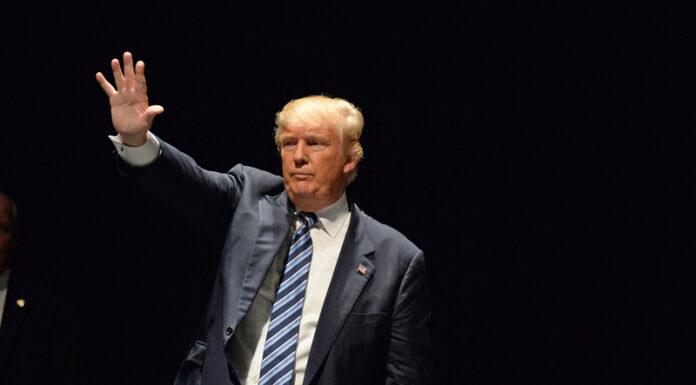
President Donald Trump made waves on Thursday night, December 11, 2025, during the White House Congressional Ball by suggesting that the nation has prosperous years ahead, extending well beyond his current presidential term. Accompanied by First Lady Melania Trump, the 79-year-old president stated that the country would enjoy “a great three years, four years, 10 years, we’re going to make it great.”
This remark is the latest indication that Trump might be considering staying in office beyond the two-term limit defined by the Constitution’s 22nd Amendment. Previously, he expressed a desire for a third term to reporters and shared a video in October that depicted him governing for thousands of years, concluding with the message “TRUMP 4EVA.” His campaign merchandise store began offering Trump 2028 hats in April, urging supporters to express their support by wearing them.
In November 2025, former White House strategist Steve Bannon disclosed discussions with top constitutional lawyers about ways to circumvent the term limits. On his War Room podcast, Bannon mentioned that one lawyer commented that you could drive “a Mack truck through the 22nd Amendment.” He also told The Economist that there were various alternatives to bypassing the amendment, asserting that Trump would be president in 2028.
Throughout 2025, Trump has sent mixed signals regarding a potential third term. In March, he told NBC News he was “not joking” about seeking an additional term, claiming “there are methods” to bypass the 22nd Amendment, though he did not provide details. He proposed that Vice President JD Vance could win the 2028 election and then “pass the baton” back to Trump. However, by late October, Trump seemed to retract these statements, telling reporters aboard Air Force One that “it’s pretty clear I’m not allowed to run,” adding, “It’s too bad.” In August, when asked if he would run again, Trump replied “no, probably not,” but quickly added “I’d like to.” House Speaker Mike Johnson acknowledged discussions with Trump about this issue but noted there was no feasible path, as any constitutional amendment would take approximately 10 years to complete.
Polls indicate that Americans are divided on this issue. Among those who voted for Trump in 2024, 45 percent oppose his running for a third term, while 43 percent support it. However, among the general American populace, only 21 percent are in favor of Trump serving a third term.
Trump has also been explicit about using federal law enforcement against his critics. In September 2024, prior to resuming the presidency, he released a book threatening to imprison Facebook founder Mark Zuckerberg, warning that if Zuckerberg engages in illegal activities, he would face a life sentence. At that time, Trump posted on social media that if he were to win, those who cheated would be prosecuted to the fullest extent of the law, including “long-term prison sentences.” The threats extended to lawyers, political operatives, donors, illegal voters, and corrupt election officials.
Legal experts note that the Supreme Court’s recent immunity decision grants presidents significant power. Stephen Gillers, a professor at New York University Law School, stated that Trump wields tremendous power if he desires to pursue prosecutions and that there would be minimal barriers to obtaining an indictment. Gillers added that fear remains Trump’s most effective tool as high-profile prosecutions can intimidate people into compliance, even without securing convictions.
Trump’s broader agenda includes establishing what he describes as the most comprehensive mass deportation program in history. In addition to ICE, he is deploying the National Guard and local police to remove individuals living illegally in the country. He is also attempting to end birthright citizenship, which currently grants citizenship to anyone born in the United States, regardless of parental legal status. On the economic front, Trump pledged during his campaign to lower prices, extend his 2017 tax cuts, and eliminate federal taxes on tips, overtime pay, and certain Social Security benefits.
The administration released its 2025 National Security Strategy on December 4, 2025, detailing foreign policy priorities. The document emphasizes the Western Hemisphere rather than global competition with China and Russia. It includes what officials refer to as a Trump Corollary to the Monroe Doctrine, asserting American influence closer to home and challenging Chinese presence in Latin America. In Europe, the strategy claims that the continent is facing significant cultural changes and calls for supporting “patriotic parties,” referring to hard-right groups in countries like France, the United Kingdom, and Germany.
The Trump administration has also been working to dissolve the Department of Education while using federal funding as leverage over schools. It has cut funding for schools teaching critical race theory or what Trump terms gender ideology. The administration has already taken control of college accreditation processes and has denied funding to universities that do not adhere to its policies.
Since spring 2025, the administration has frozen or canceled more than $11 billion in university research funding, targeting schools over alleged antisemitism and diversity programs. Several universities, including Columbia, Cornell, Penn, and Brown, have reached settlements, paying tens of millions of dollars to restore their funding. Harvard University is the only institution contesting this in court—a federal judge ruled in September that the administration’s $2.6 billion funding freeze violated the Constitution, but the Trump administration is appealing. The administration has also utilized executive orders to pressure college accreditation bodies, with legal disputes over these actions ongoing.
Project 2025, a policy blueprint developed by former Trump administration officials and the Heritage Foundation, outlines many of these goals. The 900-page document calls for major changes, including limiting abortion access, expanding deportations, reducing voting protections, and rolling back transgender rights. At least 140 individuals involved in Project 2025 previously worked in Trump’s first administration. Several now hold key positions in his second term, including Attorney General Pam Bondi, Budget Director Russell Vought, and Border Czar Tom Homan.
Trump’s repeated hints about remaining in power beyond two terms, along with his administration’s assertive policy agenda and allies’ discussions about constitutional workarounds, have raised concerns among constitutional scholars and Democratic lawmakers. While the 22nd Amendment poses a significant legal obstacle to a third term, Trump’s pattern of testing boundaries and the Supreme Court’s immunity decision granting presidents considerable power have introduced uncertainty about how seriously such talk should be considered.
As the 79-year-old president approaches the 2026 midterm elections, whether this represents genuine ambition, political theater to retain influence, or a strategy to deter potential Republican challengers remains uncertain. What is clear is that Trump continues to dominate his party’s political landscape, making it challenging for other Republicans to plan for a post-Trump future.