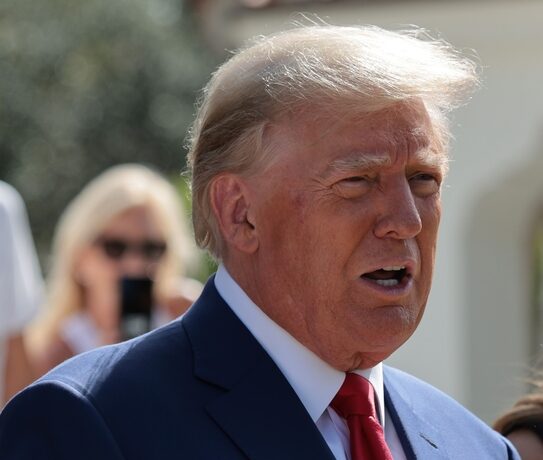
President Donald Trump pardoned former Honduran President Juan Orlando Hernández, in a decision that overturned a 45-year prison sentence for drug trafficking offenses that federal prosecutors described as one of the largest criminal conspiracies ever prosecuted in U.S. courts. Hernández was released from a federal prison in West Virginia shortly after the pardon was granted.
The December 1 pardon has sparked intense criticism from lawmakers on both sides of the aisle, who questioned how the decision aligns with the Trump administration’s aggressive stance against drug cartels. The controversy centers on whether a convicted drug trafficker who helped move hundreds of tons of cocaine into the United States deserves clemency.
Hernández, who served as president of Honduras from 2014 to 2022, was convicted in March 2024 after a three-week jury trial on cocaine trafficking and weapons offenses. According to the indictment filed on Jan. 27, 2022, in U.S. District Court in the Southern District of New York, Hernández participated in a corrupt and violent drug-trafficking conspiracy that facilitated the importation of more than 400 tons of cocaine into the United States.
Federal prosecutors presented evidence that Hernández received millions of dollars in bribes from drug-trafficking organizations, including from Joaquin “El Chapo” Guzman, the former leader of the Sinaloa Cartel. In exchange, Hernández allegedly protected drug traffickers from investigation and extradition, provided sensitive law enforcement information to cartels, and allowed brutal violence to occur without consequence.
Judge P. Kevin Castel, who was nominated by President George W. Bush, sentenced Hernández on June 26, 2024, to 45 years in prison and an $8 million fine. The prosecution marked the culmination of an investigation that began in 2015, initially led by Emil Bove III, then a Department of Justice prosecutor who later became a key defense lawyer for Trump and is now a judge.
Hernández was extradited to the United States in April 2022. During his trial, he maintained his innocence and claimed to be the victim of political persecution. He testified that he had championed anti-crime legislation and worked with the U.S. to fight drug cartels.
Trump defended the pardon by claiming the prosecution was a setup by the Biden administration. White House Press Secretary Karoline Leavitt said Hernández had been targeted because he was “opposed to the values of the previous administration,” describing Trump’s action as reversing over-prosecution.
The pardon drew immediate bipartisan condemnation from Congress. Republican Sen. Bill Cassidy questioned the decision, asking why the administration would pardon a convicted drug trafficker while simultaneously pursuing Venezuelan President Nicolás Maduro for alleged drug-running activities. Republican Sen. Rand Paul told reporters the pardon demonstrates concerns about policy consistency regarding the administration’s strikes on alleged drug boats in the Caribbean.
Maduro, and his wife, Cilia Flores, were captured by U.S. special forces on January 3, 2026, during Operation Absolute Resolve — a U.S. military operation in Caracas. The couple was initially transferred to the USS Iwo Jima and subsequently flown to the U.S., arriving at Stewart Air National Guard Base the same day.
Maduro was taken into federal custody to face 2020 narco-terrorism charges in the Southern District of New York. A superseding indictment was unsealed on January 3, including charges of narco-terrorism conspiracy and cocaine importation conspiracy.
On January 5, Maduro and Flores appeared before U.S. District Judge Alvin Hellerstein and both entered not guilty pleas to numerous drug trafficking charges. They are currently detained at the Metropolitan Detention Center in Brooklyn.
The original indictment, first filed in 2020, alleged that Maduro and his associates conspired with Colombian guerrilla groups to traffic cocaine into the United States as part of what prosecutors termed a narcoterrorism conspiracy. Attorney General Pam Bondi accused Maduro of collaborating with foreign terrorist and criminal organizations, including the Tren de Aragua, the Sinaloa Cartel, and the Cartel of the Suns, to bring deadly violence into the United States.
Republican Rep. Maria Salazar said she felt Trump’s announcement about Hernández’s pardon sent a mixed message as the administration advances its campaign against drug trafficking. Democratic Rep. Norma Torres sent a letter to Trump urging him not to pardon Hernandez, writing that releasing him contradicts stated aims to fight narco-trafficking.
Hernández’s attorney, Renato Stabile, thanked Trump for what he called correcting an injustice. His wife, Ana Garcia de Hernández, posted on social media that her husband was now a free man thanks to Trump’s pardon, adding that the family had endured years of pain and difficult challenges.
Current Honduran President Xiomara Castro, who had Hernández arrested and extradited to the U.S., remains in office. The political implications of the pardon continue to reverberate through both U.S. and Honduran politics, raising questions about the administration’s priorities in combating international drug trafficking while granting clemency to a convicted participant in one of the world’s largest cocaine smuggling operations.
The case against Hernández relied on testimony from former drug traffickers and evidence presented during the three-week trial. During closing arguments, prosecutors argued that Hernández had used his position to protect drug traffickers and facilitate massive cocaine shipments into the United States.
The contradiction between Trump’s pardon of former Honduran President Juan Orlando Hernández and the military operation to capture and prosecute Venezuelan President Nicolás Maduro has drawn sharp criticism from lawmakers on both sides of the aisle. Trump pardoned Hernández on December 1, 2025, just weeks before U.S. special forces captured Maduro on January 3, 2026, on narco-terrorism charges involving allegations of similar drug-trafficking collusion.
Sen. Mark Warner called the hypocrisy “especially glaring,” arguing that the administration “cannot credibly argue that drug trafficking charges demand invasion in one case, while issuing a pardon in another.”
Rep. Nancy Pelosi called Trump’s reasoning “entirely hypocritical.”
Republican Sen. Bill Cassidy echoed the sentiment, writing: “Why would we pardon this guy then go after Maduro for running drugs into the United States?”
Critics point out that the cocaine deliveries facilitated by Hernández dwarf the amounts allegedly carried by the boats being targeted by the U.S. Navy in the Caribbean and eastern Pacific as part of the administration’s anti-narcotics campaign. When pressed on the contradiction after Maduro’s capture, Trump maintained that Hernández had been “set up” by the Biden administration — an explanation that has done little to satisfy critics on either side.
Internationally, the reaction has been more muted but present. Honduras reactivated domestic charges and sought an international warrant for Hernández’s arrest on separate fraud and money-laundering allegations. In Venezuela, the National Assembly issued a formal resolution condemning the U.S. decision, with Assembly president Jorge Rodríguez describing it as an illegal and desperate attempt to undermine Maduro and the Venezuelan people.
There’s also been commentary from analysts and opinion writers framing it in broader terms — one South African academic argued the contradiction “lays bare the calculus of US foreign policy: allies, even criminal ones, are protected if they serve a purpose,” and the Washington Office on Latin America framed it as the U.S. risking undermining its own justice system’s credibility by signaling that high-level officials can be shielded when it suits political or strategic interests.