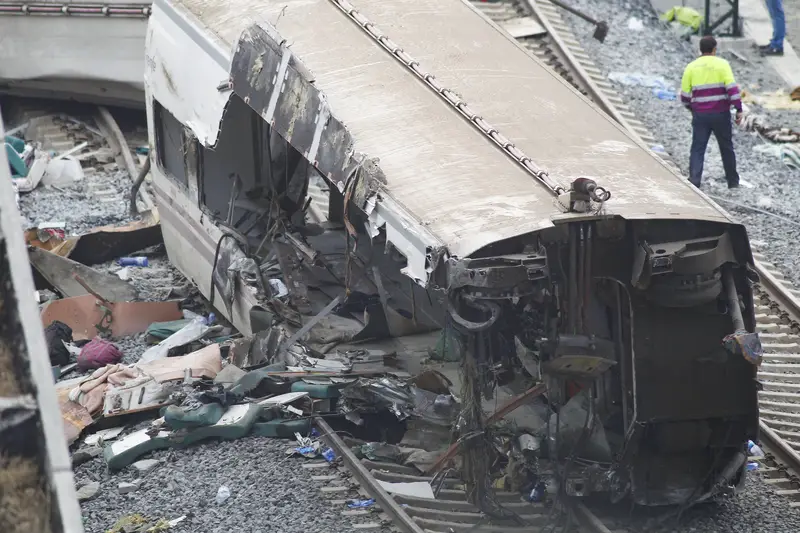
At least 40 people were killed and 159 were injured when two high-speed trains collided in southern Spain on Monday night, after one derailed and crossed onto an adjacent track near Córdoba.
The collision occurred at 7:45 p.m. local time on January 19, 2026, near Adamuz in the Andalusia region when the tail end of a train traveling from Malaga to Madrid went off the rails. The derailed train crossed to the adjacent track and slammed into an oncoming train traveling from Madrid to Huelva.
Spanish Interior Minister Fernando Grande-Marlaska announced Monday that authorities believe three more bodies remain trapped in the wreckage, with the death toll expected to rise to 43.
The Malaga train was carrying 289 passengers, while nearly 200 passengers were aboard the Madrid train. About 400 people were on both trains combined.
Of the 159 people injured, 75 passengers were hospitalized, including 15 in very serious condition. Twelve remain in intensive care units. By Monday afternoon, 81 passengers had been discharged while 41 remain hospitalized.
The first two carriages of the second train were knocked off the track and plummeted down a 13-foot slope. Some passengers were catapulted through windows, with bodies found hundreds of meters from the crash site.
Passengers used emergency hammers to break windows to escape the wreckage. Salvador Jiménez, a journalist for Spanish broadcaster RTVE who was aboard one of the derailed trains, told the network by phone that “there was a moment when it felt like an earthquake and the train had indeed derailed.”
Spanish Prime Minister Pedro Sánchez promised a “thorough and absolutely transparent” investigation into the crash during a news conference in Adamuz, where many locals helped emergency services handle the influx of passengers overnight.
Sánchez canceled his trip to the World Economic Forum in Davos, Switzerland, which started Monday.
Regional President of Andalusia Juanma Moreno described the wreckage as a mass of twisted metal and said the region was heartbroken. Emergency crews worked through difficult conditions to search the mangled carriages for additional victims.
Spanish Transport Minister Óscar Puente called the crash truly strange because it occurred on a flat stretch of track that had been renovated in May. He said the train that jumped the track was less than four years old.
The earliest signs point to mechanical failure as the cause of the crash, though the investigation is ongoing.
The derailed train belonged to the private company Iryo, while the second train, which took the brunt of the impact, was operated by Spain’s public train company Renfe. Rail operator Adif, which manages Spain’s state-owned railway infrastructure, suspended high-speed rail services between Madrid and a number of cities in Andalusia on Monday in the aftermath of the collision.
Iryo said in a post on X that it deeply regretted what happened and had activated all emergency protocols. Renfe chief Álvaro Fernández Heredia called the incident a tragedy that affects us all.
In Adamuz, a sports center was transformed into a makeshift hospital while the Spanish Red Cross established a help center to assist emergency services and people seeking information. Members of Spain’s civil guard and civil defense worked at the site throughout the night.
Spain’s civil guard activated the national protocol for responding to mass casualty incidents, with personnel including experts in fingerprinting and DNA analysis joining efforts to identify victims. The nationalities of the victims remain unknown.
Spain operates the largest high-speed rail network in Europe for trains moving more than 155 mph, with over 1,900 miles of track, according to the European Union.
The country’s worst train accident this century occurred in 2013 when 80 people died after a train derailed in the country’s northwest. An investigation concluded the train was traveling 111 mph on a stretch with a 50 mph speed limit when it left the tracks.