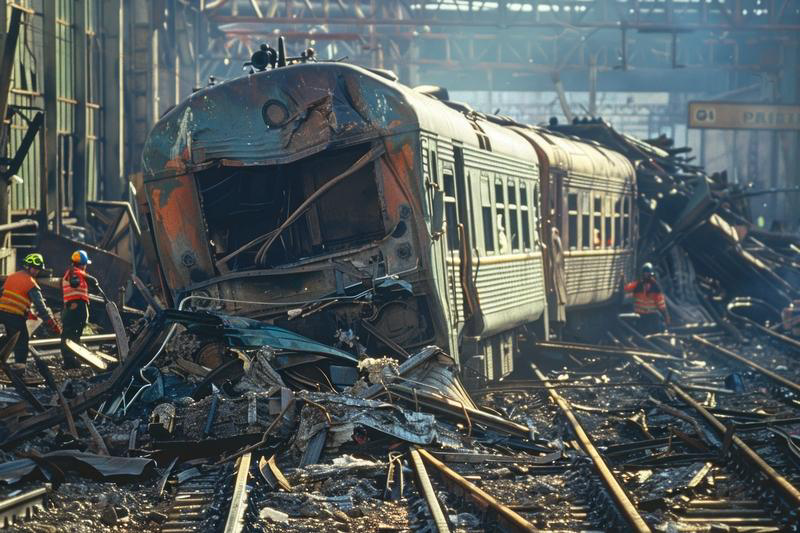
A construction crane fell onto a passenger train in Thailand on Wednesday morning, January 14, 2026. The accident resulted in the death of at least 30 individuals and injured at least 69 others. The train was en route from Bangkok to Ubon Ratchathani province when the incident occurred around 9:10 a.m. local time in Sikhio district, Nakhon Ratchasima province, roughly 143 miles northeast of Bangkok. The collision caused the train’s carriages to derail and catch fire.
Deputy Prime Minister and Minister of Transport Phiphat Ratchakitprakarn said that 195 passengers were onboard at the time of the accident. Other sources, newly confirmed, say 157 passengers were on the train. The train, consisting of three carriages, was traveling at a speed of approximately 75 mph when the incident occurred. The Nakhon Ratchasima Provincial Public Health Office reported that at least 66 individuals were injured, with eight of them in critical condition.
An eyewitness, Mitr Intrpanya, 54, recounted the tragic event. “At around 9 a.m., I heard a loud noise, like something sliding down from above, followed by two explosions,” he informed the media. “The metal from the crane seemed to hit the middle of the second carriage, cutting it in half.”
Local residents responded immediately, attempting to rescue passengers from the bisected second carriage. Theerasak Wongsungnoen, the train driver, tried to aid the injured passengers but was hindered by the spreading fire, which blocked access to the second carriage. One observer described witnessing pieces of concrete falling before the full collapse of the crane.
Rescue efforts were briefly halted due to a chemical leak at the scene, but authorities later confirmed the fire had been put out. Evening updates revealed three passengers were still unaccounted for among those believed to have been on the train, and transport officials are working to identify all victims.
Among the casualties was a German tourist who was traveling with his wife to her hometown in Surin province. Taew Eimertenbrink, 63, a survivor of the incident, told reporters from her hospital bed that her German husband “was killed instantly” in the derailment. The couple had chosen to travel by train from Bangkok.
Italian-Thai Development PCL, the Thai company responsible for operating the crane and one of the largest construction firms in the country, issued a statement expressing their deepest condolences. The company also pledged its responsibility to provide support and compensation to the victims and their families. Anan Phonimdaeng, the acting governor of the State Railway of Thailand, stated that the contractor for the project is Italian-Thai Development, while a Chinese firm is in charge of design work and construction oversight. He added that the responsibilities of both groups will be reviewed, and the Railway Department plans to take legal action against the contractor as a preliminary measure.
The company has been linked to several deadly accidents at its sites in recent years. It was the co-lead contractor for the State Audit Building in Bangkok that collapsed during construction in March 2025 following an earthquake in neighboring Myanmar. That collapse killed 95 people, marking the only major structure in Thailand to suffer such severe damage. Several company executives were indicted in relation to the disaster.
Prime Minister Anutin Charnvirakul stated that the Comptroller General’s Department and Transport Ministry are responsible for blacklisting contractors. He called for legal changes to blacklist companies that are repeat offenders. The state rail operator ordered Italian-Thai to halt construction activities, and Transport Minister Phiphat Ratchakitprakarn ordered an investigation. A fact-finding committee will be established within 15 days to investigate the circumstances leading to the collapse.
The crane was part of a two-stage rail project with a total investment of over $16.8 billion. The project aims to construct a high-speed railway network across Thailand, connecting Bangkok to the northeastern province of Nong Khai, bordering Laos. The network is part of Beijing’s Belt and Road Initiative, designed to facilitate travel and commerce between Southeast Asia and China.
This project is a significant infrastructure investment for Thailand. The initial segment, running from Bangkok to Nakhon Ratchasima, is projected to cost about 179 billion Thai baht. The next stretch from Nakhon Ratchasima to Nong Khai will cover about 222 miles with a budget of 341 billion baht. When completed, the rail line will link with routes in Laos, creating a connection to Kunming, China by 2030.
This is not the first fatal incident linked to the high-speed rail construction project. In August 2024, a railway tunnel on the planned route, also in Nakhon Ratchasima province, collapsed, killing three workers. Heavy rainfall over several days was believed to have contributed to the tunnel collapse. The project has been plagued by multiple delays and safety issues during its construction phase.
The Railway Department plans to initiate legal action against the contractor as a first measure. The damage to the train is estimated at over $3.2 million, while the construction machinery sustained only minor damage. Local media broadcasts throughout the day showed rescue crews atop overturned rail cars, some with large holes torn into their sides, as paramedics attended to injured passengers on site.
By January 18, all 30 victims had been identified and returned to their families. The three “missing” passengers were accounted for (some had survived, one wasn’t on the train).