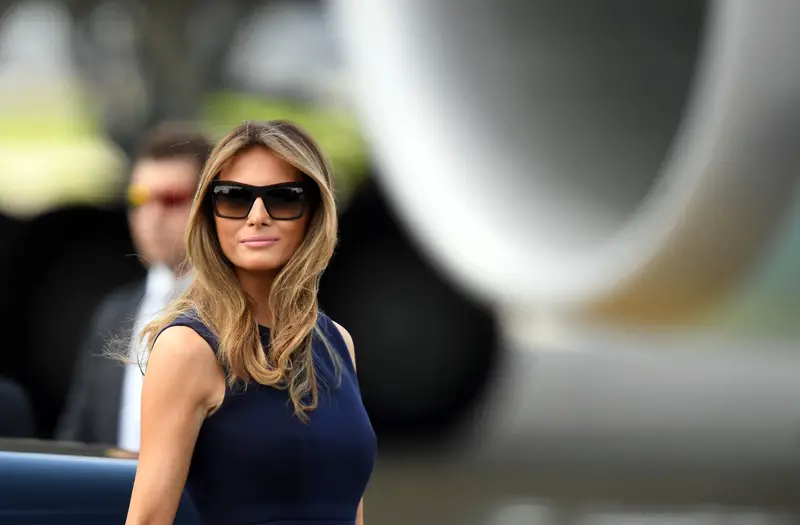
First Lady Melania Trump revealed the grandeur of a private White House screening of her new documentary on Saturday, January 24. She posted a video on Sunday that displayed how the White House East Room was converted into a theater for the black-tie event.
The exclusive viewing of Melania, the $75 million documentary produced by Amazon ($40M acquisition + $35M marketing), took place on Saturday evening. The film, directed by Brett Ratner, chronicles the 20 days leading up to President Donald Trump’s inauguration. It was the first time the president had seen the complete film.
Guests were greeted by a full military band performing “Melania’s Waltz” upon their arrival at the East Room. The video shared by Melania included footage of her and President Trump entering the room.
Among the guests at the event were Queen Rania of Jordan, Apple CEO Tim Cook, Amazon CEO Andy Jassy, and former heavyweight boxing champion Mike Tyson. Other notable attendees included Zoom CEO Eric Yuan, President of NYSE Group Lynn Martin, AMD CEO Lisa Su, Erika Kirk, Tony Robbins, and Barron Trump.
Guests received memorabilia from the event, such as popcorn boxes, framed collectible screening tickets, and cookies bearing the first lady’s name. The elaborate setup mirrored the high-profile nature of the occasion, arranged after the White House Family Theater was demolished in October to create space for a $400 million ballroom project.
The screening’s timing has been criticized by some. The event occurred on the same day as the fatal shooting of Alex Pretti, a 37-year-old ICU nurse, by federal agents in Minneapolis, Minnesota. This incident resulted in immediate backlash against attendees who chose to attend the celebration amidst the ongoing crisis.
Former Trump lawyer Jenna Ellis, publicly questioned the decision to continue with the screening. “I have deep respect for the first lady and have been honored to meet her. But this event should have been postponed,” Ellis wrote. “With Minneapolis unraveling and Americans demanding leadership, this feels disconnected from reality.”
Despite the controversy, the documentary was set to follow its planned release schedule. A premiere at the Kennedy Center was held on Thursday, January 29, followed by the official release on Friday, January 30. Amazon is making the film available in approximately 2,000 U.S. theaters and 3,000 theaters worldwide across 27 countries.
Industry projections initially suggested the film would face challenges at the box office. The documentary was anticipated to generate between $1 and $5 million during its opening weekend, a modest figure considering the significant investment in production and promotion. However, reports from the opening weekend indicate the documentary had a good start, generating about $7 million.
President Trump endorsed the film on social media last Monday, posting a relatively brief message for a figure known for extensive reviews of books and other media he supports. He wrote, “MELANIA, the Movie, is a MUST WATCH. Get your tickets today — Selling out, FAST!”
The scale of this documentary filmmaking is a departure from traditional first lady projects, which typically concentrate on public service initiatives or cultural preservation. The commercial nature of the project, combined with the significant budget and wide theatrical release, sets the project apart from previous first lady media appearances.
The screening, attended by major corporate figures like the CEOs of Apple, Amazon, and other Fortune 500 companies, underscored the blend of politics, business, and entertainment that defined the Trump era. These relationships between the administration and corporate leadership continue to attract attention from political observers and media analysts.
Amazon’s global theatrical release strategy, covering 27 countries, indicates its confidence that international audiences will be interested in this behind-the-scenes look at American political tradition.
There has already been pushback in one country. Filmfinity, the film’s South African distributor, announced on Wednesday, January 28, that Melania will no longer receive a theatrical release in the country. The documentary had been slated to screen at the nation’s two major theater chains, Ster-Kinekor and Nu Metro, as well as at independent venues like Cape Town’s Labia Theatre.
Thobashan Govindarajulu, Filmfinity’s head of sales and distribution, said the company chose to halt the theatrical release in light of recent events. He declined to provide further details but stressed that no external pressure influenced the decision to pull the film.