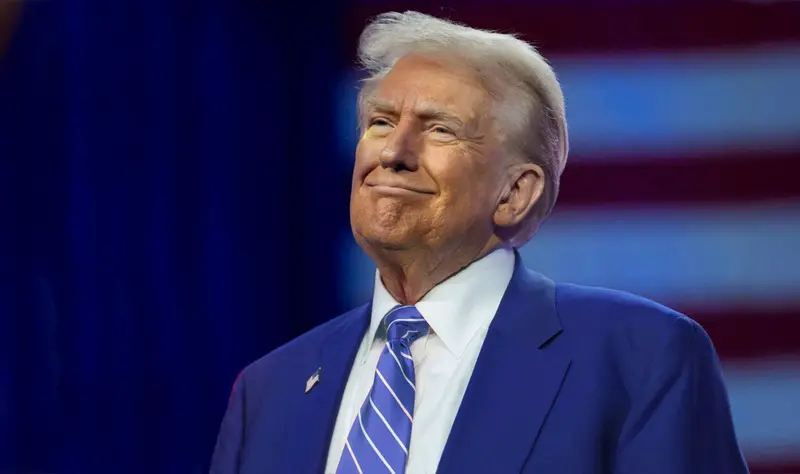
President Donald Trump, aged 79, surprised his close associates by calmly speculating about his own mortality, according to a recent report. The president made the comment at his Mar-a-Lago estate in Florida, while watching coverage of the late President Jimmy Carter’s funeral, stating: “You know, within ten years that will be me.”
The statement was reported in a comprehensive profile titled “The Superhuman President” in New York Magazine, which explored the president’s health and mindset. However, Press Secretary Karoline Leavitt could not recall the president making such a remark when asked by the magazine.
This instance adds a somber tone to the discussions within Trump’s team about the year 2028. Conversations about mortality occasionally emerge as aides contemplate whether the president will be eager, or even able, to initiate another political campaign as he enters his early 80s.
Meanwhile, Trump has emphasized the importance of maintaining his position in the Oval Office for his own longevity. He recalled a saying of his father, Fred Trump, in his conversation with New York Magazine: “To retire is to expire.” He has repeated this line in past interviews and appearances, indicating his belief that work, especially his role as president, serves as a defense against aging.
Trump holds the record as the oldest individual ever elected to the presidency. Despite this, he has frequently suggested the possibility of running for office again, even asserting he could seek a third or potentially fourth term at 86, despite the Constitution’s two-term limit, as noted by legal experts.
Concerns about Trump’s health have grown amongst his advisers. They are worried about the bruising on his hands, his propensity to fall asleep in public, and an unexplained visit to Walter Reed Medical Center last year for an MRI. A large bruise was noticeable on his left hand during his appearance at the World Economic Forum in Davos, Switzerland on January 22.
Former White House lawyer, Ty Cobb, warned that signs of Trump’s mental decline are becoming increasingly apparent. Dr. Bruce Davison, on a podcast, mentioned that the president’s daily 325 mg aspirin regimen is typically prescribed to stroke patients.
Within Trump’s inner circle, there is a distinct dichotomy: on one side, he discusses mortality, his legacy, and his aspirations—from a $400 million East Wing ballroom to the “Arc de Trump” he envisions opposite the Lincoln Memorial—yet he continues to portray himself as a larger‑than‑life figure capable of outperforming younger opponents and defying the constraints of age.
Trump’s recent actions have triggered additional concerns among observers. On January 23, he posted more than 70 times on Truth Social within 50 minutes, from 12:40 a.m. to 1:30 a.m., after returning from his Davos, Switzerland trip.
The Switzerland trip was challenging for the president, where he withdrew plans to annex Greenland. His late-night posts covered a variety of topics, from a trailer for Melania’s Amazon documentary to reposted videos from Fox News and Joe Rogan’s podcast.
During his late-night social media activity, Trump also announced a joint venture with TikTok, in which Oracle will have a 15 percent stake in TikTok U.S.
The president has shared disparaging posts about his political adversaries, including Gavin Newsom, Rep. Ilhan Omar, and Tim Walz. He stated on Truth Social that the Department of Justice is investigating Omar regarding her wealth. According to Trump, the Justice Department and Congress are scrutinizing Omar, who immigrated from Somalia as a child with nothing, and is now reportedly worth over $44 million.
The contrast between Trump’s public image of strength and vitality and the private health concerns witnessed by those close to him is a recurring theme in his second term. The difference between his active social media presence and reports of frequent public napping underscores the challenge of evaluating his fitness for office.
Trump’s reference to his father’s adage about retirement and death becomes more poignant considering Fred Trump’s own life. The President’s interpretation of this idea—that continuous work, specifically in the Oval Office, can somehow delay aging and death—reveals a mindset that may be influencing his reluctance to acknowledge or address health issues.
The President’s legacy plans include ambitious and costly physical monuments. The proposed $400 million East Wing ballroom is a significant extension to the White House, while the Arc de Trump across from the Lincoln Memorial would place his name on the National Mall. These projects indicate a president deeply concerned with his legacy, even as he publicly dismisses concerns about his mortality and suitability for office.