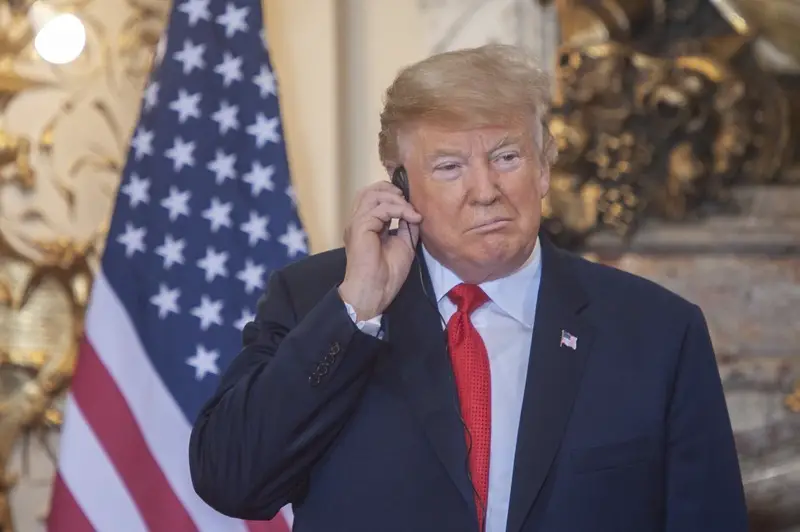
President Donald Trump appeared to disclose disappointing economic data in a typo-filled social media post on Friday morning, Feb. 20, 2026, revealing weak GDP figures 40 minutes ahead of their official release while launching a new criticism of Federal Reserve Chair Jerome Powell.
“LOWER INTEREST RATES. ‘Two Late’ Powell is the WORST!!!” Trump wrote on Truth Social at 7:50 a.m. ET, seemingly misspelling his usual “Too Late” label for the Fed chair. The message went out as the Commerce Department prepared to unveil fourth-quarter economic numbers showing growth had slowed sharply to just 1.4%.
The president’s early post also faulted Democrats for the economic deceleration, saying the shutdown “cost the U.S.A. at least two points in GDP” and cautioning against future funding breakdowns.
When the official data was released at 8:30 a.m., it validated Trump’s bleak preview. The economy expanded at an annualized rate of 1.4% in the final quarter of 2025, a steep drop from the prior quarter’s 4.4% and far below economists’ forecasts of 2.5% to 3%. The figure marked a decline of 3 percentage points from the preceding three-month period.
The premature disclosure represents at least the second time Trump has shared economic data before its scheduled release. Office of Management and Budget rules prohibit executive branch officials from commenting early on such data and bar public remarks until at least 30 minutes after the official publication. In January, Trump indirectly hinted at upcoming non-farm payrolls data, leading the White House to admit an “inadvertent public disclosure of aggregate data.”
The weak GDP report poses a major setback for Trump’s economic messaging ahead of the Tuesday, February 24 State of the Union address. The president has repeatedly taken credit for what he calls a “booming” economy, even telling a Georgia crowd on Thursday that he had “solved” affordability issues.
The economic slowdown was driven in part by the record 43-day government shutdown that began on Oct. 1 and extended into mid-November. The Bureau of Economic Analysis estimated the closure cut roughly 1 percentage point from real GDP growth. The Congressional Budget Office projected the shutdown would reduce annualized growth by up to 2 percentage points.
But the shutdown explains only part of the picture. Consumer spending, which powers much of the U.S. economy, rose just 2.4% in the fourth quarter, down from a solid 3.5% increase in the third quarter. The slowdown suggests Americans are feeling financial pressure despite the administration’s upbeat claims.
Joel Kan, vice president and deputy chief economist at the Mortgage Bankers Association, cautioned that households with sufficient income continue to drive most spending, while pressure intensifies on lower-income Americans dealing with higher prices and elevated debt levels.
Adding to the administration’s difficulties, another Commerce Department report showed inflation picked up in December. The PCE price index climbed 2.9% year-over-year, nearly a full percentage point above the Federal Reserve’s 2% target. Persistent inflation makes it unlikely Powell will move to cut interest rates as quickly as Trump wants.
The timing is politically challenging for Trump. His overall approval rating has fallen to 38% in the latest Reuters/Ipsos survey, down from about 50% when he took office in January 2025. Consumer confidence dropped 9.7 points to 84.5 in January 2026, the lowest reading since May 2014 and even below levels seen during the depths of the COVID-19 recession.
For all of 2025, the economy expanded 2.2%, down from 2.8% in 2024. Despite steady growth, employers added only 181,000 jobs that year, the weakest annual total outside recession periods since 2003. The unemployment rate stood at 4.3%.
White House spokesperson Kush Desai attempted to cast the numbers favorably, saying GDP growth “smashed” expert forecasts and crediting the president’s policies of tax cuts, deregulation, and tariffs for setting the stage for a stronger rebound in 2026.
Certain indicators showed some underlying stability. Real final sales to private domestic purchasers—combining consumer spending and business investment—rose 2.4%, in line with post-pandemic recovery trends. Budget Lab executive director Martha Gimbel characterized consumer and business spending as “reasonably solid,” noting: “This is not a disastrous report.”
The Federal Reserve released minutes from its January meeting, indicating policymakers are increasingly hesitant to lower interest rates this year. Several officials even suggested the central bank might need to raise rates if inflation remains elevated. Chris Zaccarelli, chief investment officer at Northlight Asset Management, said the weak growth and persistent inflation highlight the tension between the Fed’s hawks and doves.
As Trump prepares for his State of the Union address to Congress, he must explain why the economy has slowed significantly during his tenure while inflation stays above target. His Friday morning social media post, complete with an apparent typo, indicated he recognizes the economic news poses political challenges heading into the midterm election year.