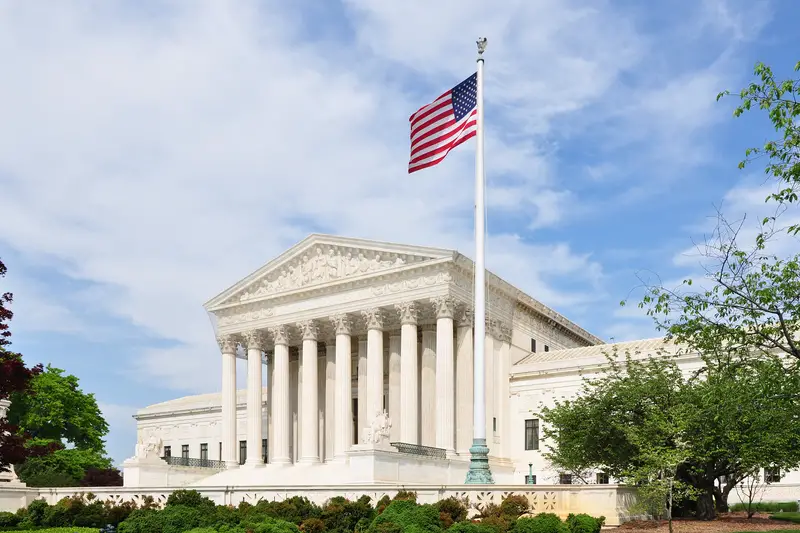
The Supreme Court delivered a crushing blow to President Donald Trump’s economic agenda on Friday, Feb. 20, 2026, striking down his sweeping global tariffs in a 6-3 decision that upends one of his signature policy initiatives and could trigger more than $175 billion in refunds.
Chief Justice John Roberts, writing for the majority, ruled that Trump exceeded his authority when he used the International Emergency Economic Powers Act of 1977 to impose tariffs on dozens of countries. The law, first invoked during the Iran hostage crisis and later used for events like the 9/11 attacks, contains no mention of tariffs and does not grant the president such expansive trade powers.
“When Congress grants the power to impose tariffs, it does so clearly and with careful constraints,” Roberts wrote. “It did neither here.”
The decision strikes at the heart of Trump’s “Liberation Day” tariffs announced on April 2, 2025, when he imposed reciprocal tariffs of up to 50% on dozens of countries and a baseline 10% tariff on nearly all imports. Trump justified the measures as responses to drug trafficking, undocumented immigration and trade imbalances, declaring them necessary for economic revival.
In a stunning rebuke to the president who appointed them, Justices Amy Coney Barrett and Neil Gorsuch joined the court’s three liberal justices and Roberts in the majority. Only Justices Clarence Thomas, Brett Kavanaugh and Samuel Alito dissented.
Trump reacted with fury, calling the Supreme Court decision a “disgrace” and describing the majority justices as “very unpatriotic and disloyal to the Constitution.” Speaking at the White House, the president announced and later invoked Section 122 of the Trade Act of 1974 to impose a new 10% tariff “across the board” effective immediately—though that statute limits such taxes to 150 days without congressional approval.
The ruling affects tariffs Trump imposed using IEEPA on countries ranging from Syria and Lesotho to major trading partners including the United Kingdom, China, Canada, Mexico, Japan and European Union nations. Trump had also used the law to slap duties on Brazilian imports over the prosecution of former President Jair Bolsonaro and on India for purchasing Russian oil.
The Treasury collected approximately $150 billion from these tariffs through Feb. 20. The potential refunds could reach $175 billion. Studies have consistently found that American companies and consumers shouldered the vast majority of these costs.
Small businesses celebrated the decision. We Pay the Tariffs, an advocacy group of 800 small businesses, called it “a tremendous victory.” The group’s executive director, Dan Anthony, said companies have taken out loans just to survive and frozen hiring while watching their savings drain away to pay unexpected tariff bills.
Learning Resources, the educational toy company that served as lead plaintiff in the case, joined hundreds of other firms including retail giant Costco, aluminum producer Alcoa and tuna brand Bumble Bee in filing lawsuits to contest the tariffs and position themselves for refunds. The Illinois-based company’s CEO, Rick Woldenberg, said the tariffs had “raised the tax rate on our company to the point it was asphyxiating.”
The refund process could prove chaotic. During oral arguments, Justice Barrett acknowledged it would likely be “a mess.” Kavanaugh echoed this in his dissent, noting the court “says nothing today about whether, and if so how, the government should go about returning the billions of dollars that it has collected from importers.” Trump himself reiterated this when questioned by the press about the refund process.
The decision leaves intact other Trump tariffs imposed under different legal authorities, including duties on steel, aluminum, cars, copper, lumber, kitchen cabinets, bathroom vanities and upholstered furniture. The European Union faces 50% tariffs on steel and steel derivatives, while the United Kingdom pays 25%.
Trump retains authority under Section 122 of the 1974 Trade Act to impose temporary import surcharges of up to 15% for 150 days to address balance of payment issues, though this power expires without congressional approval.
Stock markets responded positively to the news, with the S&P 500 rising 0.6% and the Nasdaq climbing 0.9% in Friday afternoon trading.
The path forward remains uncertain. Trade deals that many countries negotiated with the Trump administration last year to lower tariff rates now face doubt, and the administration has vowed to pursue “even stronger” measures through alternative legal channels.
Commerce Secretary Howard Lutnick and Solicitor General D. John Sauer flanked Trump during his White House response, but the administration offered few specifics on its next steps beyond the president’s immediate 10% global tariff (later changed to 15% via a Truth Social post – the maximum allowed under Section 122).
The Supreme Court’s ruling left unanswered a critical question: what happens to the billions of dollars already collected under the now-invalidated IEEPA tariffs?
When asked about refunds during his Friday press conference, Trump suggested the matter would be tied up in litigation, stating, “I guess it has to get litigated for the next two years.”
Legal experts predict a chaotic refund process involving U.S. Customs and Border Protection, the Court of International Trade, and numerous lower courts, with trade lawyer Joyce Adetutu warning, “it’s going to be a bumpy ride for a while.” Meanwhile, trade experts are already challenging the legality of Trump’s Section 122 replacement tariffs, arguing the law requires a “fundamental international payments problem” that economists say does not exist under the U.S.’s floating exchange rate system. The Section 122 tariffs automatically expire after 150 days on July 24, 2026, unless Congress votes to extend them—an unlikely prospect with midterm elections approaching.