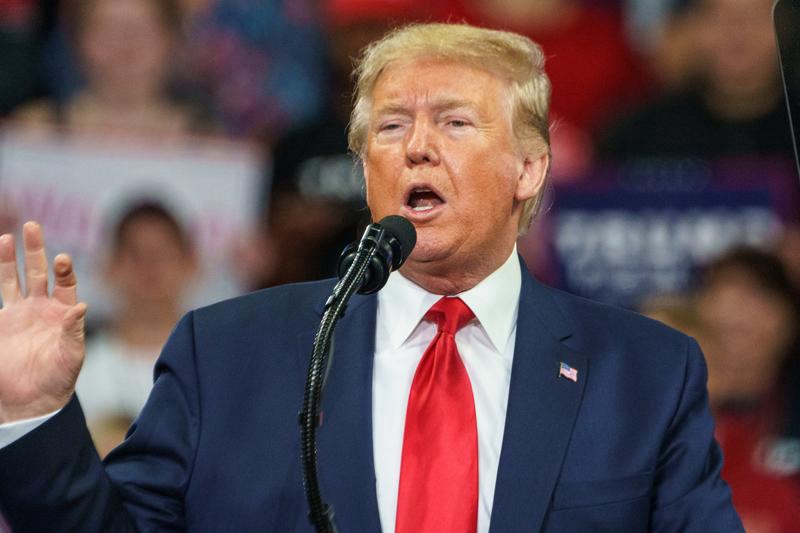
President Donald Trump avoided answering a question from Rachel Scott, ABC News’ senior political correspondent, about the fatal shooting of Alex Pretti in Minneapolis, Minnesota. The shooting involved federal agents, and instead of addressing the issue, Trump criticized Scott, prompting cheers from the crowd at the Horizon Events Center in Clive, Iowa.
On Tuesday, January 27, Trump called Scott and ABC News “fake news.” He remarked that he didn’t care for Scott and claimed she hadn’t asked him a good question in years. In December, he had previously described her as “the most obnoxious reporter in the entire place” and a poor journalist.
Trump referred to Pretti’s death as a regrettable situation but also criticized him for being armed during his encounter with federal agents. Pretti had a pistol in a waist holster. However, videos reviewed by CBS News, ABC News, and other outlets show that Pretti was only holding a cellphone when agents approached him.
The footage shows an officer removing Pretti’s gun from his waistband during a struggle, about one second before the first shot was fired. At no point in the videos does Pretti display or reach for the weapon. Minnesota officials confirmed that Pretti had a legal permit to carry a concealed firearm.
Gun rights organizations denounced the President’s statements about an armed citizen. Both the National Rifle Association and Gun Owners of America—groups known for defending the rights of lawful gun owners—criticized officials’ comments following the shooting.
The shooting occurred during Operation Metro Surge, a large-scale deployment of federal agents to Minneapolis. The operation sparked controversy and legal challenges from state and local leaders opposed to the federal presence.
The U.S. Department of Justice launched a civil rights investigation into Pretti’s death. Deputy Attorney General Todd Blanche announced the probe, noting that investigators are “reviewing everything that could clarify what occurred that day.” The FBI and Homeland Security Investigations are leading the effort.
Following conversations with Trump, Governor Walz requested independent investigations into shootings involving federal agents. Tom Homan, Trump’s border czar, met with both Walz and Mayor Frey. In an exclusive interview with ABC News, Trump said federal operations would be scaled back going forward.
Trump also asserted that crime in Minnesota had fallen as a result of the federal mission.
Tensions between Trump and ABC’s Scott escalated during an exclusive interview on Tuesday. Trump claimed, without providing evidence, that Representative Ilhan Omar staged an attack on herself at a Minneapolis town hall where a man sprayed apple cider vinegar at her while she was speaking.
The killing of Renee Good, a 37-year-old mother, by an ICE agent on January 7 had already sparked protests in Minneapolis before Pretti’s death intensified the unrest. ICE maintains the agent acted in self-defense, alleging Good used her car as a weapon—an assertion disputed by local leaders, including Mayor Frey.
Trump’s confrontational behavior toward reporters—especially women and journalists of color—has been a recurring theme during his political career. Scott, like other journalists who have pressed him with difficult questions, has often been publicly criticized by Trump.
Amid growing pressure and public outrage over the fatal shootings, Trump sent border czar Tom Homan to Minneapolis on Monday, January 27 to meet with Governor Walz, Mayor Frey, and other officials. Homan assumed command of Operation Metro Surge from Border Patrol leader Gregory Bovino and worked to negotiate agreements with local authorities.
On Wednesday, February 5, Homan announced that 700 of the roughly 3,000 federal officers in Minnesota would be withdrawn “effective immediately,” citing what he described as unprecedented cooperation from county jails in transferring detained immigrants to ICE.
A week later, on Thursday, February 13, Homan stated that Operation Metro Surge would be fully wound down, with most of the remaining officers leaving over the next week. The move represented a major shift for the administration, which had been facing intense criticism over the deaths of Alex Pretti and Renee Good, widespread demonstrations, and bipartisan backlash.