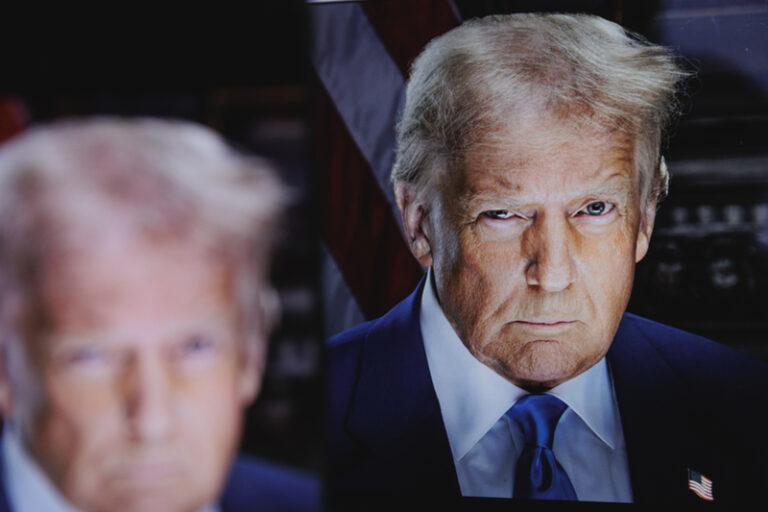
President Donald Trump’s own advisers seem to be mounting an extraordinary internal pushback—leaking cautionary messages to the press in what appears to be a coordinated effort to prevent him from ordering military strikes on Iran.
Across roughly 48 hours beginning Sunday, Feb. 22, 2026, several major news organizations received unusually consistent briefings from anonymous administration officials, each warning about the dangers of initiating military action against Iran. The rare wave of leaks indicates significant unease within Trump’s inner circle over the president’s handling of the intensifying crisis.
The concerns focus on Chairman of the Joint Chiefs of Staff Gen. Dan Caine, Trump’s most trusted military adviser, who has privately warned that U.S. stocks of key munitions have been heavily depleted by defending Israel and supporting Ukraine. According to multiple reports, Caine informed Trump and senior leaders during a White House meeting believed to have taken place on Feb. 17 that U.S. reserves of Patriot, THAAD, and SM-3 interceptors might last only about two weeks in the event of a major Iranian missile attack.
The meeting included Vice President JD Vance, Secretary of State Marco Rubio, CIA Director John Ratcliffe, and adviser Stephen Miller. Sources say Caine warned that attacking Iran could pull the U.S. into a drawn-out conflict—a message that may have driven allies inside the administration to make their concerns public through anonymous channels.
“Someone in that administration is trying to head off what they realize will be a disaster,” said Branko Marcetic, a journalist who highlighted the pattern of coordinated leaks.
Military preparations near Iran have escalated sharply. The USS Gerald R. Ford, the largest warship in the U.S. fleet, has entered the Mediterranean and is expected to be within striking range of Iran within days. The carrier has been deployed since June 2025, potentially surpassing 300 days at sea and breaking the post-Vietnam record of 294 days set by the USS Abraham Lincoln in 2020. Meanwhile, more than a dozen guided-missile destroyers have positioned themselves in Middle Eastern and Mediterranean waters.
Aircraft-tracking data has also documented numerous flights toward Diego Garcia, the U.S. base in the Chagos Islands south of Iran across the Arabian Sea. Over recent weeks, more than 150 American military cargo flights have delivered weapons and ammunition to the Middle East, with analysts calling it one of the largest U.S. buildups in the region since the 2003 Iraq invasion.
Trump, 79, is said to be considering a limited strike “in the coming days,” according to officials speaking to several outlets. Yet the scale of any potential operation remains uncertain. Former Pentagon officials have told reporters that meaningfully damaging Iran’s missile capabilities could require attacks on hundreds of targets, while any attempt to undermine the Iranian government might expand the list to thousands of sites and prolong operations for weeks or months.
Logistical complications continue to rise. Several Arab states have privately informed Washington that they will not permit their territory to be used for launching strikes on Iran, according to a senior Gulf official. Meanwhile, the State Department has ordered the evacuation of non-essential staff and family members from the U.S. Embassy in Lebanon, anticipating possible retaliation from Iran-aligned militias.
Pentagon worries have deepened due to recent naval issues. The USS Harry S. Truman lost three F/A-18 Super Hornet jets during operations against the Houthis in the Red Sea between late 2024 and May 2025, with a Navy inquiry citing leadership errors, training deficiencies, and faulty equipment. The Ford is now dealing with recurring sewage-system malfunctions requiring almost daily maintenance, and sailors—strained by months at sea—are considering leaving the Navy.
The internal struggle has created notable fractures. Vice President Vance has questioned the risks and potential long-term entanglement, while envoys Steve Witkoff and Jared Kushner have advised Trump to allow more time for diplomacy.
In a striking break from past practice, CENTCOM commander Adm. Brad Cooper, whose command oversees Iran, has reportedly been excluded from Trump’s Iran planning meetings and has not spoken with the president since the crisis began in January. His predecessor, Gen. Erik Kurilla, regularly briefed both Trump and former President Biden on Middle East developments.
Diplomatic meetings between U.S. representatives and Iranian negotiators were held Feb. 26 in Geneva, offering a potential pathway to avoid armed conflict.
Trump has attacked the reporting as “100 percent incorrect” on Truth Social, saying the media presented his stance “incorrectly, and purposefully so.” He wrote that Caine “has not spoken of not doing Iran” and “only knows one thing, how to WIN.” White House spokeswoman Anna Kelly defended the president’s decision-making, saying Trump “listens to feedback from all members of his national security team, and he is always the final decision maker.”
White House Press Secretary Karoline Leavitt and Chief of Staff Susie Wiles have not addressed the leaks publicly.
The organized leak campaign marks an unusual moment in American governance—senior officials working through the media to limit their own president’s options. The outcome of the upcoming diplomatic talks may decide whether these leaks succeed in steering Trump away from military escalation, or whether they harden his determination as the military buildup advances and diplomatic efforts race against time.