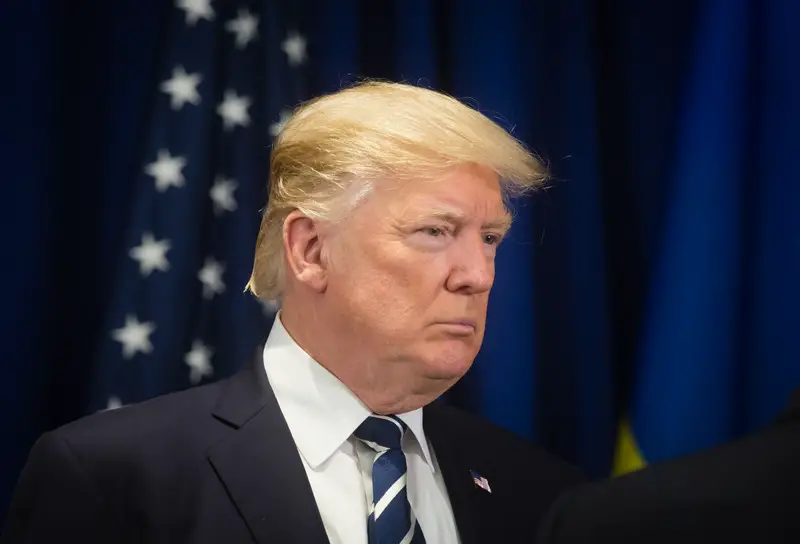
President Donald Trump has admitted that Americans will probably die in his new military operation against Iran, telling reporters that casualties “often happen in war” as U.S. forces begin what the administration describes as “major combat operations” throughout the Middle East.
The 79-year-old president revealed the strikes in a Truth Social video posted early Saturday morning, Feb. 28, 2026, wearing a white “USA” trucker hat as he vowed that American forces intend to “raze their missile industry to the ground” and “annihilate their navy.” The statement represents a sharp reversal for a leader who ran on ending foreign conflicts.
“I’m not going to start a war. I’m going to stop wars,” Trump said in his November 2024 victory speech, pledging to redirect national resources toward domestic priorities instead of overseas engagements.
Now that we are in a war that appears to be a widening conflict, the president has stated that Supreme Leader Ayatollah Ali Khamenei was killed in U.S. and Israeli strikes. Despite that high-profile target, Trump said “heavy and pinpoint bombing” would continue in Iran “as long as necessary.”
When ABC News’ Jonathan Karl asked what comes next, Trump brushed off the question. “Forget about ‘next,'” he said, adding, “I hope you are impressed. How do you like the performance? I mean, Venezuela is obvious. This might be even better. How do you like the performance?”
CNN’s chief political correspondent Dana Bash told News Central she had a five-minute conversation with President Donald Trump about the Iran conflict, during which he shifted the subject to Cuba unprompted.
According to Bash, Trump said the U.S. military is performing exceptionally — “better than anybody could have dreamed.” She said he also claimed he rebuilt the military during his first term and is now employing it in his second.
“And then he quickly turned to Cuba. He said, without her asking him, “Cuba is going to fall pretty soon, by the way, that Cuba is going to fall. They want to make a deal so badly.’”
Trump, who refers to himself as a “Peace President,” has suggested the U.S. could push for regime change in Cuba once the Iran conflict — which shows no clear end — is over. A war with Cuba could be the next conflict on his agenda.
The casual tone stands in stark contrast to growing casualties. Within hours of the initial U.S. strike, explosions were reported in Bahrain, Qatar, Kuwait, UAE, Iraq, and Jordan — all sites of major U.S. military bases. Iranian retaliation has already been deadly: seven US service members have been killed.
In his Saturday video, Trump acknowledged the human toll, warning that “the lives of courageous American heroes may be lost.”
When Time’s Eric Cortellessa pressed him about whether Americans should fear retaliatory attacks on U.S. soil, Trump gave a troubling response. “I guess,” he said. “But I think they’re worried about that all the time. We think about it all the time. We plan for it. But yeah, you know, we expect some things. Like I said, some people will die. When you go to war, some people will die.”
The conflict has already left dozens of U.S. service members seriously wounded and marks America’s first new full-scale war since 2003. Historical parallels are prominent: 110 service members suffered traumatic brain injuries when Iran struck Al-Asad Air Base in Iraq after Trump’s 2020 killing of Islamic Revolutionary Guard Corps commander Qasem Soleimani. About 7,000 U.S. troops died in earlier wars in Afghanistan and Iraq.
The war runs counter to explicit promises Trump made during his 2024 campaign to reduce U.S. military involvement overseas. This is his second strike on Iran after targeted attacks on its nuclear facilities in June 2025, and follows military actions in Nigeria on Christmas Day 2025 and the January invasion of Venezuela to capture President Nicolás Maduro.
Trump has also threatened force against Panama, Canada, Colombia, Mexico, and Greenland — an autonomous Danish territory and NATO ally. The more aggressive military stance came after he was passed over for last year’s Nobel Peace Prize, which went to Venezuelan opposition leader María Corina Machado.
In a January letter to Norwegian Prime Minister Jonas Gahr Støre, Trump wrote that “considering your Country decided not to give me the Nobel Peace Prize for having stopped 8 Wars PLUS, I no longer feel an obligation to think purely of Peace.”
The White House has posted videos on social media blending real combat footage with clips from video games and action movies featuring Tom Cruise, treating the conflict like entertainment. One clip was captioned “JUSTICE THE AMERICAN WAY.”
Narges Bajoghli, an associate professor at Johns Hopkins who studies Iran, told Democracy Now! that Iran seems ready for a “war of attrition” against what she called “the biggest military superpower in world history.” Reported deaths in Iran have topped 1,000, including many children.
Public attitudes toward U.S. military involvement have shifted in recent years; a 2024 survey found only 56% of Americans believed the U.S. should play an active role in world affairs. The new war may challenge those views as operations continue from the USS Abraham Lincoln and USS Gerald R. Ford, with no sign the president intends to send ground troops in what remains mainly an air-and-sea campaign.
Defense Secretary Pete Hegseth and Vice President JD Vance have voiced support for the president’s decision, while observers note the stark contrast between Trump’s “America First” campaign rhetoric and the growing military commitments of his second term.