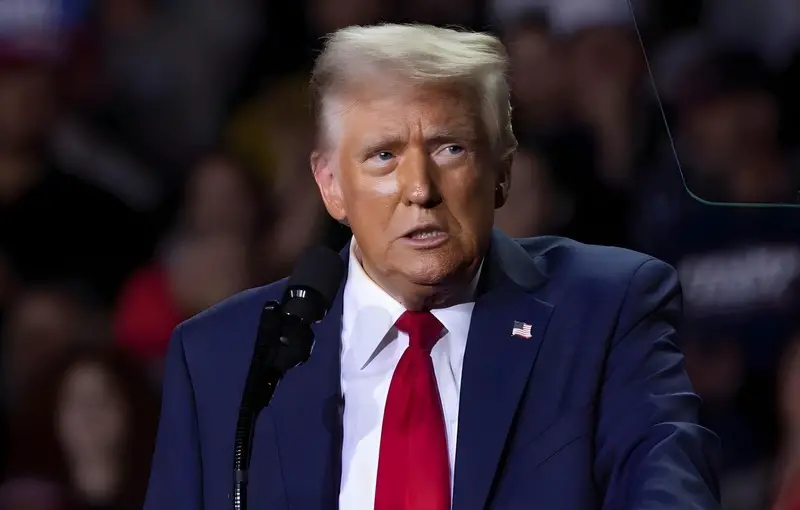
President Donald Trump refused to answer a direct question about how many American deaths he would accept in the ongoing war with Iran, instead claiming families of fallen troops urged him to “finish the job” during a combative press conference Monday evening, March 9, 2026, at his Trump National Doral resort in Florida.
“How many American deaths are you willing to have in this war?” an off-camera reporter asked. Trump pivoted to describing a dignified transfer ceremony he attended Saturday at Dover Air Force Base, claiming every family member told him the same thing: “Finish the job.”
The press conference featured several controversial moments, including Trump’s false claim that Iran possesses U.S.-made Tomahawk cruise missiles. The president made this assertion while deflecting questions about a Tomahawk strike on a girls’ elementary school in the southern Iranian city of Minab that killed at least 165 people—most of them children between ages seven and 12—on the war’s first day.
When asked if the United States would accept responsibility for the school strike, Trump claimed he lacked sufficient information and said, “I’m willing to live with that report”—referring to an ongoing Pentagon investigation. Video footage analyzed by Bellingcat and BBC Verify has identified a cruise missile matching a U.S. Tomahawk striking the area near the school, directly contradicting Trump’s claim that Iran was responsible. Tomahawk missiles are manufactured by Raytheon exclusively for the U.S. military and close allies like Japan and Australia. Iran does not possess them.
Trump also incorrectly stated that Iran carried out the 2000 bombing of the U.S.S. Cole in Yemen. The attack was conducted by al-Qaeda, though a 2015 federal court ruling found Iran partly complicit for supporting the terrorist network.
The president offered an upbeat assessment of the military campaign, describing it as “very complete, pretty much” and telling reporters that Iran’s military capabilities have been decimated. He claimed the U.S. has eliminated more than 90 percent of Iran’s missile launchers and sunk 46 Iranian naval vessels in just days.
Defense Secretary Pete Hegseth struck a different tone Monday, posting on social media that American forces have “Only Just Begun to Fight”—a message at odds with Trump’s suggestion that operations were nearly concluded.
The conflict’s economic impact has rattled global markets. Oil prices briefly surged above $110 per barrel Monday morning before retreating, as Iran threatened shipping lanes through the Strait of Hormuz. Average gasoline prices in the United States climbed to $3.48 per gallon, according to the American Automobile Association, with California drivers paying $5.20 per gallon.
Trump dismissed concerns about energy costs, calling the price spikes “short-term” and describing anyone worried about oil prices as a “fool.” He characterized the entire military operation as “a little excursion” and “a very positive thing.”
The president also revealed he was “thinking about taking over” the Strait of Hormuz, the critical waterway through which roughly one-fifth of the world’s petroleum passes daily. He suggested the United States was conducting the war partly for the benefit of other nations dependent on Middle Eastern oil, including China.
Trump expressed disappointment with Iran’s selection of Mojtaba Khamenei—the 56-year-old son of the slain supreme leader—as the country’s new leader. The Assembly of Experts announced the appointment on Sunday, March 8. Trump had previously called the younger Khamenei a “lightweight” and “unacceptable,” insisting he should have a say in selecting Iran’s leadership. At Monday’s press conference, Trump predicted the appointment would mean “more of the same problem” but declined to say whether the new Iranian leader would be targeted for assassination.
The president drew a comparison to Venezuela, where the United States captured Nicolas Maduro on January 3 on drug trafficking charges. Vice President Delcy Rodriguez assumed power as acting president, and Trump suggested a similar approach—with internal leadership transitions—could work for Iran.
Trump acknowledged Vice President JD Vance was “maybe less enthusiastic” about striking Iran than he was, noting his running mate was “philosophically a little bit different” on foreign interventions. Vance has historically opposed U.S. military engagements abroad.
The press conference capped a four-day weekend Trump spent between his Palm Beach residence and the Doral resort, where Republican lawmakers gathered for a policy retreat.
Trump warned Iran against further provocations, saying they had “shot everything they have to shoot” and threatening that any additional attacks would mean “the end of that country.”