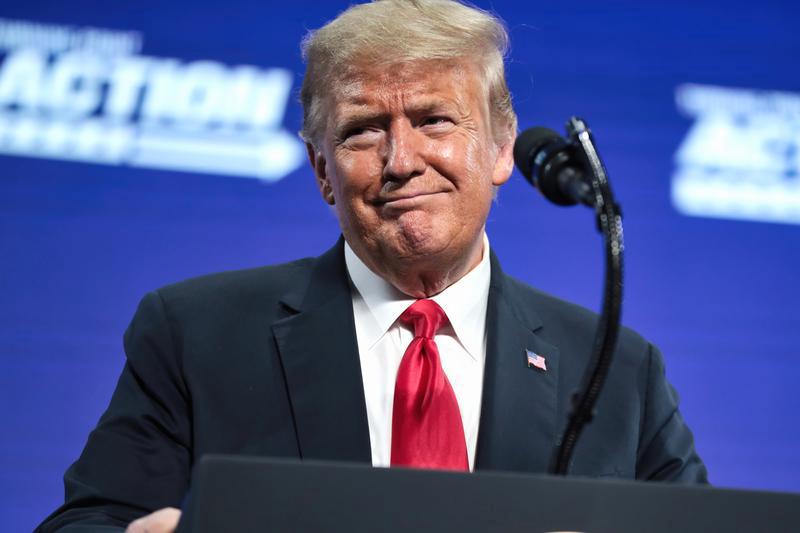
President Donald Trump ignited strong criticism on Sunday evening, March 1, 2026, after he sidestepped pressing inquiries about U.S. military actions in Iran to instead commend newly added statues in the White House Rose Garden, telling reporters his focus in nine words: “Unbelievable statues, you’ll see. Come and look at them.”
The president arrived back in Washington from Mar-a-Lago on Sunday, a day after initiating what the Pentagon labeled “Operation Epic Fury” against Iran. The coordinated U.S.-Israeli strike killed Iran’s Supreme Leader Ayatollah Ali Khamenei, 86, along with several top officials such as the nation’s defense minister and the head of the Islamic Revolutionary Guard Corps.
As journalists called out questions regarding the mission’s purpose and who Trump envisioned leading Iran after Khamenei’s death, he paused to admire newly placed statues of Thomas Jefferson, Alexander Hamilton, and Benjamin Franklin, installed while he was away. When a reporter asked whether he had any words for the families of fallen U.S. troops, Trump walked off without replying.
CNN’s Kaitlan Collins noted that Trump declined to talk with reporters during the Air Force One flight back from Florida, a departure from his usual approach. He did speak with several reporters by phone over the weekend as events unfolded.
The statues were not present when Trump left for Texas on Friday. They mark the latest updates to the Rose Garden, which the president ordered remodeled in June 2025.
Trump’s focus immediately drew criticism online. Many contrasted his attention to garden decorations with the seriousness of U.S. casualties and a rapidly expanding conflict that has prompted Iranian retaliation across several Gulf nations.
The controversy deepened Monday, March 2, after U.S. Central Command reported that three American F-15E Strike Eagles were accidentally shot down by Kuwaiti air defenses late Sunday in a friendly fire incident. All six crew members safely ejected and are recovering. Kuwait’s Ministry of Defense had previously confirmed that “several” U.S. aircraft had crashed.
Trump ordered the unexpected aerial assault Saturday evening following a black-tie event at Mar-a-Lago, where he was photographed dancing to Lee Greenwood’s “God Bless the U.S.A.” The strikes not only killed Khamenei but also Iran’s defense minister and the IRGC’s top commander.
In a video message Sunday addressing U.S. casualties, Trump delivered a stark warning: “And sadly, there will likely be more before it ends, that’s the way it is. But we’ll do everything possible where that won’t be the case.”
Trump, who received five draft deferments during the Vietnam War, did not dismiss the possibility of deploying U.S. ground forces in Iran “if they were necessary.” He also cautioned that Iran would face complete destruction if it struck back at American leadership.
Public support for the strikes remains weak. A Reuters/Ipsos poll taken February 28 – March 1 found that only 27% of Americans backed the action, while 43% opposed it and 29% were undecided. Even among Republicans, just 55% approved, and about one in four said Trump is too inclined to use military force.
When pressed on the polling, Trump dismissed the results. “It’s not a question of polling. You cannot let Iran, which is a nation that has been run by crazy people, have a nuclear weapon,” he said.
NATO Secretary General Mark Rutte voiced support for the mission in comments to Fox News. “There is no sliver of light between us,” he stated, noting that European partners back the removal of Khamenei and the weakening of Iran’s nuclear capabilities.
Iran’s Revolutionary Guard vowed massive retaliation, declaring that “the most intense offensive operation in the history of the armed forces of the Islamic Republic of Iran will begin in moments.” Airbus satellite imagery showed significant destruction to Khamenei’s compound in central Tehran due to the strikes.
As of March 11, 2026 (day 12 of the conflict), casualty figures show at least 1,300 civilians killed in Iran according to Iranian officials, though independent human rights organizations report higher tolls. Seven U.S. service members have been confirmed killed, with approximately 140 wounded, the majority in Iranian retaliatory strikes on American bases in Kuwait, Saudi Arabia, and across the Gulf region.