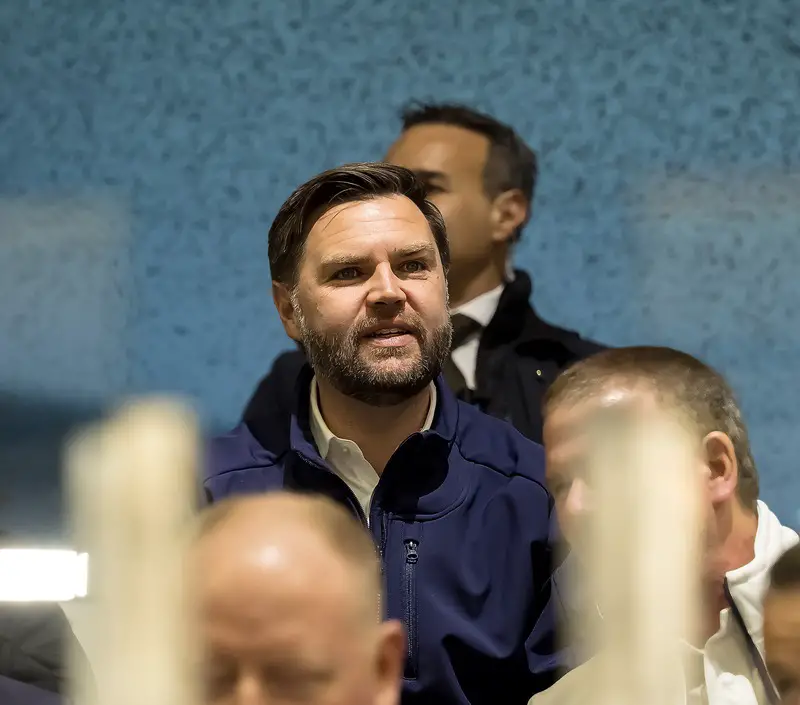
Vice President JD Vance is embroiled in a major White House dispute after reports surfaced saying he played a part in the departure of a senior national security official and in a sharp internal clash over the administration’s Iran strategy.
The 41-year-old, who rose from poverty in Middletown, Ohio, to become the country’s second-highest official, is now under scrutiny for his reported role in what sources call a explosive confrontation about war aims and policy toward Iran.
According to multiple reports, Vance met at the White House on March 16 with National Counterterrorism Center Director Joe Kent and Director of National Intelligence Tulsi Gabbard — the day before Kent announced he was resigning. Kent was the first senior Trump administration official to step down over the Iran war, publishing a public letter saying he could not “in good conscience support the ongoing war in Iran” and asserting that “Iran posed no imminent threat to our nation.” Kent later said in media remarks that Vance and Gabbard had been “put in a tough spot” by Trump’s choice, adding: “I know that I put them in a tough spot. And that’s why I wanted to give them a heads up.”
The disagreement revolves around differing plans for the Iran campaign. President Donald Trump initiated military actions against Iran on Feb. 28, 2026, in an effort the administration calls “Operation Epic Fury.” Trump initially pushed for regime change, urging Iranians to “take back your government” in social posts after strikes. Yet Vance later seemed to minimize regime change as a central aim during a Fox News interview, creating an apparent split between his remarks and earlier White House messaging.
Asked about potential differences with Vance, Trump acknowledged tension, telling reporters Vance had been “maybe less enthusiastic” about striking Iran, but added that “we get along very well on this.”
Vance outlined what he described as Trump’s four main goals in the Iran operation: eliminating Iran’s missile capabilities, dismantling its navy, stopping nuclear weapon development, and cutting off terrorism funding. He argued those aims marked a clearer endpoint than many prior U.S. military actions.
On Fox News, Vance defended the strategy: “There’s just no way that Donald Trump is going to allow this country to get into a multi-year conflict with no clear end in sight and no clear objective.”
At a campaign-style rally in Auburn Hills, Michigan, on March 19, Vance addressed Kent’s resignation for the first time publicly, saying “nobody likes war” and backing Kent’s decision: “Whatever your view is, when the president of the United States makes a decision, it’s your job to make that decision as effective and successful as possible. If you are on the team and you can’t help implement the decisions of his administration, then it’s a good thing for you to resign.”
The episode arrives as Vance seeks to define his place in an administration where tech billionaire Elon Musk frequently draws more attention than the vice president. Vance’s long-standing anti-interventionist identity — shaped by years opposing “regime change wars” — now clashes with his role defending military measures against Iran.
Vance drew global attention in February 2025 when a televised Oval Office meeting with Ukrainian President Volodymyr Zelenskyy escalated into a tense exchange. Vance criticized Zelenskyy for being “disrespectful” by challenging the administration’s diplomacy, telling him: “I think it’s disrespectful for you to come into the Oval Office to try to litigate this in front of the American media.” News outlets called the confrontation an unprecedented public clash between U.S. leaders and a foreign head of state.
Sources say Vance, Gabbard, and Kent — who all rose politically opposing foreign interventions — have been unusually silent about the Iran war. When Kent showed Vance his resignation letter, a White House official said the vice president “encouraged him to be respectful to POTUS” and suggested he speak with the White House chief of staff before finalizing his decision.
Vance’s path from Marine Corps service to vice president includes notable shifts. After finishing high school in 2003, he spent four years in the Marines as a combat correspondent and was deployed to Iraq for six months in 2005 in a public affairs role. He later attended Yale Law School and wrote the 2016 bestselling memoir “Hillbilly Elegy.” He won a Senate seat in 2022 before Trump chose him as his 2024 running mate.
The timing is sensitive for Vance, seen as an early favorite for the 2028 presidential contest. Trump, at 79 the oldest inaugurated president, will be barred from running again. The fate of Mike Pence — whose career faltered after refusing to overturn the 2020 results — serves as a warning that influences Vance’s efforts to stay in Trump’s good graces while building his own brand.
Complicating matters, Vance and his wife, Usha, announced in January they are expecting their fourth child, a son due in late July — making Usha Vance the first modern second lady to give birth while her husband holds office. The couple, married in 2014, already have three children: Ewan, Vivek, and Mirabel. In 2013, Vance adopted his mother’s maiden name in honor of the maternal grandparents who raised him.
Once a fierce critic who called Trump “reprehensible” and an “idiot” in 2016 before becoming a devoted MAGA supporter, Vance now faces the task of juggling his role as Trump’s deputy with his own political ambitions in an administration that prizes loyalty — even as a war he once opposed risks shaping his future career.