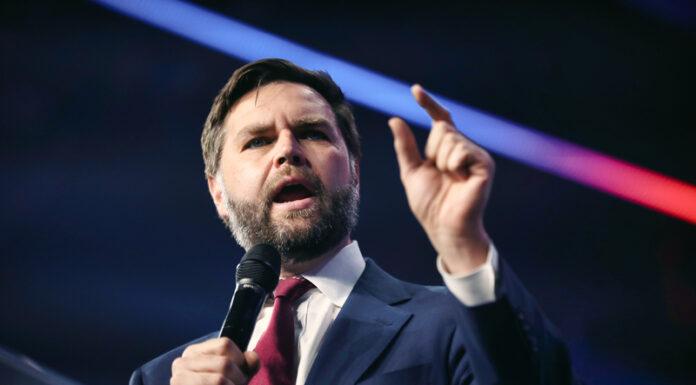
On Monday, March 16, 2026, Vice President JD Vance charged a reporter with “trying to drive a wedge” between himself and President Donald Trump following inquiries about his earlier doubts regarding overseas military interventions—a noteworthy reaction considering the administration’s current military actions in Iran.
The exchange took place during an Oval Office event, where Trump put his signature on an executive order naming Vance to head a new federal anti-fraud task force. Philip Wegmann, a reporter from RealClearPolitics, questioned Vance about whether, considering his “past skepticism of foreign adventurism,” he was “completely on board with the current war in Iran.”
Appearing defensive, Vance shifted to challenging the question’s foundation. “I know what you’re trying to do, Phil, you’re trying to drive a wedge between members of the administration, between me and the president,” the vice president stated before transitioning to a prepared statement: “We have a smart president, whereas in the past we’ve had dumb presidents.”
The response from the vice president takes on greater significance in light of recent reports indicating he privately voiced concerns about military action against Iran prior to its commencement. According to ABC News, Trump personally acknowledged the pair are “philosophically a little bit different” regarding the Iran war, with Vance “maybe less enthusiastic about going.”
Having served in the United States Marine Corps with deployment experience in Iraq, Vance has consistently presented himself as doubtful of American military engagements overseas. Prior to the 2024 election, he made an appearance on “The Tim Dillon Show” and stated that an Iran war would be “a huge distraction of resources” and “massively expensive to our country.”
“Our interest, I think, very much is in not going to war with Iran,” Vance stated back then—a sharp departure from his present public stance supporting Operation Epic Fury as it reached its fourth week.
This transformation highlights a consistent theme for the vice president: reconciling his non-interventionist beliefs with his allegiance to Trump. During 2023, Vance stated that Trump’s “best foreign policy” was “not starting any wars,” further noting, “He has my support in 2024 because I know he won’t recklessly send Americans to fight overseas.”
The interaction with Wegmann represented merely one episode in Vance’s growing prominence. Following his swearing-in on January 20, 2025, he has assumed responsibility for significant policy undertakings, ranging from directing the new anti-fraud task force focused on federal benefits programs to broadening foreign aid limitations.
The vice president has simultaneously been cultivating his political base for a prospective 2028 presidential campaign. During December, he secured victory in a straw poll at the Turning Point USA AmericaFest conference held in Phoenix with 84% backing. The organization’s CEO, Erika Kirk, who is the widow of deceased founder Charlie Kirk, officially endorsed Vance, stating: “We are going to get my husband’s friend JD Vance elected for 48 in the most resounding way possible.”
Various obstacles have confronted Vance this year. During early January, an individual reportedly damaged the vice president’s Cincinnati residence, shattering windows using a hammer while Vance and his family were located in Washington. The defendant’s legal counsel contended the episode resulted from mental health concerns rather than political motives. William DeFoor, the suspect, currently faces federal criminal charges that could result in up to 30 years of imprisonment.
A native of Middletown, Ohio, Vance emerged from an upbringing characterized by economic hardship and domestic instability to become a Marine, Yale Law School graduate, bestselling author of “Hillbilly Elegy,” and prosperous venture capitalist preceding his U.S. Senate election in 2022.
His path from Ohio’s rust belt to the nation’s second-highest position has formed the core of his political persona. He has established himself as an advocate for working-class households, promoting manufacturing resurgence and border security.
Yet Monday’s guarded response to a direct policy inquiry exposed the delicate balance Vance must maintain—developing his individual political trajectory while sustaining public devotion to the president who promoted him. His management of disagreements regarding Iran, especially as the conflict persists without an obvious conclusion, will probably influence both his competence as vice president and his prospects as Trump’s potential successor in 2028.