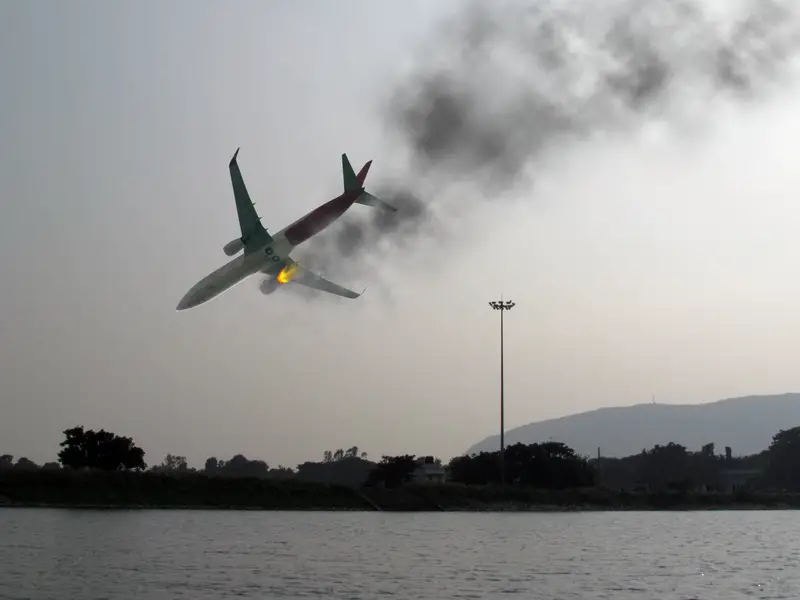
A military transport plane belonging to Russia plummeted into a cliff face in Crimea, which is under occupation, on Tuesday, April 1, 2026, resulting in the deaths of all 29 individuals on board in an incident the Russian Defense Ministry says was caused by a technical issue.
The An-26 aircraft from the Soviet period vanished from radar around 6 p.m. local time while conducting what authorities characterized as a standard flight across the Crimean Peninsula. Following a comprehensive search and rescue effort, Russian military search units discovered the debris in a forested mountainous section of the Bakhchisarai district.
“The Defense Ministry reported that a search team found the site of the catastrophe,” state news agency TASS reported. “According to a report from the site, six crew members and 23 passengers on board were killed.”
Russian military authorities quickly dismissed the possibility of hostile activity. The Defense Ministry indicated there was no indication of exterior damage, terminology that essentially rules out missiles, drones, or bird strikes as plausible explanations. Authorities ascribed the disaster to an initial technical malfunction, with a military commission working at the site.
Russia’s Investigative Committee confirmed the crash and initiated a criminal investigation into violations of flight safety. The committee offered a somewhat different casualty count, indicating seven crew members and 22 passengers were on the plane. No official clarification for the inconsistency has been offered. Lieutenant General Alexander Otroshchenko, commander of the Mixed Aviation Corps of the Northern Fleet, was purportedly among those killed, according to BBC’s Russian Service. Ukrainian officials have not issued any statement regarding the incident.
The disaster happened over Crimea, the Ukrainian peninsula that Russia unlawfully seized in 2014. The area contains expansive mountains that slope down toward the Black Sea shoreline, producing hazardous conditions for both flying and search missions. Combat between Ukrainian and Russian military forces has persisted in the peninsula since Moscow initiated its comprehensive invasion of Ukraine more than four years ago, with Ukrainian attacks primarily focusing on Russian military installations in the area.
Ukrainian President Volodymyr Zelenskyy has continually insisted Russia pull out from Crimea as a component of any ceasefire deal. Last November, a U.S.-backed 28-point peace plan proposed that Kyiv would cede control of the peninsula, though negotiations have stalled over key territorial issues.
The An-26 is a light tactical military transport aircraft that has operated in multiple roles since the late 1960s. Manufactured by the Ukrainian aerospace company Antonov, the turboprop plane was designed primarily for military use and can transport cargo along with up to 40 passengers over short and medium distances. Despite its long service history, the aging aircraft has accumulated a troubling safety record.
In 2020, 26 people—including 19 cadets and seven crew members—were killed when a Ukrainian An-26 crashed near Kharkiv during a training flight; only one person survived. That same year, eight people including five Russians died when an An-26 went down in South Sudan. In July 2021, 28 people perished when an An-26 crashed in Russia’s Kamchatka region. In 2022, one person died in a crash in Ukraine’s Zaporizhzhia region. Four of 10 people aboard were killed when an An-26 crashed on landing in Ivory Coast in 2017.
Tuesday’s disaster contributes to an increasing number of Russian military aviation catastrophes since the Kremlin deployed troops into Ukraine in 2022. In December 2025, an An-22 military transport plane crashed in Russia’s Ivanovo region, killing seven crew members. In October 2025, a MiG-31 fighter jet crashed in the Lipetsk region. A Tu-22M3 bomber went down in the Siberian region of Irkutsk in April 2025.
In March 2024, a Russian military transport plane with 15 people aboard crashed during takeoff from an air base in western Russia. Perhaps most devastatingly, a Su-34 bomber crashed into a residential area of Yeysk in October 2022, sparking a massive fire that killed 15 people on the ground.
The rate of these incidents highlights significant worries about the upkeep and operational preparedness of Russia’s outdated military aircraft fleet, especially as the nation maintains its extended military campaigns in Ukraine. Many of these planes date back to the Soviet era and have remained in service for decades beyond their intended operational lifespans.
Russia’s Defense Ministry did not immediately respond to requests for additional comment on the crash beyond its initial statements to state news agencies. The military commission investigating the incident continues to examine the wreckage in the remote mountainous area where the plane went down.
The crash site’s challenging terrain in the Bakhchisarai district has hindered recovery operations, though authorities have verified there were no survivors. The investigation into what caused the technical malfunction that allegedly brought down the aircraft continues, with military officials working to determine why the plane lost contact with authorities and crashed into the cliff face.
The death of 29 service members and passengers constitutes one of the most fatal individual aviation accidents involving Russian military aircraft in recent years. The crash underscores the mounting toll that aging equipment and sustained military operations have taken on Russia’s defense infrastructure.