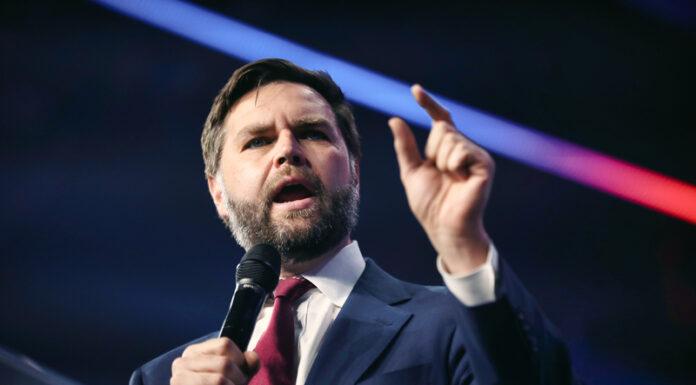
Vice President JD Vance remained seated and silent as King Charles III urged Congress to protect the environment during a historic address to a joint meeting on Capitol Hill — a conspicuous refusal that quickly drew attention across social media and underscored deep fractures between the Trump administration and America’s oldest ally.
The moment came during Charles’ April 28, 2026, speech as Democrats leaped to their feet when the British monarch called on lawmakers to “safeguard nature, our most precious and irreplaceable asset.” Most Republicans remained in their chairs, but Vance’s stillness stood out. Seated on the dais beside Speaker Mike Johnson, the vice president kept his hands in his lap, expressionless, while even Johnson rose and clapped, glancing down at his motionless colleague.
Environmental protection represents a lifelong passion for Charles, who has championed conservation for half a century. President Trump, by contrast, withdrew the United States from the Paris Climate Agreement on his second term’s first day and has repeatedly attacked Britain over its green energy investments.
NATO, Ukraine, and an Isolated President
Charles never mentioned Trump by name during his address. He didn’t need to. The topics he chose — the transatlantic partnership, NATO, Ukraine, climate change — formed a precise catalog of policies and alliances the president has attacked since returning to office in January 2025.
“The story of the United Kingdom and the United States is, at its heart, a story of reconciliation, renewal, and remarkable partnership,” the king told lawmakers. He prayed that the alliance would “continue to defend our shared values, with our partners in Europe and the Commonwealth, and across the world, and that we ignore the clarion calls to become ever more inward-looking.”
Trump has spent months complaining that the U.S. has gotten “nothing” out of NATO, accusing member nations of failing to back Washington after he ordered strikes on Iran without consulting allies. He has also feuded openly with British Prime Minister Keir Starmer over the Iran war, deepening a transatlantic chill.
Charles reminded Congress that NATO invoked Article 5 for the first time after 9/11, and that British and American forces had stood “shoulder to shoulder, through two World Wars, the Cold War, Afghanistan, and moments that have defined our shared security.”
The king called for “unyielding resolve” in defense of Ukrainian sovereignty — a clear contrast with Trump’s repeated warmth toward Russian President Vladimir Putin and his sniping at Ukrainian President Volodymyr Zelensky. The line drew a standing ovation, though Vance again remained seated.
A Royal Rebuke, Gently Delivered
Members of both parties rose and returned to their seats in something close to unison for much of the address. It landed in a chamber that has, in recent State of the Union addresses, devolved into heckling and stunts. Not this time. The political theatrics that have defined Washington’s recent ceremonial moments were largely absent.
Charles also touted the rule of law and an “independent judiciary,” a pointed nod at an administration that has spent its second term blasting federal courts. Retired Supreme Court Justice Stephen Breyer made a rare public appearance in the chamber for the address.
The Climate Moment Vance Sat Out
Vance’s gesture fit a pattern. The vice president has positioned himself as the administration’s sharpest edge against European allies, climate policy, and what he describes as globalist drift. Standing for a king’s environmental homily would have undercut that posture. Sitting through it preserved it — and broadcast it to social media within minutes.
From The Capitol To The State Dinner
Trump and First Lady Melania Trump hosted Charles and Queen Camilla at a White House state dinner hours after the address on the second day of the monarch’s four-day visit. The optics were unmistakable: the president fawning at the head table over a guest whose speech had, in plain English and in front of Congress, catalogued Trump’s foreign-policy ruptures.
Set against that backdrop, a king’s measured speech — and a vice president’s refusal to clap — became more than ceremony. They became a snapshot of where the United States stands with its oldest ally, and with itself.