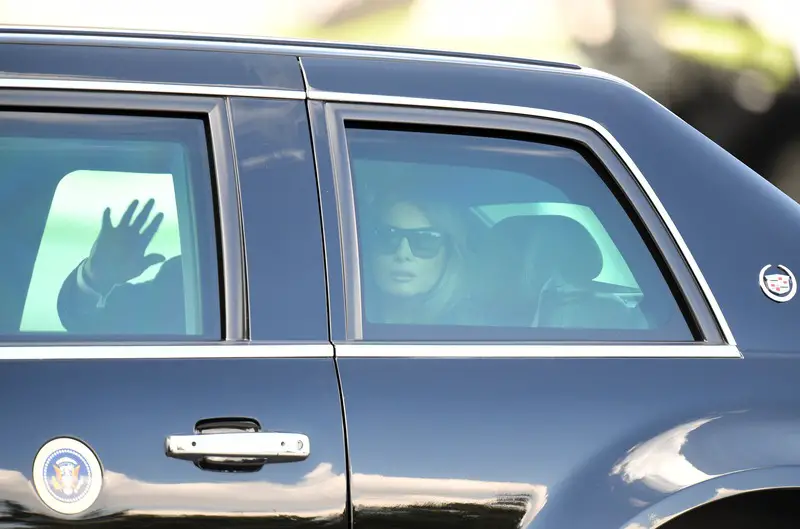
First Lady Melania Trump has emerged as the single figure inside the West Wing that no one — not the president, not his staff — can steer, according to a new column by Michael Wolff, author of the bestselling “Fire and Fury” and a longtime chronicler of the Trump presidency, published on his Substack newsletter, HOWL. The piece, titled “Melania: The Wild Card,” contends that West Wing staffers remain constantly anxious about the first lady’s next move, an unease Wolff attributes partly to her public statement on Jeffrey Epstein, in which she denied any connection to the disgraced financier.
Wolff frames Melania Trump not as a background presence but as the biggest unknown in her husband’s orbit. According to him, aides privately question whether she might break ranks, and their inability to dismiss that possibility is what deeply troubles them.
Wolff said White House personnel fear the first lady’s potential influence, should she decide to exercise it. He noted that while most staffers believe she’s unlikely to use that influence against the administration directly, they can’t be entirely sure.
A Marriage at a Low Point
By Wolff’s telling, the relationship between President Donald Trump and Melania Trump has cooled to its chilliest since the Stormy Daniels trial — a stretch he describes as extraordinarily tense. He claims the couple barely speaks and that there is hardly even the pretense that she lives at the White House, echoing earlier reporting that the first lady appears to spend most of her time in New York City rather than full time in Washington with her husband.
Wolff added that “Every appearance is a negotiated one.” In his account, Melania Trump has grown more independent — freer, he says, and more distant from the president than at any earlier point in their marriage. That independence, rather than any single grievance, is what he casts as the true wild card.
The unpredictability, Wolff argues, extends to the smallest details of scheduling and appearances. Almost no one close to the president, he writes — including the president himself — knows what the first lady will do until she does it.
Alarm Over Her Business Moves
Beyond the personal, Wolff points to a professional anxiety humming through the West Wing: worry over Melania Trump’s next commercial ventures, which he says register as a bigger concern than the business dealings of Trump’s children. According to Wolff, what most unsettles staffers isn’t the financial gain but rather the attention she attracts—a pattern he believes could lead to direct conflict with the president. Within the Trump family, Wolff suggests, earning money is generally acceptable; becoming the center of attention is not.
Those worries have a paper trail. On June 30, the U.S. Office of Government Ethics released a 927-page financial disclosure document that shed light on the first lady’s income — and the numbers tell a curious story. Her documentary, “Melania,” flopped at the box office, yet the project still proved lucrative for the family.
Amazon MGM Studios, owned by Jeff Bezos, spent about $75 million on the documentary. The film followed the first lady during the 20 days before her husband’s second inauguration. Ticket sales landed at just $16.7 million worldwide. Even so, according to the ethics disclosure, the Trumps received $10.71 million from the licensing deal. Melania Trump also earned a reported $521,000 from her 2024 memoir, likewise titled “Melania.”
The White House Pushes Back
The administration was not gentle in its response. Reached for comment, White House spokesman Davis Ingle dismissed Wolff as “a lying piece of s–t.” It’s a rebuttal Wolff’s critics have heard before, and one that stops well short of engaging with the column’s specifics.
Wolff and the first lady remain in active litigation over his Epstein-related claims: a federal judge dismissed Wolff’s suit against her as “patently meritless” in May 2026, and on July 21, 2026, Melania Trump filed a motion seeking sanctions against him.
Wolff closes his piece by placing the first lady in a wider portrait of a president he describes as insulated. Trump’s political vulnerabilities, he writes, sit in plain view — his dealings, questions about his associates, and speculation about his health — yet aides, lawyers, doctors, congressional leaders, and billionaires have, in his words, cooperated in a sweeping effort to keep those questions at bay. His wife, Wolff concludes, is the one variable outside that machinery: a wild card the president can’t seem to control or game.
As with much of Wolff’s Trump-era reporting, the claims are sourced to unnamed insiders and framed through his own interpretation, and the White House has flatly rejected them. What’s clear is that the journalist has once again trained his lens on the one member of the Trump orbit who tends to say the least publicly — and, by his account, keeps everyone around her guessing.