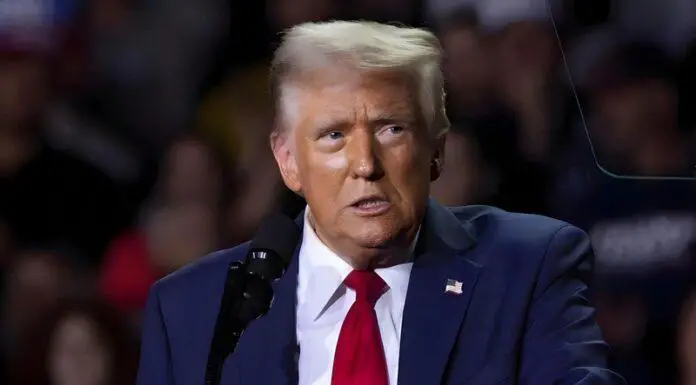
Days after Canadian Prime Minister Mark Carney called for a new economic partnership with the United States, President Donald Trump delivered a stark two-word response to news of Canada’s technical recession. On Monday night, June 1, 2026, Trump shared an article about Canada’s declining gross domestic product across two consecutive quarters and posted: “51st State!”
The president has repeatedly promoted the idea of absorbing Canada since returning to the White House on January 20, 2025, framing his argument around claims that the country depends on its southern neighbor for survival. Canadian leaders have rejected the premise outright, with Carney insisting that Canada does not live because of the United States but instead thrives because Canadians are Canadian.
Ontario Premier Doug Ford dismissed Trump’s latest post, saying he could not believe he had to repeat that Canada would never become the 51st state and was not for sale. Carney, who was sworn in as prime minister in March 2025, has repeatedly said the president’s dream of absorbing his country “will never happen.”
A Fresh Arrangement for Two Neighbors
In a speech to the Economic Club of New York on May 28, 2026, Carney struck a conciliatory but confident tone, arguing that the moment had arrived for a fresh arrangement to redefine the economic relationship between the two nations. He argued that Canada and the United States should identify opportunities to collaborate and compete against the rest of the world.
Carney described a world “undergoing a rupture” and growing more divided, arguing that strength lies in unity. He pointed to a string of international trade agreements Canada has reached with global partners, saying the country’s central goal is to build strategic autonomy in an era where economic integration has been used as a weapon.
The prime minister also proposed concrete areas of cooperation, suggesting the United States could purchase Canadian aluminum, automobiles, and critical minerals. He tied the pitch to the newly established Canada Strong Fund, which is designed to channel investment into the country’s infrastructure, and offered a rhetorical flourish aimed at Washington, saying a stronger Canada would help make America great again.
Recession Figures Draw Caution From Bank Officials
Trump’s outburst came as the Bank of Canada urged caution about reading too much into the recession figures, which showed the nation’s gross domestic product declining across two consecutive quarters on an annualized basis. Senior Deputy Governor Carolyn Rogers of the Bank of Canada told a parliamentary committee that policymakers should avoid placing excessive emphasis on a single indicator, according to her remarks.
Trade Deal Renewal and Defense Leverage
The economic sparring unfolded against the backdrop of looming negotiations over the North American trade framework. On Tuesday, June 2, Canadian Minister for Internal Trade Dominic LeBlanc issued a formal request to the United States and Mexico to renew the United States-Mexico-Canada Agreement (USMCA) ahead of a July deadline to negotiate the pact. In his letter to counterparts in both countries, LeBlanc called the deal highly beneficial to all three nations and to the integrated North American economy, and he framed the review as a chance to assess whether the agreement could be strengthened.
Edward Alden, a senior fellow at the Council on Foreign Relations, said Ottawa’s priority is stability and predictability, including renewal of the three-country agreement and either the elimination or a significant lowering of tariffs. Alden argued that Canada had built its economic future on trusting the United States, but that Trump had turned his back on that arrangement.
The annexation talk, which Trump has floated repeatedly since returning to the White House, has also been tied to national defense. In a speech to U.S. military officials on September 30, 2025, Trump suggested Canada could receive access to the $175 billion Golden Dome missile defense program at no cost by joining the union. The system, which Trump had earlier floated selling access to for $61 billion, is intended to shield the United States from missile threats and is slated for completion by 2029.
Around the same time, U.S. Ambassador to Canada Pete Hoekstra warned during an interview on a podcast that Washington might reconsider its defense partnership with Ottawa absent a full commitment to joint Arctic defense through the North American Aerospace Defense Command (NORAD) and NATO. Hoekstra noted that Ottawa has pledged $38.6 billion dollars over 20 years for NORAD upgrades. Alberta Premier Danielle Smith and Hoekstra have both said negotiations over a broader trade deal have stalled and may not conclude until 2027, though Alberta Premier Danielle Smith has struck a more optimistic note on the timeline.