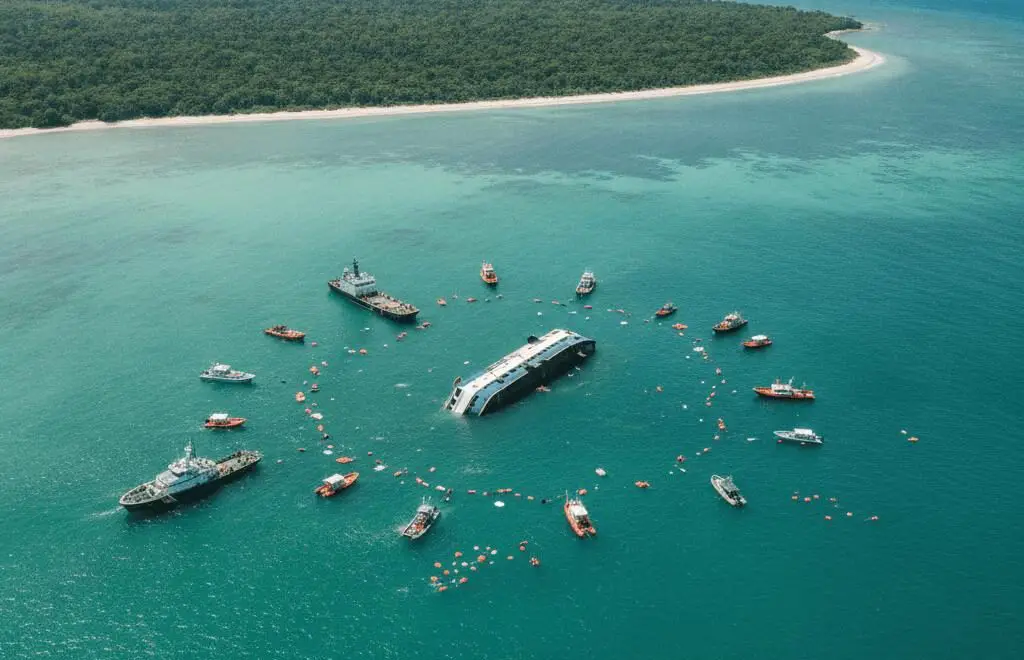
Zimbabwe has declared a State of Disaster following a ferry tragedy on Lake Kariba that has claimed at least 97 lives as of Thursday, August 20, with the toll still rising as bodies are recovered, and with authorities mobilizing additional resources for search operations and humanitarian relief as the nation grapples with one of its deadliest maritime disasters.
The government ferry Mbuya Nehanda, operated by Zimbabwe’s Rural Infrastructure Development Agency, sank on August 11, 2026, carrying far more people than it was designed to hold. Officials confirmed 114 adults and five crew members were ticketed for the journey, despite the ferry’s 90-person capacity. However, over 160 people may have been aboard the overloaded craft.
Police have released the names of 44 of those confirmed dead. The recovery effort has continued for days, with fishermen and search teams finding additional victims floating in the lake. Seventy-seven people survived the disaster on August 11 and were rescued from the water.
Unknown Number of Passengers Complicates Count
The true number of people aboard when the vessel went down remains uncertain. Official records documented only adults who purchased tickets, leaving children below ticketing age potentially uncounted on any manifest. This gap means the actual passenger count when the ferry capsized may never be known with certainty.
State broadcaster ZBC confirmed that children were among the dead; police have since said at least 18 children were killed, 16 of them aged 10 or younger. The broadcaster aired footage showing speedboats speeding toward what appeared to be the capsized vessel while a helicopter circled above. An underwater search-and-rescue team was sent to scour the lake’s depths.
The ferry’s wreckage was towed to a nearby island several days after the sinking. No bodies were discovered beneath the hull during that operation.
Concerns Voiced Before Departure
Local member of Parliament Mutsa Murombedzi shared video footage captured as the ferry departed, showing crowds gathered on shore to wave goodbye to passengers beginning the roughly five-hour voyage to Kariba town. The recording also captured something ominous: bystanders expressing alarm about whether the aging craft could withstand the strong waves pounding the lake that day.
Murombedzi noted that remote village residents depend on this ferry service as their lifeline for reaching the town. The government agency that operates the vessel provides one of the only practical transportation options for shoreline communities where road access is difficult or nonexistent.
Authorities have not disclosed at what point during the five-hour journey the capsizing occurred or what specific conditions triggered the vessel to go down.
Africa’s Largest Reservoir
The disaster struck on a body of water that holds the distinction of being the world’s largest artificial reservoir by volume. Created when a dam wall blocked the Zambezi River in the late 1950s and early 1960s, Lake Kariba extends more than 200 kilometers — approximately 124 miles — in length and spreads up to 40 kilometers, or about 25 miles, at its widest sections.
The lake forms part of the international boundary between Zimbabwe and Zambia, with the border running down its middle. For Zimbabwean communities scattered along its banks, the ferry route represents an essential connection to commerce and services, not a recreational choice.
Investigation and Missing Answers
Zimbabwe’s disaster management agency provided the initial tallies of survivors and casualties on August 12 following the capsizing. The mathematics of the tragedy remain troubling. With at least 119 ticketed passengers and crew believed aboard and 77 known to have survived, a significant number of fates remained unresolved even before the updated death toll. The absence of complete passenger records — especially for children traveling without individual tickets — means investigators face a substantial challenge in determining exactly how many people the ferry carried when it sank.
No official cause for the capsizing had been announced as of mid-August. Witnesses described strong waves, while the vessel carried many more people than its design allowed and had accumulated years of age — a combination of factors that may have sealed its fate before reaching port.