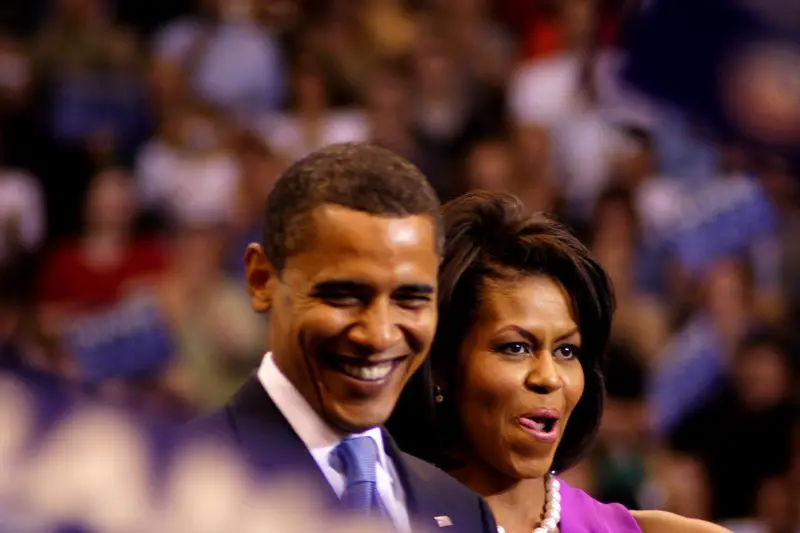
There is a particular kind of political theater that requires no podium, no flag backdrop and no press secretary — only two people, a microphone and a well-timed joke. On July 16, 2025, former President Barack Obama turned up unannounced on “IMO with Michelle Obama and Craig Robinson,” the podcast and video show hosted by his wife, former First Lady Michelle Obama, and her brother and co-host, Craig Robinson, and did something more disarming than issue a denial. He made light of the idea that his marriage was collapsing. The gambit was small, deliberate and revealing, and it says as much about the machinery of modern rumor as it does about the couple at its center.
The speculation had been building for months. Earlier in 2025, Michelle Obama skipped several high-profile events at which her husband appeared — she was absent from the swearing-in of President Donald Trump, and absent again from the state funeral held for Jimmy Carter, the former president — and the internet did what the internet does with an empty chair. It filled it with a story. Absence, in the attention economy, is never neutral. It is a blank space that invites narration, and the narration always runs toward the most dramatic available explanation.
The Absence That Became the Evidence
What makes the episode instructive is the nature of the so-called evidence. There was no filing, no statement, no leaked account from an aide. There was only a pattern of non-attendance at events where a former first lady might conventionally be photographed. That pattern was enough. In a media environment that rewards inference over confirmation, the failure to show up became a data point, and data points, repeated often enough, harden into narrative.
This is a relatively new hazard for public figures, and a peculiarly modern one. Political spouses were once measured by what they said; now they are measured by where they are seen, and the ledger is kept in public by millions of amateur accountants. The Obamas, who have spent decades under photographic surveillance, presumably understood that no amount of silence would settle the question. Silence, in this system, is not an answer. It is oxygen.
Comedy in Place of a Formal Denial
So the couple chose a different instrument. Rather than issue the sort of grim, lawyer-vetted statement that tends to confirm the seriousness of whatever it denies, they answered the rumors with humor. “It was touch and go for a while,” Barack Obama quipped when the subject came up. The technique belongs to stand-up: accept the premise, nudge it one notch past plausibility, then hand it back as nonsense. A denial wrestles with a rumor and, in wrestling, grants it standing. A joke withholds that standing — and leaves anyone still repeating the story to look ridiculous for doing so.
Michelle Obama supplied the more solid half of the double act, direct where her husband had been dry. “There hasn’t been one moment in our marriage where I’ve thought about quitting on my man,” she said on air. Note the construction. It is a statement about her own interior life, offered in her own voice, on a platform bearing her own name — not a joint communique, not a spokesman’s paragraph, not a photograph staged for the purpose. The credibility of the response derives from its informality. It sounds like a person talking, which is precisely the register that a formal denial cannot reach.
There is a risk in this approach, and the Obamas ran it knowingly. Humor concedes that the rumor is widely known enough to be worth addressing at all. It converts a whisper into a topic. But the alternative — a stony refusal to engage — had already been tried by default for months, and the speculation had only compounded. Once a story reaches the stage where a couple’s absence from a funeral is treated as a clue, the choice is no longer between responding and ignoring. It is between responding on your own terms and being characterized on someone else’s.
The Podcast as the New Podium
The venue matters more than the punchline. A generation ago, a former president wanting to correct the record about his private life would have sat for a network interview, submitting to an anchor’s questions and an editor’s cut. Barack Obama instead walked into a show his wife hosts with Robinson, in a format the couple controls, and spoke to an audience that had chosen to listen. No adversarial questioner brokered the exchange. No producer decided which sentence would survive.
This is the arrangement toward which nearly all high-profile communication has been drifting: the direct-to-audience channel, owned or friendly, from which clips are then harvested by everyone else. And harvested they were. A video of the exchange ran 1:52, a length engineered for social feeds and mid-morning news blocks. On July 17, 2025, NBC’s “Today” compressed the whole affair into a 2:39 segment. The original conversation was the raw material; the coverage was the refinery.
What the couple achieved, in other words, was distribution without surrender. They supplied the sound bite, and the wider press supplied the reach. It was, by the standards of crisis communication, an unusually efficient trade — and one available only to people whose media infrastructure they already own. For everyone else, the rumor cycle remains a one-way conveyor belt.
Why a Private Marriage Became Public Property
Underneath the levity sits a harder question about why this particular marriage generates such fascination. The Obamas’ partnership has long functioned as a piece of public iconography, invoked as evidence for arguments that have nothing to do with them. A rumored rupture, then, is never merely gossip about two people; it is a referendum on a symbol, and symbols attract attackers and defenders alike. That is the cost of having been cast, for years, as an aspirational tableau.
It is also worth observing where the scrutiny landed. The chain of speculation began not with anything the former president did, but with events his wife did not attend. She was under no obligation to explain her calendar. Yet the asymmetry is familiar: a woman’s absence is read as a statement, while a man’s presence is read as routine. The rumor mill did not need a source. It needed only a vacancy and an assumption.
By the accounting of the coverage that followed, the July 2025 episode marked the first time the two addressed the speculation together. That framing carries its own quiet argument: the response had to be joint to be persuasive, because the rumor was about jointness itself. Two people appearing side by side, riffing at the expense of a story about their estrangement, is a rebuttal that no press release can replicate. The medium was the message, and the message was the pairing.
Whether the laughter settled anything is another matter. Rumors of this kind rarely die; they subside, wait and return whenever a new photograph shows one half of a couple standing alone. What the exchange demonstrated was not that speculation can be defeated, but that it can be outmaneuvered — briefly, wittily, on ground of one’s own choosing. In an era when a missing seat at a funeral can outrun a fact, that may be the most any public figure can hope to accomplish: not to end the story, but to be the one telling it.
Ten months later, the former president gave the story a fresh turn himself. In a New Yorker profile published May 4, 2026, he said the pressure to stay politically active through the Trump years had cost him at home: his wife “wants to see her husband easing up and spending more time with her, enjoying what remains of our lives,” he said. “It does create a genuine tension in our household, and it frustrates her.” It was the frankest acknowledgment of strain he has offered — and not the kind a joke can absorb.