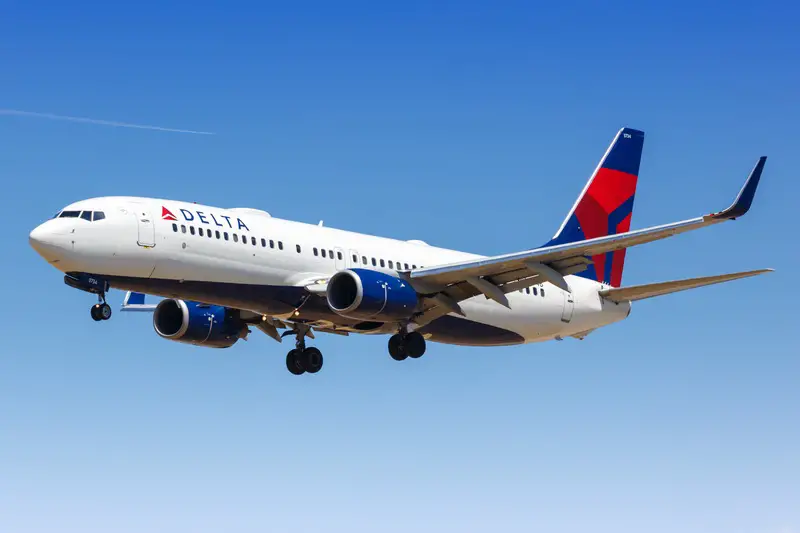
A Delta Air Lines captain flying 147 passengers from Los Angeles to Boston keyed his microphone midway through the cross-country run on Tuesday, August 25, 2026, and told air traffic controllers that the medical emergency aboard the jet was him.
About three and a half hours in, the crew of Flight 437 gave up on the route east and pointed the Boeing 757 toward Detroit Metropolitan Wayne County Airport. Air traffic control recordings caught what came next: the sick pilot breaking the news himself, his voice flat and unhurried, like a man working down a checklist.
“This is the captain. I am the one who is ill,” he told controllers, adding that he planned to taxi the jet to the gate and then needed to get to a hospital.
The Detroit tower did not hesitate. Yankee Two, the quickest route off the runway and over to the gate, was the exit the controller handed Flight 437.
Diverted Three and a Half Hours In
Roughly five and a half hours was the block time on the schedule when the flight left LAX around 10:45 a.m. PT on August 25, with Boston Logan International Airport as its destination. It was also sold as Virgin Atlantic 2577. It never reached Boston on that schedule.
The jet was N707TW, a Boeing 757-200 built in 1997, and it was cruising at 39,000 feet about 120 nautical miles west of Detroit when the diversion began. It touched down on Runway 22L at about 5:38 p.m. local time on August 25 and reached the gate about five minutes later. The arrival gate briefly flipped from A10 to A13 before a controller flagged A13 as too small for a 757, and the crew carried on to A10. The Wayne County Airport Authority said the diverted plane was met by airport firefighters, and the captain went on to a local hospital afterward. The aircraft left Detroit at about 7:17 p.m.
Delta spokesperson Drake Castañeda told the Boston Globe the captain had “stomach pains,” the first symptom to make it onto the official record. Delta has not named him or released a diagnosis, and as of September 10 there was still no official medical update.
Why the Sick Pilot Was Talking
On the recording, the setup can sound upside down: the ailing pilot working the radios while an emergency unfolds. Aviators say it is exactly right.
The division of labor at an airline hands the radios to whoever is not at the controls, a former military and commercial aviator, Matthew “Whiz” Buckley, explained to CBS News Boston; the pilot flying is then left with nothing to think about but the airplane. That put the first officer on the controls by hand and the captain on the frequency aboard Flight 437, he said. The book calls for an immediate diversion to the closest suitable airport whenever a pilot is incapacitated or expects to become unable to fly safely, Buckley noted, and he said the crew did exactly that.
Who actually flew the approach is in dispute. Delta told the New York Times that the first officer landed the plane while the captain stayed on the radios. Air Data News, by contrast, reported on August 28 that the recordings do not establish which pilot was flying and that “Delta has not disclosed how cockpit duties were divided during the diversion.”
Kit Darby, a retired United Airlines captain and former Delta instructor, told the New York Times that a captain becoming the medical emergency and declaring it himself is rare, though not unheard of.
Wider attention followed after the Instagram account AviationCircle shared the audio. The passengers, meanwhile, had almost no sense of the decision being made for them: nothing wrestled in the cockpit, nothing plunged, and all that changed was the heading, explained by a steady voice.
Passengers Reach Boston 90 Minutes Late
A replacement crew took over to finish the trip, Delta said, while the ill captain stayed behind in Detroit, where the airline confirmed the aircraft had landed without incident. Tracking data from FlightAware shows the jet flew on to Boston and pulled into the gate at roughly 9:04 p.m., roughly an hour and a half later than originally scheduled.
The pilot’s condition was something the airline would not discuss, though it did offer travelers an apology. “We apologize to our customers for this disruption in their travels,” Delta said in a statement.
Current medical certification is required of commercial pilots in the United States, and airlines build redundancy into every cockpit precisely for moments like this one. Flight 437 had two qualified pilots at the controls. Landing it took one.
A Similar Scare in June
No one on board was hurt in the Detroit diversion. Earlier this year, an incident drew passengers themselves into a cockpit crisis, and the Detroit outcome was far quieter by comparison.
Aboard Flight AC7664 on June 24, a pilot who appeared to suffer a seizure in the air was restrained with help from travelers. That flight was operated by Air Canada regional partner PAL Airlines and was carrying 61 passengers from Newark, N.J., to Halifax, Nova Scotia. Aboard the De Havilland Q400, the struggle ran about 40 minutes.
The aircraft lurched repeatedly, as though someone had jolted the controls, passenger Rodney McDonald told ABC News. A flight attendant dragged the pilot out of the flight deck and into the aisle, where McDonald and four other travelers pinned him down with seatbelts; a nurse on board helped as well. Boston is where the plane came down safely, with the first officer at the controls.
Two pilots could not finish the job on two flights this summer. Both times, the second seat in the cockpit did what it exists to do.