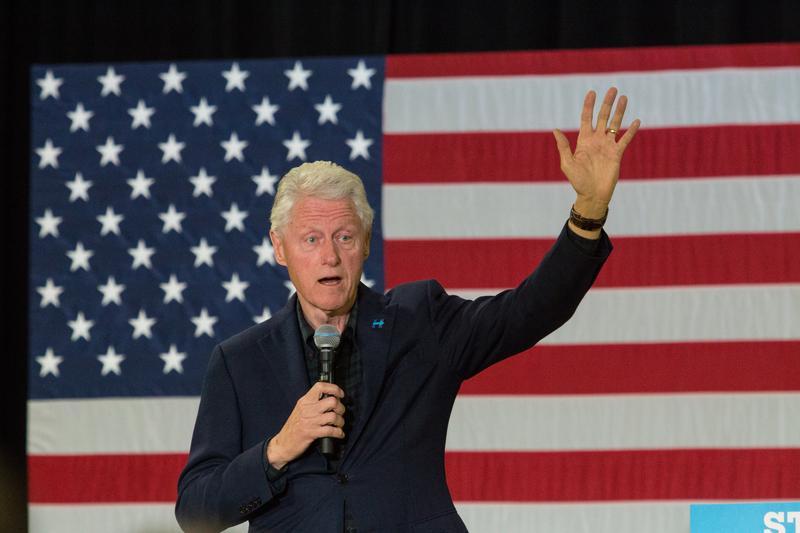
The Clinton Global Initiative’s annual meeting got under way in New York on Tuesday, Sept. 22, 2026, with former President Bill Clinton at the lectern. He spent his first minutes there on President Donald Trump’s plan for a triumphal arch between Washington and Virginia.
“I suppose I could take my entire allotted time to discuss the self-evident wisdom of building an Arc de Triomphe in Washington to hold all our drones,” Clinton said, as the audience laughed.
“Some of this stuff — it’s hard to make up,” he added.
Clinton, 80, never uttered Trump’s name in the speech. Few assessments of Trump’s presidency from the 42nd president have been as pointed in recent months.
A 250-Foot Arch Near Arlington
Designers have drawn up a 250-foot arch to rise near Arlington National Cemetery, where it would bridge the gap between Washington, D.C., and Virginia. Trump has folded the arch into celebrations marking the country’s 250th anniversary, and he has said the structure would double as a military facility.
On Sept. 20, two days before Clinton spoke, Trump said on Truth Social that “at the strong request of the United States Military” he had agreed to make it a “Military Complex/Triumphal Arch,” with drones and snipers stationed on it.
A National Park Service historic-preservation review has acknowledged the arch will cause “adverse effects” on the surrounding Memorial Circle landscape that “cannot be fully avoided.”
The Great American State Fair ran from June 25 to July 10, and organizers put a mock-up of the arch on display on the National Mall for its duration.
The arch has cleared some federal design reviews. Veterans and a historian have a lawsuit pending, and a federal judge requires 48 hours’ notice before any work begins.
The Fight Over Kennedy Center
Clinton also addressed the fight over the John F. Kennedy Center for the Performing Arts name and tributes. U.S. District Judge Christopher Cooper in May ordered Trump’s name removed from the building. In a Sept. 15 ruling, Cooper barred the Trump-picked board from adding new tributes to the president, such as a “President Donald J. Trump Plaza,” unless Congress approved them first.
That same day, the board voted to shut the building for roughly two years of renovations. Trump spoke to reporters the next day aboard Air Force One, where he warned that the center would “end up being ripped down” if his administration went unrecognized. The courts have so far barred the renaming of the Kennedy Center.
Clinton dismissed the argument over the lettering as a small matter that has crowded out weightier ones. He said what happens inside the building — and outside it — counts for more.
“You really think 100 years from now anybody’s going to care very much about whose name’s on what building?” he asked.
Zero-Sum Politics at 250
Much of his speech critiqued what Clinton called the zero-sum thinking of the country’s political leaders. American politics, he said, cannot rest in the nation’s 250th year on the premise that one side’s win requires the other side’s loss.
Clinton allowed he understands the appeal. He said leaders around the world who have taken that approach have been richly rewarded for it, and that the payoff has been more apparent in the United States than in any other country.
“The people in charge have created one set of rules for themselves and another set for everyone else,” he said.
“They’ve weaponized government to settle personal scores, prosecute enemies, stamp out free speech. They’ve even made the federal government a new profit center for themselves and their allies.”
“That violates the spirit and letter of the Emoluments Clause of our Constitution,” Clinton said.
He said there are days he can scarcely believe what is happening in a country he loves, and he said he rejects the politics of “brute force.”
Clinton also took a swipe at his own party, which has watched democratic socialists and progressives rack up primary victories over the past year.
“So here we are at the 250th anniversary of our country, where there seems to be, at the right and left, dueling visions of socialism. Should it be socialism for everybody, or should it just be for the wealthy and well-connected?” he told the gathering.
Two Reasons for Hope
Clinton named two developments that he said left him more hopeful about the country’s direction. The first was the backlash in Minnesota after federal agents shot and killed two U.S. citizens, Renee Good and Alex Pretti, during an immigration enforcement operation in Minneapolis in January.
The second came from the Supreme Court, which declined on Sept. 14, for now, to let the Trump administration enforce new restrictions on voting by mail ahead of the November midterms. Both fights he singled out remain unresolved.
A lifetime, Clinton told the audience, offers only a handful of decisions that shape both personal history and the history of everyone around us. This, he said, is one of them.
He returned to a theme from his first run for president more than 30 years ago: diversity is an asset rather than a liability, collaboration produces better results than conflict, and nearly every challenge the world faces could be met if those in power cared less about who got the credit.
Trump addressed the 81st session of the United Nations General Assembly in New York on Sept. 22, the same day Clinton spoke.