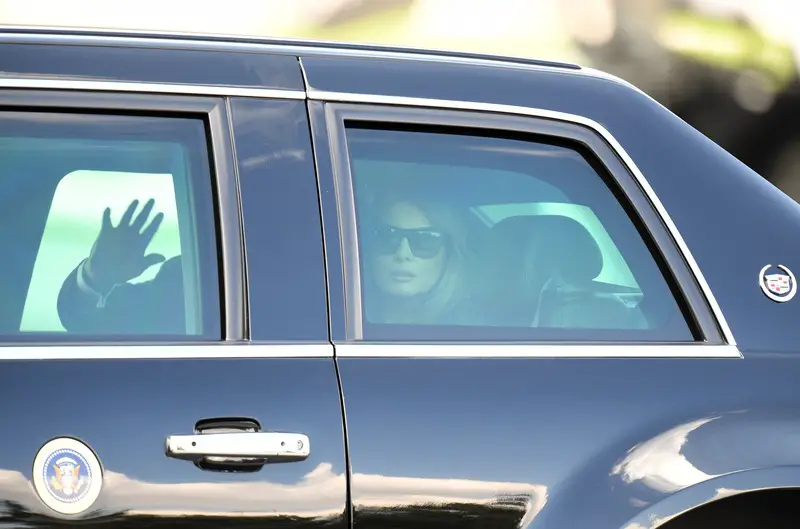
First Lady Melania Trump may never have slept at the White House in the nearly 600 days since President Donald Trump returned to office, biographer Michael Wolff wrote on Monday, August 31, 2026, in his Substack newsletter, Howl — an allegation the White House rejected in blistering terms.
Wolff, the author of the 2018 best-seller “Fire and Fury: Inside the Trump White House,” wrote that the 56-year-old first lady has built an entirely separate life far from Pennsylvania Avenue. In his telling, she is based in New York City, running a company built around her own name that, according to a disclosure he cites, cleared $17 million in net profits in 2025.
He traced the arrangement to the 2024 campaign, when, he wrote, aides fielding questions about her scarcity on the trail began workshopping a new description of her role: she would be more of a part-time first lady. Every element of the account is Wolff’s claim, and none of it has been confirmed by the White House, which disputes the entire premise.
A Blunt Line From a Trump Aide
Wolff wrote that when he pressed Trump’s senior aides in 2024 for an explanation of the first lady’s absence from the campaign, he got a one-sentence answer. “‘She hates his f—ing guts,’ is what a top Trump aide said to me,” Wolff recalled. He did not name the aide, and the remark cannot be independently verified.
Wolff argued that Melania Trump has pulled off something no first lady has managed before — living nowhere near the White House while converting her title into a multimillion-dollar business — and asked what leverage she used to negotiate such an arrangement and what else she extracted from it. He described her thin effort to obscure the setup as a particular Trump-style pretense, writing that the pretending is so half-hearted that everyone can see it, which in his view means it is not really pretending at all.
The White House Hits Back
The administration’s response was immediate and personal. White House spokesperson Davis Ingle called Wolff “a professional scumbag and serial liar whose brain has been completely warped by his severe and incurable disease known as Trump Derangement Syndrome.”
The administration also cast the account as engineered to produce sensationalist headlines. Wolff’s reporting on the Trump family has been repeatedly disputed by the White House over the years, and this round is no exception.
Still, the pushback has not quieted questions about how often the first lady turns up in official Washington. Her public schedule has been conspicuously light, and even in the first term she frequently moved on her own itinerary, apart from the president, with her appearances tightly managed.
A Summer Out of Sight
That the Trumps lead largely separate personal lives is not a new observation. But this summer the gap widened: the former model went a full month without surfacing in public at all.
She reappeared on August 20 in the White House Rose Garden, joking that she had heard she was missed, then welcoming the crowd to the White House. Her return followed a stretch in which chatter about Trump aide Natalie Harp climbed to a fever pitch — talk that was reported to have irritated the first lady.
There have been other public signals of distance. In April, on the first lady’s birthday, the president posted prolifically on Truth Social without marking the occasion. In June, she gave him the cold shoulder when he turned 80.
A Court Fight in the Background
Readers weighing Wolff’s account should know that he and Melania Trump are legal adversaries. On May 22, a federal judge in Manhattan threw out a preemptive lawsuit Wolff had filed against the first lady over statements concerning the late financier Jeffrey Epstein, with the court pointing to tactical gamesmanship in how the case was brought.
That history sits directly behind the latest dispatch from Substack’s Howl, and it is central to the White House’s framing of Wolff as a hostile chronicler rather than a neutral one. Wolff, for his part, presented the $17 million business figure not as an aside but as the core of his argument, contending that the commercial success and the geographic separation are two halves of the same understanding between the president and the first lady.
Neither side has produced documentation to settle the central question. Wolff has offered no records showing where the first lady sleeps, and the White House, while calling him a liar, has not published a competing account of her schedule. What remains is a familiar Trump-era standoff: an unverified claim from a biographer with a long and contentious relationship with the family, a scorched-earth denial from the press shop, and a first lady whose sparse public calendar keeps the speculation alive. That calendar has not filled out since. The first lady skipped the Republican National Committee’s first-ever midterm convention in Dallas on September 9 and 10, a White House official having said in early September that she would not attend, and she surfaced publicly on September 9 at the White House itself, speaking in the Rose Garden to the White House Historical Association’s Presidential Sites Summit about restoration and design work in the executive residence.