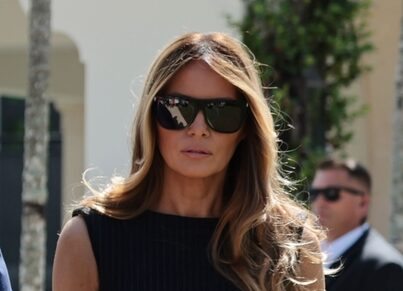
Melania Trump has become an unlikely rival to her own husband in the chase for the Nobel Peace Prize he has wanted for years.
The first lady will host Russian and Ukrainian representatives at the White House on Thursday, Nov. 5, and deliver remarks on the limited ceasefire she brokered for the Russian-occupied Ukrainian city of Oleshky — a truce that ran six days and ended Nov. 1, 2026. Nearly 800 people were evacuated from the city during the operation, she said.
Her Debut Outranked the President
Kalshi opened its 2027 Nobel Peace Prize market on Tuesday, Oct. 27, and First Lady Melania Trump, 56, debuted in second place with a 4 percent chance. Doctors Without Borders sat ahead of her at 4.6 percent. President Donald Trump, 80, opened at 1.1 percent, and the betting interest followed the ceasefire.
Ukrainian President Volodymyr Zelenskyy, Pope Leo XIV, the Committee to Protect Journalists and the International Criminal Court all opened ahead of the president as well. Trump sanctioned the court in October.
Her price did not hold. Within a few days it slid to 1.2 percent, level with her husband, on a board that also carried Yulia Navalnaya, Pope Leo XIV, Elon Musk and the International Criminal Court. Polymarket ran the opposite direction, pricing the president at 9 percent, Zelenskyy at 6 percent and the first lady at 5 percent, the eighth favorite there.
A Truce With Two Start Dates
The White House announced on Friday, Oct. 23, that Melania Trump had brokered a localized truce in Oleshky, a Kherson region city on the southern bank of the Dnipro that Russian forces captured in 2022. It had about 24,000 residents before the invasion; around 2,000 remained before the evacuation.
An event she hosted on the sidelines of September’s U.N. General Assembly was where she first learned what Oleshky was enduring, the White House said, and the talks began from there. Her office called her the agreement’s sole intermediary.
Her statement put the start of the truce at Oct. 29, with fighting halted so aid could reach the city and civilians could leave through a designated safe passageway. The Russian and Ukrainian militaries, however, set their own start: they said they would observe the truce from 0100 GMT Tuesday, Oct. 27, two days before the date she gave.
Dmytro Lubinets, Ukraine’s human rights ombudsman and the chief negotiator in the talks, thanked the first lady. He had said the route to Oleshky must be cleared of mines before any aid moved or anyone was evacuated. Both sides announced on Oct. 29 that the demining was complete, and two people taking part in the clearing were killed, according to the authorities.
Kremlin spokesman Dmitry Peskov welcomed her efforts. Her husband told reporters she is “doing better than the professionals right now.”
Questions Over Who Brokered It
The White House account of a single-handed negotiation has since come under scrutiny. Le Monde reported on Nov. 2 that Russia’s GRU and Ukraine’s HUR military intelligence agencies negotiated the operation over about four months, and that it could not be ruled out that Kyiv and Moscow wanted to please the president.
More than 30 children separated from their families by the war have been reunited through her work, according to her office. Eight of those children went back to relatives after back-channel talks with Russian President Vladimir Putin, she announced in October 2025.
The Bar Eleanor Roosevelt Never Cleared
Timothy D. Sisk teaches political science at the University of Denver and previously served as a visiting scholar and Fulbright fellow at the Norwegian Nobel Institute. He told Newsweek that one local truce is not enough for the 2027 prize in a war where ceasefires keep collapsing. He put the bar closer to Eleanor Roosevelt’s work shaping the 1948 U.N. Universal Declaration of Human Rights. Roosevelt was nominated several times and never won.
Frank Rusciano, who teaches American and comparative politics at Rider University, rated her chances remote and called the Oleshky effort short of what the prize demands. He added that the president’s limited support for Ukraine damages her case.
Venezuelan opposition leader Maria Corina Machado beat Trump to the 2025 Nobel Peace Prize, then later handed him her medal. Navanethem “Navi” Pillay took the 2026 award; the former U.N. human rights chief led a commission that concluded in 2025 that Israel was committing genocide against Palestinians in Gaza.
The prize he does hold is the inaugural FIFA Peace Prize, which FIFA President Gianni Infantino handed him at the Kennedy Center in December 2025, during the 2026 World Cup draw. Two days before the Kalshi market opened, at a rally on Sunday, Oct. 25, he complained about a promise he had made to the first lady that he would win the 2026 prize, then launched a profane tirade on Norway.
Trilateral Ukraine-Russia-U.S. peace talks will resume in Abu Dhabi, according to the Kremlin. Asked whether his wife could take part, Trump replied, “No, but it’s not the worst idea I’ve ever heard.”