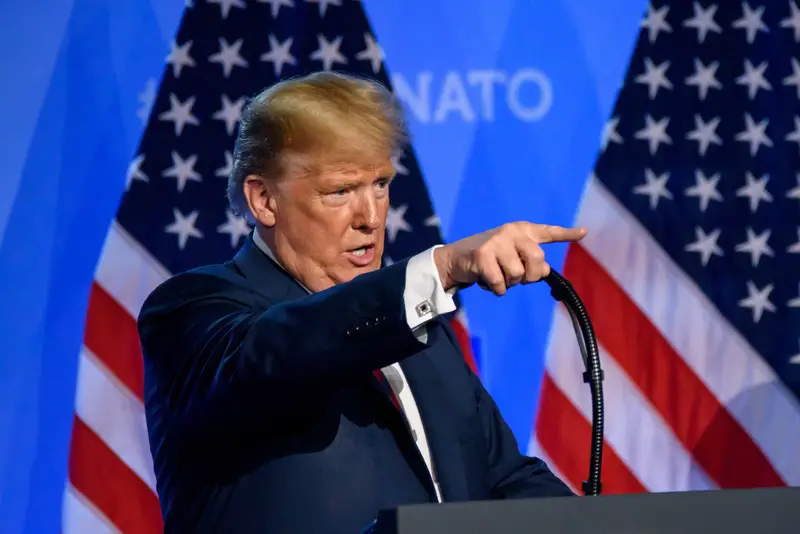
President Donald Trump unleashed a fierce critique of Prime Minister Sir Keir Starmer, declaring, “This is not Winston Churchill that we’re dealing with,” as diplomatic relations between Washington and London hit a fresh low amid the Iran crisis.
Speaking from the Oval Office on March 3, 2026, Trump delivered a harsh appraisal of the British leader while seated next to German Chancellor Friedrich Merz and positioned before a bust of Britain’s wartime prime minister. The president escalated his anger over the UK’s initial refusal to allow American forces to use British military facilities for strikes against Iran.
Trump voiced open irritation at the delays caused by Britain’s decision, noting it took several days to arrange alternative basing options for U.S. military operations. He referred to the Chagos Islands, accusing the UK of being “very, very uncooperative with that stupid island” and calling the situation “a shame.”
The clash began after the UK initially prevented the U.S. from using British bases, including the strategically crucial facility at Diego Garcia in the Chagos Islands, to conduct strikes on Iran over the weekend. The Prime Minister reversed his position only after Iran launched retaliatory attacks across the Middle East, including a drone strike on RAF Akrotiri in Cyprus that was said to have damaged a runway early on March 2. (Foreign Secretary Yvette Cooper initially said the drone hit the runway on Sky News on March 2, but Downing Street later confirmed it actually hit a hangar, not the runway. The hangar housed US U-2 spy planes. Cooper’s initial statement was corrected by official sources.)
Trump broadened his attack beyond military cooperation, criticizing Starmer’s controversial agreement to transfer the Chagos Islands to Mauritius under a 99-year lease. The arrangement, finalized in May 2025, allows the UK and US to keep operating the Diego Garcia base while transferring sovereignty of the archipelago to Mauritius.
The president’s remarks mark an extraordinary public rift in the so-called “special relationship” between the two countries. Trump hinted that other European partners had been far more supportive during the Iran operations than Britain.
Merz, seated beside Trump as the remarks were made, later told reporters he had “addressed both issues very clearly in a personal conversation” because he preferred to avoid public disagreements. NATO Secretary General Mark Rutte received praise from Trump for his backing. The president also announced the U.S. was cutting all trade ties with Spain after Prime Minister Pedro Sánchez refused American access to jointly operated military bases for Iran operations.
The diplomatic storm has pushed Downing Street into full damage-control mode. Chancellor of the Duchy of Lancaster Darren Jones defended the government’s stance, arguing that the initial U.S. and Israeli strikes did not meet the Prime Minister’s criteria for British participation.
Starmer countered Trump’s accusations during parliamentary proceedings, asserting that he acted in Britain’s national interest. The Prime Minister stressed his government’s ideological opposition to certain military actions, saying his administration “does not believe in regime change from the skies.”
The UK later deployed the air-defense destroyer HMS Dragon and two Wildcat helicopters with counter‑drone systems to the Cyprus region to help protect RAF Akrotiri following the Iranian drone strike. Britain also authorized the use of its bases for defensive operations after Iran launched retaliatory missile and drone strikes across the Middle East.
The White House has been especially troubled by the potential loss of access to Diego Garcia, a vital Indian Ocean airbase capable of refueling B2 bombers during missions against Iran. Trump had previously approved the UK’s deal with Mauritius but has since reversed course, calling it an “act of great stupidity.”
Despite the heated exchange, the Prime Minister’s official spokesman attempted to downplay the discord, citing decades of close cooperation. When asked to describe the special relationship, the spokesman insisted the UK and US remain staunch allies.
Trump had earlier told The Sun that the special relationship was “not what it used to be” and said Starmer had “not been helpful.” The president, whose mother Mary Anne MacLeod was born in Scotland, also criticized Britain’s energy and immigration policies during his latest comments.
The public confrontation represents one of the most severe diplomatic fractures between Washington and London in modern times, with both leaders showing little interest in softening their positions. The crisis has also triggered criticism from Britain’s Middle Eastern partners, including Cyprus and Gulf nations, who say London failed to adequately protect the region from Iranian missile strikes.
With Iran continuing strikes across the region and the U.S. seeking other basing options, including RAF Fairford in Gloucestershire, the standoff between Trump and Starmer appears far from resolved. Cypriot President Nikos Christodoulides and London Mayor Sir Sadiq Khan have both commented on the worsening security situation, increasing pressure on the British government to clarify its stance.
The rift between Washington and London has deepened significantly in the weeks since Trump’s March 3 Oval Office broadside. On March 7, Trump posted on social media that Britain was “finally giving serious thought to sending two aircraft carriers to the Middle East,” before dismissing the gesture, writing: “We don’t need people that join Wars after we’ve already won!” A new flashpoint emerged when Trump demanded NATO allies help secure the Strait of Hormuz after Iran’s new Supreme Leader vowed to keep it closed. Trump described Britain’s reluctance to send warships to de-mine the waterway as “terrible,” and when Starmer said he would need to consult his team on the request, Trump shot back: “You don’t have to worry about a team — you’re the prime minister; you can make a decision.”
On March 17, Trump again blamed Starmer for the breakdown in relations, saying the two countries got on well “until Keir came along,” while once more invoking the Churchill bust in the Oval Office.
Even Britain’s domestic opposition has rallied around the prime minister — Conservative leader Kemi Badenoch, Starmer’s fiercest critic, called Trump’s attacks “childish” and “unseemly,” saying the war of words was doing nobody any good.
Now the diplomatic damage is threatening a higher-profile casualty: King Charles had been widely expected to travel to Washington in April to mark the 250th anniversary of American independence, but a growing number of British lawmakers are questioning whether the state visit should proceed, with one Labour MP warning: “The last thing we want is to have His Majesty embarrassed.” Trump himself has signaled he still expects Charles to visit “very shortly,” but with no date confirmed and the relationship at its lowest point in decades, the future of the trip — and the special relationship — remains deeply uncertain.