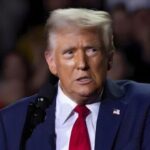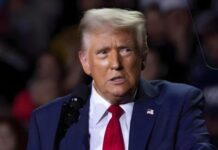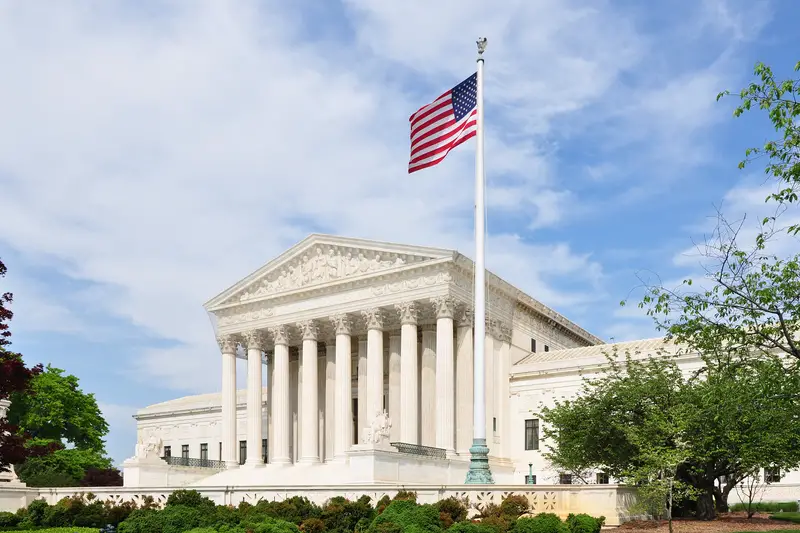
During an unprecedented yet embarrassing moment in history, President Donald Trump observed from the front row while Supreme Court Justice Amy Coney Barrett—whom he personally nominated—methodically tore apart his administration’s legal reasoning for eliminating birthright citizenship during Wednesday’s oral arguments at the Supreme Court.
Trump made history as the first sitting president ever to attend Supreme Court oral arguments on April 1, 2026, taking his seat in the public gallery next to Attorney General Pam Bondi, who has since been dismissed. However, this extraordinary display of executive presence dramatically failed when Barrett and her fellow justices voiced profound doubt about the administration’s stance in Trump v. Barbara, the groundbreaking case contesting his executive order.
The president exited the courtroom before arguments concluded, leaving shortly after ACLU National Legal Director Cecillia Wang commenced her presentation supporting expansive birthright citizenship. He subsequently shared on Truth Social that the nation was “STUPID” for permitting the constitutional right.
Barrett inflicted the most damaging critique of Solicitor General D. John Sauer’s case when she focused on the administration’s argument that children cannot obtain birthright citizenship if their parents don’t have “domicile” in the United States or maintain “allegiance” to a foreign power. Her examination revealed a critical weakness: according to the government’s reasoning, even the children of enslaved people—the exact group the 14th Amendment was created to safeguard—could fail to qualify for citizenship.
Barrett challenged Sauer on real-world scenarios, questioning how the rule would apply to children born to women who were illegally trafficked into the United States. If enslaved people transported here involuntarily still “felt allegiance to the countries where they were from” and intended “to return as soon as they can,” wouldn’t their children be denied birthright citizenship according to the government’s argument? And if that’s true, how could the administration maintain the 14th Amendment’s citizenship clause was crafted exclusively to reverse Dred Scott and provide citizenship to recently emancipated slaves?
Professor Evan Bernick of Northern Illinois University College of Law subsequently analyzed Barrett’s powerful reasoning on Slate’s Amicus podcast, observing that enslaved people lacked any “intent to remain” since they were brought to America by force. If domicile demands such intent, Bernick contended, then granting citizenship to the children of formerly enslaved people would be unachievable under Sauer’s own argument—entirely contradicting the 14th Amendment’s fundamental objective.
Barrett wasn’t the only justice expressing doubt. Chief Justice John Roberts characterized the government’s illustrations as “very quirky,” while Justice Ketanji Brown Jackson relentlessly challenged the feasibility of enforcing such a policy, asking “So, are we bringing pregnant women in for depositions?”
Justice Neil Gorsuch caused Sauer to falter uncomfortably when he questioned whether Native Americans met the criteria as birthright citizens. Despite indigenous people inhabiting the territory long before European colonizers came, Sauer could only respond “I’m not sure, I have to think through that” before referencing the Indian Citizenship Act of 1924.
Trump issued the executive order on his first day returning to office on January 20, 2025, attempting to block automatic citizenship for babies born to undocumented immigrants and numerous foreign nationals holding temporary visas. The measure would impact over 250,000 babies born each year and could potentially render some children stateless, according to research cited in court briefs.
Lower courts without exception enjoined Trump’s order as presumably unconstitutional and inconsistent with federal statute 8 U.S.C. § 1401, which reflects the 14th Amendment’s text. The 1898 Supreme Court case Wong Kim Ark determined that a child born in San Francisco to noncitizen parents of Chinese ancestry was a U.S. citizen, confirming the “ancient and fundamental rule” of jus soli—citizenship based on soil rather than descent.
The courtroom proceedings occurred amid remarkable circumstances. While Trump occupied his seat in the gallery, his spiritual adviser Paula White-Cain likened him to Jesus Christ during an Easter lunch at the White House, telling the president “no one has paid the price like you have paid the price.”
The justices could decide on statutory grounds without reaching the full constitutional scope of the 14th Amendment, or they could address the constitutional question head-on. If the administration is defeated on the statute, it could pursue legislation in Congress, though lawmakers have repeatedly considered but never passed measures to restrict birthright citizenship.
Legal experts caution that imposing restrictions would demand costly new federal verification infrastructure and risk mistakes that could make infants stateless. The Supreme Court is anticipated to release a decision by late June or early July.
For Trump, Wednesday’s arguments marked an unusual instance of accountability, with even his own judicial appointees declining to rubber-stamp his most radical constitutional gambit. His premature exit from the courtroom indicated he grasped what even ordinary legal observers recognized: this case is not going his way.