Sixteen people died after a passenger bus collided head-on with a fuel tanker on one of Sumatra’s main highways Wednesday, May 6, 2026, triggering an explosion that trapped and burned victims inside both vehicles.
The intercity bus was traveling from Lubuklinggau city in South Sumatra to Pekanbaru with at least 20 passengers aboard when it struck the tanker on the Trans-Sumatra Highway in North Musi Rawas regency around midday. Only four people survived the crash, and three of them suffered severe burns before being rushed to a nearby health clinic.
The death toll includes 13 or 14 passengers, the tanker driver and his assistant. Whether the bus driver survived remains unclear. Mugono, a local disaster management agency official who uses a single name like many Indonesians, said every victim burned to death inside the vehicles.
A Split-Second Decision On The Highway
Preliminary findings suggest the bus may have emitted sparks shortly before the crash, prompting the driver to swerve toward the right shoulder in an apparent attempt to avoid a more serious incident. But the oil tanker was bearing down at high speed in the opposite lane, and there was no time.
A revised preliminary assessment from police investigators offered a different account of those final seconds. The bus may have crossed into the opposite lane while attempting to avoid a pothole — a hazard all too familiar on Indonesian roads. Whatever the precise cause, the result was the same: a head-on impact that detonated the tanker’s volatile cargo.
Smoke, Flames And Twisted Metal
“The forceful impact triggered a fire that engulfed both vehicles, leaving many victims trapped inside,” Mugono said.
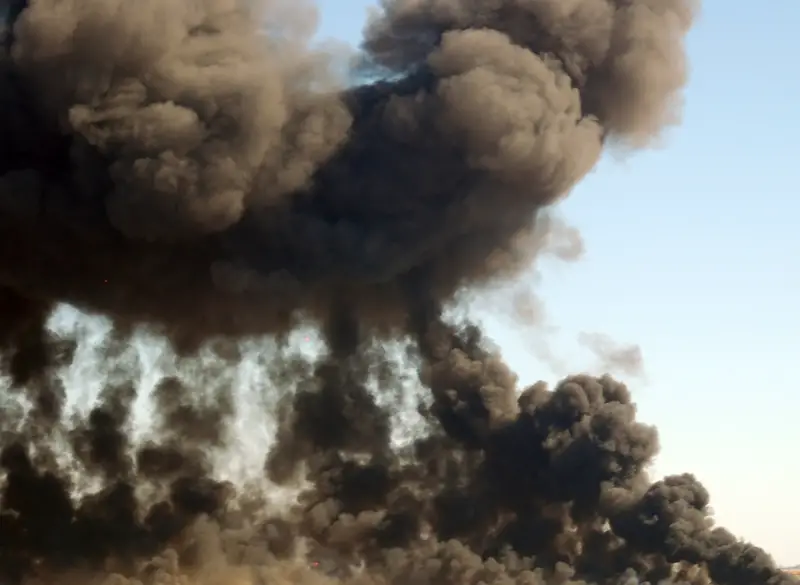
The National Search and Rescue Agency released photos and videos showing firefighters in heavy gear hosing down the blaze as thick plumes of black smoke and orange flames climbed into the sky. After the fire was extinguished, only charred shells of the bus and tanker remained, surrounded by twisted metal scattered across both lanes.
A mix of disaster officers and traffic police spent hours recovering bodies and clearing debris. Several victims were pinned inside the gutted vehicles, their bodies fused to seats and frames, making extraction agonizingly slow. Traffic backed up for miles in both directions as the fire and wreckage complicated every step of the operation.
Authorities are continuing to collect data on the total number of fatalities because the passenger manifest is still being traced. The figure of 16, while confirmed, may not yet be final.
The Painful Work Of Identification
Disaster Victim Identification teams from the South Sumatra police had identified only five of the dead by Thursday, May 7, after 16 body bags arrived at Siti Aisyah Hospital in Lubuklinggau for initial processing. Those identified were the bus driver, two other bus crew members, the tanker driver and one passenger. Eleven remain unidentified.
“All the bodies are severely burned, which has complicated the identification process,” Muhammad Karim, the North Musi Rawas traffic police chief, said.
The remains are being transported by land to Bhayangkara Police Hospital in Palembang, the provincial capital, where forensic teams will conduct autopsies. DNA matching and dental records are expected to play a central role in confirming the identities of the dead, a process that could take days or even weeks given the condition of the bodies.
For families waiting for news, the uncertainty has been excruciating. With the manifest incomplete and identification stalled, some relatives can only wait at hospitals and clinics, hoping for word.
A Recurring Tragedy On Indonesian Roads
Catastrophic crashes are a persistent feature of Indonesian roads, where poor safety standards, aging vehicles and crumbling infrastructure converge in deadly fashion. The Trans-Sumatra Highway, a critical artery linking cities across the island, sees heavy traffic of buses, trucks and fuel tankers competing for narrow lanes that are often pitted with potholes and obscured by tropical weather.
Wednesday’s wreck combined the worst hazards of that environment: a long-haul passenger bus, a fully loaded fuel tanker, a possible mechanical malfunction, a road defect and a high-speed closing approach. The fire that followed left almost no margin for survival.
As forensic teams continue their work in Palembang and investigators piece together the final movements of the bus driver, the human toll of the disaster is only beginning to be reckoned with. Sixteen lives have been lost, four people are recovering from injuries that may scar them permanently, and an entire stretch of highway stands as a grim reminder of how quickly an ordinary journey can end.