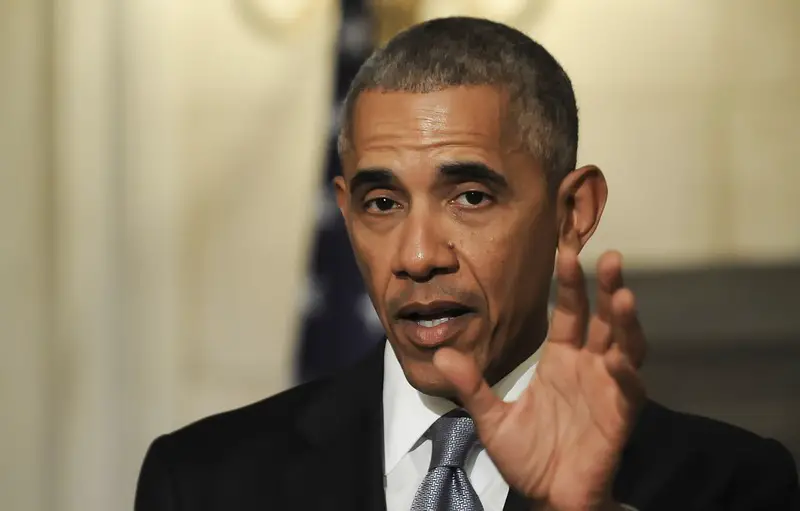
Former President Barack Obama delivered a pointed rebuke of President Donald Trump’s foreign policy approach during a June 13, 2026, interview, casting doubt on whether the president’s much-touted Iran agreement would amount to anything meaningfully different from the nuclear deal Trump spent years attacking — while a separate firestorm erupted after a UFC fighter used his White House victory speech to make a slur directed at Michelle Obama.
Heavyweight fighter Josh Hokit, 28, made the slur during his interview with UFC commentator Joe Rogan following his victory at the UFC Freedom 250 event on the South Lawn on June 14, 2026. Trump praised Hokit in a Truth Social post on June 15 alongside other winning fighters from the evening, without addressing the comment.
As of June 15, the Obamas had not publicly responded to the slur, though it drew widespread condemnation. The incident is not the first time the former first lady has been targeted by Trump allies, but the setting — a White House event, during a presidential birthday celebration — gave the episode unusual weight.
The firestorm came about 24 hours after Obama delivered a pointed rebuke of Trump’s foreign policy approach during the interview at the Obama Presidential Center in Chicago on June 13. The former president sat down with “Good Morning America” co-anchor Robin Roberts in an interview set to air in full on June 17. Speaking one day before Trump announced that the United States and Iran had reached a deal to reopen the Strait of Hormuz and end the U.S. naval blockade, Obama cast doubt on whether the president’s much-touted Iran agreement would amount to anything meaningfully different from the nuclear deal Trump spent years attacking.
“It is doubtful that any agreement that arises is going to be significantly different or a significant improvement from the deal that we had in the first place,” Obama told Roberts, referring to the 2015 Joint Comprehensive Plan of Action — the landmark nuclear accord his administration negotiated with Iran and five other world powers, which Trump abandoned in 2018, calling it one of the worst agreements ever made.
Obama expressed hope for an end to the fighting, then turned to the broader lesson of the last decade of Iran policy, suggesting the president had mistaken military force for leverage. “Then in retrospect it’s a reminder that on a lot of difficult foreign policy problems — the notion that we can just bully our way or bomb our way to solutions — may sometimes seem appealing,” Obama said, “but the fact of the matter is that taking the time to explore diplomacy and exhaust the possibilities of coming up with deals that don’t solve 100% of the problem but solve 80 or 90% of the problem, while avoiding the necessity of going to war. You’d think we would’ve learned that lesson by now, but it seems like every so often we have to relearn that lesson again.”
Trump, speaking alongside French President Emmanuel Macron at the G7 summit in Evian-les-Bains, France — with the formal signing of the agreement set for Bürgenstock, Switzerland on June 19 — dismissed the comparison to Obama’s original accord. “It’s not like the Obama document, which was just a terrible document,” he said.
The remarks landed as Trump prepared to sign what he described as a “very powerful document” in Switzerland — a Memorandum of Understanding establishing a 60-day ceasefire with Iran and setting aside the central question of the country’s nuclear program for future negotiations. Administration officials said the deal would lead to the dismantling of Iran’s nuclear capabilities and the removal of its stockpile of highly enriched uranium, though the full text had not been released and key details remained unsettled.
Critics, however, noted the structural similarities between the two frameworks. Under the 2015 Joint Comprehensive Plan of Action (JCPOA), Iran agreed to strict limits on uranium enrichment, dramatic reductions in its nuclear stockpile, and an extensive international inspection regime in exchange for sanctions relief. The provisions now being described in Trump’s agreement — uranium dismantlement and verification measures — prompted comparisons to the 2015 accord.
Obama argued his original deal had succeeded until Trump pulled the United States out of it.
Whether Trump’s new agreement proves him right or wrong remains to be seen — but the 60 days ahead will go a long way toward answering that question.