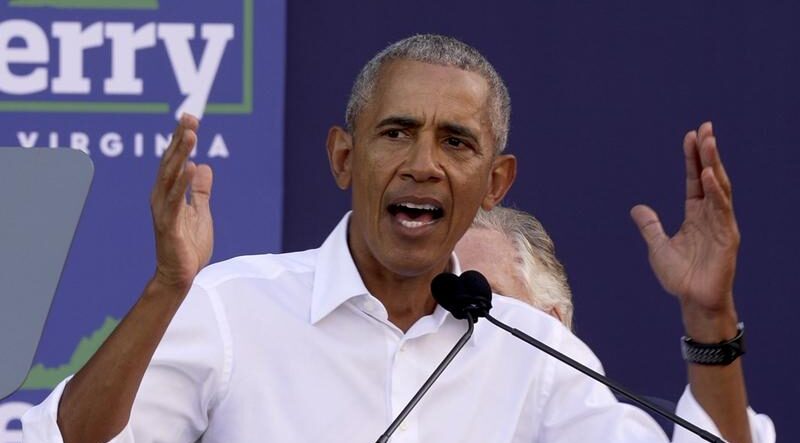
Former President Barack Obama will headline a fundraiser for Senate Democrats in the Washington, D.C., area on Oct. 7, 2026, his first appearance at a Democratic Senatorial Campaign Committee (DSCC) fundraiser this midterm cycle.
Party operatives designed the event to deliver a financial boost during the closing stretch before the elections on Nov. 3. Sen. Lisa Blunt Rochester of Delaware, a DSCC vice chair, will sit down with Obama for a conversation centered on “the importance of flipping the Senate and the stakes of the election,” a DSCC spokesperson said.
Obama remains a popular and influential figure among Democratic voters. Registered voters told an NBC News poll conducted in September that they would be more likely to support a candidate he endorsed — 43 percent of them overall, and 77 percent among Democrats. Voters are growing more engaged in the midterms, and Democrats are likely to treat his involvement as a lift at such a moment.
Four Senate Seats Draw Democrats’ Eye
Control of the upper chamber in November requires Democrats to flip four seats. The Cook Political Report currently rates seven Senate seats as tossups — Alaska, Iowa, Maine, Michigan, New Hampshire, Ohio and Texas — with North Carolina leaning Democrat and Kansas leaning Republican. Republicans hold 53 of 100 seats to Democrats’ 47, and 35 seats are on the Nov. 3 ballot.
Democrats are increasingly optimistic, with several red states moving into play. Multiple polls in Texas show Democrat James Talarico ahead of Trump’s endorsed candidate, Republican Ken Paxton. A Talarico victory would make him the first Democrat to win a statewide election in Texas since 1994, and the first to capture a U.S. Senate seat there since 1988.
A CNN analysis published Oct. 2 said stumbling Republican candidates in several pivotal contests, alongside a slate of strong Democratic hopefuls, are putting Senate races long assumed to be Republican into play. The analysis cites Georgia Sen. Jon Ossoff campaigning in Athens on Sept. 13.
Even if Democrats gain a Senate majority, Pennsylvania Sen. John Fetterman could deny them their 51st vote, according to a Michael Barone column published Oct. 2 on Townhall. The column said a Democratic Senate is unlikely to confirm any Trump appointee to the Supreme Court or federal courts.
Republicans Keep Their Distance
CNN data analyst Harry Enten reported that Republican political ads airing in the first half of September mentioned Trump at all less than one percent of the time, compared with 20 percent of Democratic ads.
Forecasters widely predict the GOP will lose control of the House, and they cite backlash to Trump’s policies, his handling of the economy, his war with Iran and the party’s razor-thin majority in the lower chamber as factors. Should the Senate follow, Democrats would run Congress through Trump’s final two years in office — a near-mirror image of Nov. 10, 2016, when Republicans had won the White House and both chambers and Obama welcomed then-President-elect Trump to the Oval Office for the symbolic start of the transition.
Trump announced plans in the Oval Office on Monday, Sept. 28, for Mesabi Metallics to build a $15 billion steel plant in Iowa, as he and GOP leaders mount what CNN describes as an Iowa rescue mission in a state Trump won by 13 percentage points. Iowa races include Republican Senate candidate Rep. Ashley Hinson against Democrat Josh Turek, and Democratic gubernatorial nominee Rob Sand.
Not every sign points the Democrats’ way. The party faces a staggering spending disadvantage in Georgia’s tight race for governor. Obama headlined a Nov. 1, 2025, rally in the New Jersey governor’s race and attended the June 18 dedication ceremony marking the opening of the Barack Obama Presidential Center in Chicago.