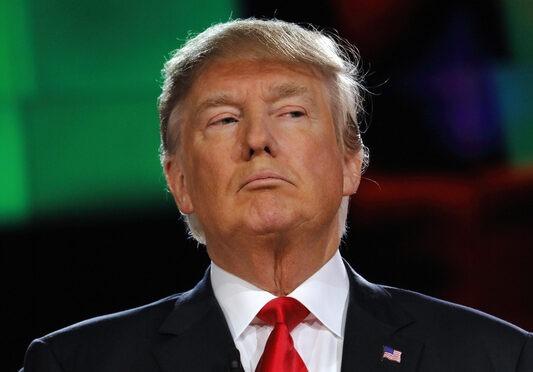
President Donald Trump, 80, singled out CNN anchor Kaitlan Collins again at a campaign rally in Vandalia, Ohio, on Saturday, Oct. 3, 2026, pointing her out to the crowd after roughly 30 seconds of “**** CNN” chants and mocking her from the stage.
“She’s such an unhappy person,” Trump said of Collins, 34.
The president was stumping for Republican midterm candidates in Ohio, including Senate candidate Jon Husted and gubernatorial candidate Vivek Ramaswamy. He told Ohio voters that if they back Republicans, “we’re going to win, and we’re going to win big, and we’re going to shove it up their (expletive).”
After the Ohio speech, Trump renewed his attacks on Fox News and Fox commentator Jessica Tarlov. CNBC called the speech “crude” and described “profane attacks” against Democrats.
Time Interview Set It Off
The rally came days after Trump attacked Collins in an interview with Time magazine published Thursday, Oct. 1. Senior Political Correspondent Eric Cortellessa and Editor-in-Chief Sam Jacobs conducted the interview at the White House on Sept. 28.
“I don’t think anybody should be forced to bear fake news, constantly bad stories, because I’ve done great things,” Trump said in the interview. “So at a certain point, you say, ‘What’s the purpose of like this crazy Kaitlan Collins?’”
He went on: “She’s a very average person. She’s the most unhappy young person I’ve ever seen.” He also said, “If I did something spectacular by any standard, and they would write about it, they will only write badly.”
Asked whether he had seen footage of Mitch McConnell on Capitol Hill and whether McConnell should resign over his health, Trump pivoted to pardons. At another point, according to the Time transcript, he told Cortellessa and Jacobs: “This ain’t gonna be much of a story. Here we are doing this. You haven’t asked me one ****ing positive question.”
Pressed on his decision to expel news organizations from the White House, Trump complained broadly about press coverage, insisting he could rattle off 100 accomplishments and still never be treated fairly. His interviewers kept trying to push the conversation toward the war in Iran, but after the remarks about Collins the president went his own way and launched, unprompted, into a defense of the crowds at his recent appearances. The applause in Duncan was heavy, he said, and he had told supporters there to disregard any account that he was booed, something he denied. His reception in Tennessee and a golf event in Chicago also came up.
Judge Blocked the Ban
CNN, MS NOW and Politico lost their White House credentials in September, revoked by Trump, who accused the outlets of reporting lies about him. A Sept. 21 post on Truth Social laid out his reasoning: the administration, he wrote, was mounting an assault on what he regards as fake coverage, which he described as corrupt, coordinated and a danger to national security.
The three outlets filed a joint lawsuit the same day, arguing that their right to due process and the First Amendment had both been violated by the move. A Trump appointee, U.S. District Judge Timothy Kelly, blocked the ban, and on Sept. 24 the court ordered the administration to return the three outlets’ press passes immediately — a humiliating setback for the president.
Even with the temporary block in place, CNN was barred from covering the president’s trip to Texas and Oklahoma on Thursday, Oct. 1. The outlets have asked for a preliminary injunction, and Kelly has set a hearing on that request for Thursday, Oct. 8, at 11 a.m. ET — the day the temporary order expires.
On Monday, Oct. 5, the White House kept Politico off Air Force One for a trip to Nebraska, Time reported.
The ban triggered an outcry across the news industry and condemnation from the three outlets. Its journalists, CNN said afterward, would go on scrutinizing the administration and reporting on what it does no matter how much pressure is applied. A CNN network spokesperson called Collins an exceptional and trusted journalist and said, “We stand by her to the fullest extent.”
Clashes Since January 2025
Repeated clashes have marked the relationship between Trump and Collins since his return to the White House in January 2025. Days after the ban took effect, Collins asked Trump at the United Nations in September when he expected the war with Iran to end. He replied that the network’s covering him at all came as a surprise to him, then turned to her and said, “You should not be here covering me.”
In February, a question related to Jeffrey Epstein prompted an exchange in which Trump, speaking from behind the Resolute Desk in the Oval Office, told Collins that in the 10 years he had known her he had never seen her smile — the reason, he said, being that she was not telling the truth. More than once during his second term, the president has come back to that same complaint about the anchor.
Collins appeared to respond on the Friday, Oct. 2, episode of “The Source With Kaitlan Collins,” where viewers spotted a mug on her desk reading “America Needs Nasty Women.” Collins has not publicly spoken about the mug.
Scholars See a Playbook
Trump’s broadsides against critics have alarmed scholars of democracy. Repressive leaders open with conspiracy claims, and almost always float them to justify crackdowns, said Steven Levitsky, a Harvard professor of government and co-author of “How Democracies Die.” Trump’s mentor, the right-wing lawyer Roy Cohn, taught Trump that unfounded claims about shadowy enemies can rally the public and cast him as the aggrieved party rather than the accused, according to Julian Zelizer, a Princeton historian.
The escalation of Trump’s fight with the news media comes weeks before the 2026 midterm elections.