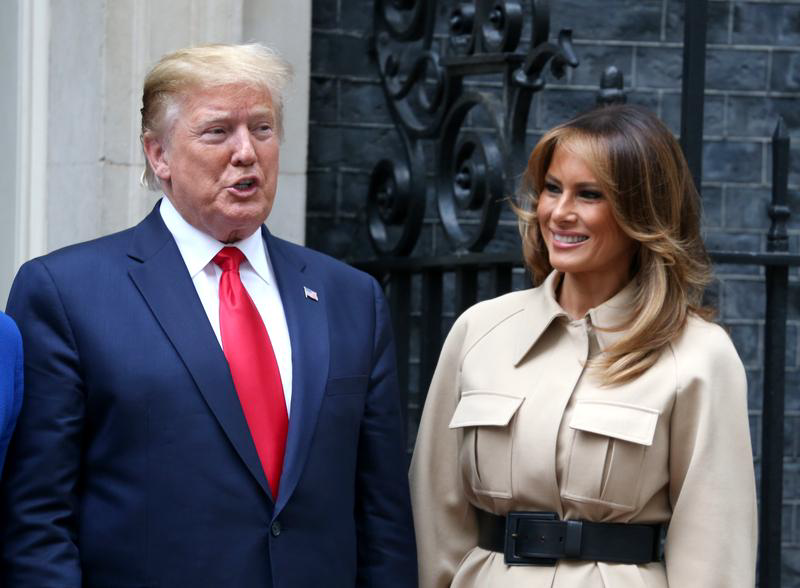
When it came time for First Lady Melania Trump to put her name on a new executive order, her husband could not resist a jab about whether that signature counted for much.
President Donald Trump signed an executive order on women’s health in the Rose Garden on Monday, Oct. 19, 2026, and as the first lady stepped up to sign, he told the gallery, “I don’t know if her signature means anything.” Melania Trump had a reply ready as she put pen to paper: “Yours is the most important.”
The pen was not the only awkward beat of the ceremony. Trump moved in for a kiss, the first lady appeared to turn to the side, and he landed a peck on the top of her head before patting her hand. Public affection between the two has been scarce, and they live in separate bedrooms when she is at the White House. He has said he likes to call her first lady, and he has indicated she calls him “sir.”
A New Division, With No Dollar Figure
The order itself was the first lady’s project. It creates a women’s health division at the National Institutes of Health and a White House task force to push federal research, and she helped shape both in consultation with physicians, White House officials, Health and Human Services Secretary Robert F. Kennedy Jr. and the president. Kennedy and White House chief of staff Susie Wiles, who has completed breast cancer treatment, will lead the panel, which was set to meet for the first time after the ceremony. The order names maternal health, mental health and endometriosis as targets, along with Alzheimer’s, osteoporosis, heart disease and stroke. It sets no specific funding goals.
Melania Trump told the audience that earlier generations fought for women’s rights and that her generation would fight to find the cures that let women live fully. The president called the move historic, praised her work, then drifted into unscripted remarks about White House renovations, including the patio stone now covering what used to be the Rose Garden lawn.
Egged on by an Alaska Crowd
The signing capped a stretch in which Trump repeatedly made his wife’s objections part of his act. At a rally in Wasilla, Alaska, on Tuesday, Oct. 13, he described his “elegant” wife’s wish that he drop his jokes about transgender athletes. “My wife hates when I talk about this,” he said. Then he asked the crowd whether he should do the impression anyway. They cheered. He did it.
The next day in Bullhead City, Ariz., on Wednesday, Oct. 14, he worked through another riff about a transgender weightlifter before blurting out, “My wife is going crazy with me.” She hates it, he told the crowd, quoting her: “She said, ‘You’re president of the United States, you shouldn’t be doing this.'” He then launched into a grunting impression of an athlete hoisting a barbell overhead.
A Gentle Wave Instead of “YMCA”
His other signature move got the same treatment. The first lady would prefer he skip the “YMCA” dance, Trump said, relaying her advice that he exit with a gentle wave instead — a suggestion he mimicked onstage with a singsong goodbye. He called the song the “gay national anthem” and claimed it helped him win the highest share of the gay vote of any Republican in history, then circled back to her plea that he not dance off the stage. He had tried the material before, at a midterm rally in Clarksville, Tenn., on Saturday, Oct. 10, and in January 2026, when he told Republican lawmakers his wife asked him to picture FDR dancing.
Private Advice Turned Into Crowd Work
Marriage therapists who watched the rally footage were not charmed. “Like everything else Trump does, his display at his rally is of course about him, with Melania in this case as the punching bag,” said Amy Begel, a therapist at the Mount Sinai School of Medicine in New York City. Begel added that in any marriage, trading a partner’s trust for a laugh is a risky kind of one-upmanship.
Los Angeles psychologist Greg Cason said the bits carry a hostile edge that can read as contempt — not because the president ignored his wife’s advice, but because he carried it to a crowd and invited them to laugh. Recruiting an audience that way tips the balance, Cason said, and it suggests she is supplying material rather than counsel. San Diego marriage and family therapist Jennifer Chappell Marsh called the dynamic “triangulation.”
The timing matters for reasons beyond the marriage. The Rose Garden ceremony landed weeks ahead of the Nov. 3 midterm elections, with the president’s approval slipping among women. About 4 in 10 independent women backed Trump in the 2024 election against Democrat Kamala Harris, according to AP-NORC polling, a figure that fell to roughly a quarter in the opening months of 2026. The first lady, whose second-term work has centered on foster care and expanding technology and artificial intelligence in schools, now has women’s health on her list as well — and a husband at rallies still asking crowds whether to keep doing the thing she asked him to stop.