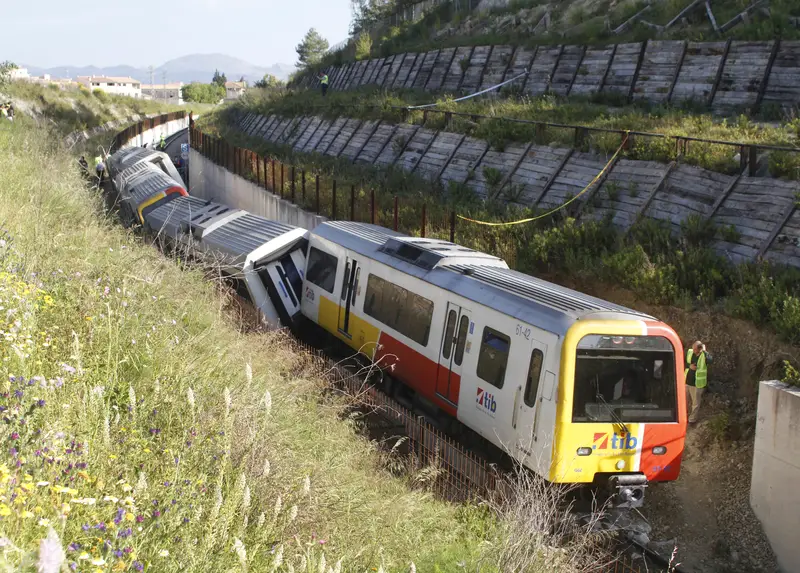
Villagers from a farming district south of Cairo ran to the tracks and began pulling passengers from the overturned carriages of two wrecked trains.
Two passenger trains collided in the al-Ayyat district of Giza province on Sunday, Nov. 8, 2026, killing seven people and injuring at least 125, authorities said.
The trains met between the Kafr Ammar and Al-Raqqa stations, about 52 kilometers (32 miles) south of Cairo. The Nile River runs past al-Ayyat, which lies in the south of Giza. That province draws visitors from around the world as the site of Egypt’s ancient pyramids.
The Rear Car Never Moved
The Transportation Ministry said a train bound for the southern province of Aswan was struck from behind by a Giza-Fayoum service. Investigators determined the impact landed on the rear car of the Cairo-Aswan train, officials said, and that car was motionless on the same track, pointed in the same direction.
The driver of the Fayoum-bound train was among the dead, according to the Chief Prosecutor’s office. Early reports put the death toll at four, a figure the Health Ministry raised to seven later in the day.
More than 70 ambulances carried the injured to nearby hospitals, and crews distributed them among three hospitals: Al-Wasta, Al-Ayyat and Atfih. More than 70 of the injured were treated and discharged, the Health Ministry said. Health Minister Khaled Abdel Ghaffar said medical teams were treating patients for fractures and head trauma.
Egyptian Red Crescent volunteers worked at the crash site on Nov. 8, bringing relief supplies and psychological counseling for survivors and relatives.
Neighbors Dug Under the Wreck
Farha Gamal, a passenger on the Fayoum train, said in an interview that some people around her appeared dead and others struggled to find a way out of the car. “There were other cars that were completely mangled,” she said.
Staff at al-Wasta Central Hospital, in neighboring Beni Suef province, received survivors who described passengers in shock and barely able to breathe through the dust thrown up by the impact. Villagers nearby eventually got them out, they said.
Neighbors ran to the wreck, pulled survivors out and called for ambulances, said Ayman Gamal, who lives in the village of Kafr Girza in al-Ayyat. He counted roughly 80 injured people loaded into ambulances and driven to nearby hospitals. Passengers were trapped inside one car of the stationary train and were dead when rescuers pulled them free, he said.
Abdel Wahed Mohamed, 31, was at a cafe nearby when the trains collided. The Aswan-bound train had stopped and the Fayoum-bound train plowed into it, he said. He counted six overturned carriages and injuries that ranged from head wounds to broken limbs.
Ahmed Moussa, 25, another witness, saw rescuers digging under one overturned carriage to reach trapped passengers. Two of the dead were women, he said. Taha Abdel Tawab, 43, said he “saw a young man leaving the train carrying his dead father.”
Pressure Mounts on the Transport Minister
A prompt investigation into the crash had been ordered so that anyone responsible would be held to account, President Abdel-Fattah el-Sissi wrote on social media. “I am following the aftermath of the train collision with great concern and extend my deepest condolences to the families of those who lost their lives, along with my sincere wishes for a speedy recovery for the injured,” he said.
Calls for Egypt’s transport minister to step down mounted Sunday, Nov. 8, after the crash.
Investigators from the Chief Prosecutor’s office reached the site late Sunday. Prosecutors ordered the controller and the stationmaster at Al-Raqqa station held in custody late Monday, Nov. 9, saying both had admitted they failed to watch the control panel for a signal tower. The controller also tampered with the signals logbook in an attempt to cover up his negligence, according to prosecutors. The driver of the Fayoum-bound train had switched off its automatic control system before the impact, investigators found, and the driver’s assistant was held for questioning.
On Tuesday, Nov. 10, Transport Minister Kamel el-Wazir spent roughly six hours before parliament’s transport committee and acknowledged shortcomings in how the railway is run. “We acknowledge that there are mistakes, and our aim is to prevent accidents or reduce them,” he said. Switching off the automatic control system is now a firing offense, he told lawmakers, adding that he did not know why it had been disabled. Some lawmakers pressed again for his resignation, while others argued that blame should be left to investigators.
Emergency crews and cranes worked into Sunday night, clearing the wreckage for a quick resumption of service, according to the Egyptian Railway Authority. Rail services between Giza and the Upper Egypt region halted Nov. 8 while the cranes and emergency crews cleared the line.
Egypt’s Deadliest Rail Disaster Struck Here
The same district holds Egypt’s deadliest rail disaster, a 2002 fire on an overnight train from Cairo to southern Egypt that killed more than 300 people. Multiple crashes in the area killed dozens in 2009, and two freight trains collided in al-Ayyat in September 2026, derailing a locomotive and two cars.
Crashes and derailments are frequent in Egypt, where the rail network has long suffered from mismanagement and poorly maintained equipment despite a government promise of modernization in recent years. Severe rail accidents rose from 289 in 2020 to 752 in 2024, according to Egypt’s Central Agency for Public Mobilization and Statistics, even as total reported crashes declined.
In a separate case, a passenger train running from Matrouh, a western Mediterranean province, to Cairo derailed in western Egypt in August 2025, authorities said, and the derailment killed at least three people and injured 94 others. Seven wagons came off the tracks and two overturned, railway authorities said, adding that an investigation was under way to determine the cause. The Health Ministry said it dispatched 30 ambulances to carry the injured to hospitals.