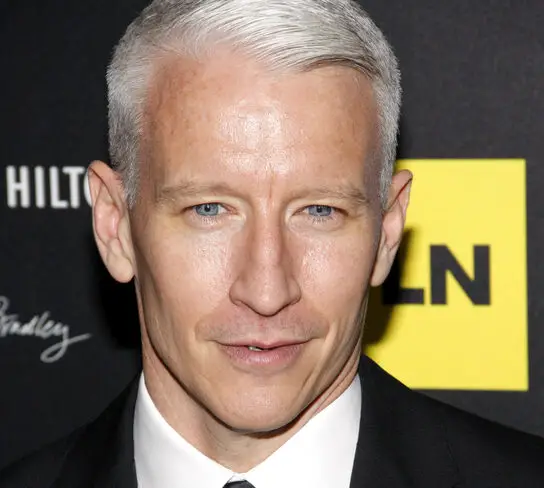
Anderson Cooper sat through talk of granite, limestone and the last piece of steel before telling CNN viewers they did not need to watch the beam go up.
President Donald Trump’s first on-camera remarks after Republicans lost both chambers of Congress came Wednesday, Nov. 4, 2026, from a construction site on the White House grounds, where he took questions outside the unfinished ballroom as the final steel beam was hoisted into place. Democrats had swept the House and the Senate in the Nov. 3 midterms. Cooper and co-anchor Dana Bash covered the impromptu news conference on “Election Day in America Continued,” which aired from 1 to 1:30 p.m. ET.
“And it went on. He talked about the granite. He talked about really every aspect of the construction of the ballroom the day after this massive election loss,” Cooper said after the first clips played.
“This will be something very special. And so we’re putting up the last piece of steel. I thought it would be appropriate to have the media here,” Trump told reporters.
He said the room would be “not only one of the biggest, but it’ll be the most beautiful ballroom, I think, anywhere in the world,” and that people had been trying to get one for 150 years. About 525 people built it, he said. Every worker on the job had signed the beam — steel workers, plumbers, electricians, painters — and he would sign it last.
“Watch the Beam Go Up”
Reporters kept trying to steer him to the election. Asked whether he was worried about impeachment by the incoming Democratic majority, Trump said, “No. Not even a little bit.” Such a move would destroy Democrats, he said, because there would be no reason for it — the country, he said, was more successful than at any time in its history.
“Watch the beam go up,” the president said.
“Wow. I don’t think we need to watch the beam go up,” Cooper said, before suggesting CNN could simply play the beam going up while the panel kept talking.
“And there seems to be a bit of denial among the president that there was a rejection of his agenda,” CNN political analyst Alex Thompson said. Thompson also pointed to a candidate quality problem that ran through the race.
Gobsmacked From Capitol Hill
Bash, anchoring from Capitol Hill, said she did not know why she was gobsmacked to hear the president discussing Corinthian columns, limestone and steel that morning, since everyone has watched him care about exactly this. The repercussions on the Hill, she said, had already begun.
CNN White House correspondent Alayna Treene said the appearance caught the press corps off guard. “We did not expect to hear from President Donald Trump publicly like this,” she said. By her count, Trump talked about the features of the ballroom for roughly 15 to 20 minutes before he touched the election at all. Many people in the building, she said, woke up unhappy, disappointed and frustrated by the results.
Vance Points at the War
Vice President JD Vance broke with the president in an online post that Cooper read on air, blaming the Iran war for the party’s losses and writing that Trump himself had said so the night before. Anyone who wanted to argue that losing the Senate for six years was a price worth paying should make that argument honestly, Vance wrote. The main problem, he added, was not turnout: it was that many people who backed the Trump-Vance ticket in 2024 voted for Democrats in 2026.
Trump’s diagnosis was different. Ahead of the vote he told The Wall Street Journal that the biggest issue facing Republicans was his own absence from the ballot, and after the returns came in he posted on Truth Social that the party would have won had he been on it. He had personally backed candidates who lost.
No Call Yet From Ken Paxton
One of those losses was in Texas, where James Talarico became the first Democrat to win a Texas Senate seat in 38 years. CNN anchor Erin Burnett asked him whether Ken Paxton, the Republican he beat, had called. He hadn’t, Talarico said, but he saw the concession speech, appreciated the kind words and looked forward to representing all 31 million Texans, Paxton included. Elon Musk sank more than $150 million into electing Paxton.
The map around it was just as stark. Texas had not sent a Democrat to the Senate since 1988; Kansas, where pastor Adam Hamilton won, not since 1932. Democrats also took seats in deep-red South Carolina and in Maine, unseating Susan Collins after five terms. They needed four flips to take the chamber and got seven, netting 54 seats. In the House, CNN projected at least 232 Democratic seats — well past the 218 needed — with 64 races still in play.
Two Senate races remained too early to call during the broadcast. In Mississippi, dozens of votes separated the candidates. In Alaska, where correspondent Kyung Lah was reporting from Anchorage, Republican Sen. Dan Sullivan was locked in a close contest with Democrat Mary Peltola.
Cooper had already answered the president’s theory of the defeat. Trump, he said, “couldn’t translate the love in the rallies he had to the candidates,” candidates the anchor said the president “largely forced down the throats of voters.”