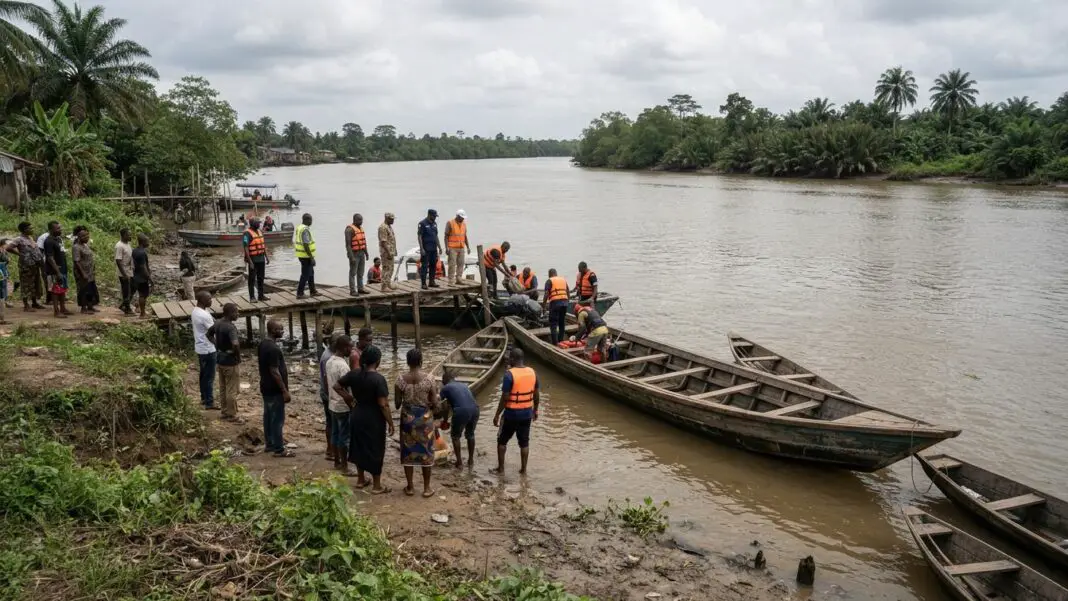
A boat carrying mourners to a burial in Bayelsa State, Nigeria, pushed off with more than 500 people aboard — more than twice the number it was built to hold.
Assistant Inspector-General of Police for Zone 16 Regina Udoette put the confirmed death toll at 32 on Monday, Nov. 23, 2026, during an inspection of the Ayama-Ijaw waterside, after the vessel capsized Friday, Nov. 20, in Nigeria’s South South region.
Udoette disclosed the same day that the boat was carrying more than 500 passengers despite a 200-person capacity. Bayelsa Commissioner of Police Saka Ajao Adewale confirmed on Nov. 23 that rescuers had recovered 32 bodies.
The mourners were traveling from Ayama to Ukubie for a burial when the boat went over at the river junction between the Oweikorogha and Otuan communities, in the Southern Ijaw district. The National Emergency Management Agency (NEMA) had rescued 50 people by Nov. 23. Gov. Douye Diri said on Nov. 22 that more than 51 survivors had been recorded, that the capsized boat had still not been retrieved and that the exact casualty figure could only be established after its recovery, as some bodies might be trapped inside. He said the state is covering survivors’ medical bills and feeding.
A Plea to Steer Ashore
Preliminary reports point to a mechanical problem on the boat, police spokesman Musa Mohammed said. Passengers asked the operator to steer toward land, and the boat capsized after his alleged refusal.
The operator fled the scene. Police said the manager of the boat is in custody. Officers coordinated with local divers and other responders, and marine police joined the search at the junction.
Rescuers pulled four bodies from the water on Friday, two of them children. NEMA spokesman Manzo Ezekiel said at least 24 had been recovered by Saturday, Nov. 21, and added in the same statement that search and rescue operations were continuing. He specified no number of missing.
Twenty-four of the rescued sought medical help in the hours after the accident, according to a police figure. Doctors treated 19 of them at a local clinic, and five went to a hospital in Yenagoa, the state capital.
“As I swam, people were dragging me to the bottom, and I bit one woman and saved myself,” survivor Charity Ebikaboaere told a Nigerian broadcaster. Another survivor, Tari Samuel, said his family lost its money, phones and everything else, and that his siblings came out of the water alive.
A Rally Held Without Fanfare
President Bola Tinubu said in a statement issued Saturday by his adviser Bayo Onanuga that those who died did not deserve to die that way. He directed federal disaster response agencies to mount a joint rescue and recovery operation, and ordered that his election rally in Ibadan, Oyo State, on Saturday, Nov. 21, be held without much fanfare in honor of those who died.
Vice President Kashim Shettima led a condolence visit to Bayelsa on Sunday, Nov. 22, and announced that Tinubu had approved 250 million naira (about $184,000) to support the victims’ families.
Shettima said in Yenagoa on Nov. 22 that Tinubu had also directed the Niger Delta Development Commission to procure boats to improve water transportation in riverine communities. He commended Diri for establishing a commission of inquiry into the incident.
No Manifest, No Life Jackets, No Charges
Diri said the boat was not seaworthy and had been loaded at a point the government had not approved. His preliminary findings describe a boat that was overloaded, carried no passenger manifest and had no life jackets on the passengers or the operator.
Police and maritime regulators had published no charges or prosecution details against the boat’s operator or jetty supervisors as of Nov. 25. Because no manifest was kept, authorities have not confirmed how many people remain missing.
The federal government ordered stricter enforcement of safety standards on inland waterways in response to the capsizing. “Overloading, speeding, recklessness and traveling without life jackets must stop. No journey is worth a life,” Bayelsa State Commissioner for Information Ebiuwou Koku-Obiyai said in a statement on Saturday, Nov. 21.
Ezekiel raised concerns about untrained boat operators and about passengers who travel without life jackets because they come from river areas and consider themselves strong swimmers. Knowing the waterways is no substitute for basic safety precautions, he cautioned. Search and recovery work was still underway as of Nov. 23.
In the Niger Delta, the waterways are not an alternative to the road; for communities with limited road access, they are the road, and many Nigerians depend on boats to travel beyond their villages. Boat disasters recur in Nigeria, where enforcement of safety rules is weak and faulty vessels without life jackets still operate, and accident reports return again and again to overloading, poor maintenance and disregard for regulations. More than 50 people died in August when a boat sank in Sokoto State, in the northwest, and at least 26 drowned in January when a boat ferrying passengers from Jigawa to Yobe State capsized.
A Condolence Trip on Kainji Reservoir
In a separate case reported Sept. 4, 2025, at least 60 people died when a boat carrying more than 100 passengers capsized in Nigeria’s north-central Niger State, according to local officials, who said dozens were rescued. The boat left the town of Tungan Sule, in Malale district, about 11 a.m. local time (10:00 GMT), bound for Dugga, a town on Nigeria’s Kainji reservoir, on a trip described as a condolence visit. The Niger State Emergency Management Agency said the vessel struck a submerged tree stump near the Gausawa community in Borgu Local Government Area, and attributed the cause to overloading and the collision. Abdullahi Baba Ara, the agency’s director general and chair of Borgu Local Government Area, said the death toll had risen to 60, that 10 people were found in serious condition and that rescue operations were continuing.