A gunman in military-style fatigues drove into one of Europe’s busiest tourist squares and fired at random from behind the wheel, leaving visitors flat on shop floors and locked in back rooms.
Michał Oksiński, 24, a Polish citizen, died in a hospital Monday, Nov. 9, 2026, after multiple surgeries. Police shot him during the attack on Main Market Square in Krakow, Poland, and he never left the hospital.
The shooting began shortly after 3 p.m. on Saturday, Nov. 7, near Sławkowska Street, on the edge of the square. Oksiński drove into the historic square in Poland’s second-largest city and shot randomly from his car. Four women and two men died and 16 people were wounded, police said. The square is one of Europe’s busiest tourist spots.
Officials counted five dead for several hours. The Malopolska regional government then revised the figure to six in a post on X.
Przemysław Nowak, spokesman for Poland’s National Prosecutor’s Office, said the gunman fired at least several dozen shots. Katarzyna Cisło, a spokesperson for the Krakow police, described military-style fatigues on the attacker and a military-type long gun in his hands. Officers recovered additional firearms and ammunition from his car, and police said he acted alone.
Police said Oksiński was masked, wore a bulletproof vest and used a semi-automatic rifle, and that he left his car at an intersection to shoot at the two officers chasing him. A tram at nearby All Saints’ Square took shots fired from the moving car, and a window in the driver’s cab shattered. Neither the driver nor the passengers were hurt.
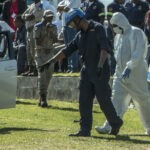
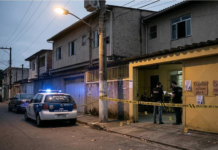
Officers shot and detained him a short distance from the square, near the intersection of Dietla and Stradomska streets. An ambulance took him away.
Interior Minister Marcin Kierwiński said gunfire wounded two police officers, one of them seriously after being hit three times. Mateusz Wierdak, a Krakow surgeon, reached that officer at the scene and stopped the bleeding in his chest. Michał Pędziwiatr, a fellow surgeon, said Wierdak worked without gloves or protective gear and that the intervention probably saved the officer’s life.
Both wounded officers have undergone surgery and regained consciousness, a regional government official said at a press conference. The interior ministry said one of them is in serious but stable condition.
Hiding on a Shop Floor
Marie-Ange Collaer, a visitor from Brussels, Belgium, wrote on Facebook that she lay on a shop floor as the shooting unfolded. “We literally ran for our lives and managed to hide from the bullets flying around,” she wrote.
A U.K. resident, Neil Thaxton, wrote that his group took the gunfire for fireworks at first, then saw people start running. Gift shop staff pulled them into a back room, locked the doors and killed the lights.
An elderly woman was pushed behind a flower planter by Magdalena Frączek, a native of Warsaw, Poland, who then covered her with her own body as the gunman passed about a meter behind her. Shrapnel left wounds in six places on her back.
A tourist from Greece, Alexandros Maronitis, said he and his companions watched the shooter being loaded into an ambulance. His group could not get back into their accommodation for five hours.
Gunshot Wounds in the Family Home
Investigators searched the gunman’s family home in Ostrowiec Świętokrzyski, about a two-hour drive northeast of Krakow. They found three more bodies there — his parents, ages 53 and 52, and his sister, all with gunshot wounds.
His sister, Magdalena Oksińska, 21, was a third-year student at the Krakow Academy of Fine Arts. A statement from the academy said its academic community had been painfully wounded. One employee’s sister took two gunshots in the square.
The prosecutor’s office said investigators recovered 11 firearms in total from the square and the family home, and that it is “highly likely” the same person was behind both sets of killings. Regional police said seven of the guns were seized from the flat.
Breivik in the Search History
Kierwiński said there are indications of a fascination with far-right ideology and radical ultranationalist views, findings that still need verification. Opposition Law and Justice (PiS) lawmaker Przemysław Czarnek demanded that Kierwiński explain the claim and warned of political consequences if he had misled the public. Kierwiński has not withdrawn it.
Justice Minister Waldemar Żurek said Tuesday, Nov. 10, that investigators had found “very strong traces of right-wing extremism” in Oksiński’s activity, including searches for websites about Anders Breivik, the Norwegian far-right terrorist who killed 77 people in 2011.
An Interior Ministry spokesperson said experts are examining emblems on the gunman’s clothing. Oksiński had held firearms permits for a rifle and a pistol since March, prosecutors said. He trained at a shooting club with his father, had not come to the attention of police before the attack and had never served in the military.
Prosecutors opened a terrorism investigation. Defense Minister Władysław Kosiniak-Kamysz described the shooting as an act of terror, and Prime Minister Donald Tusk said on social media that police are examining the background and all the circumstances. Tusk traveled to Krakow from Warsaw. Mass shootings are rare in Poland, where exceptionally tight gun laws govern a population of 38 million in a country that belongs to the EU and NATO.
Kierwiński said five foreigners were among the wounded — one each from Austria, Britain, Germany, Portugal and Russia. Krzysztof Klęczar, a regional official, said the six killed in the square included a 32-year-old British man and a 51-year-old Austrian woman. Police identified three of the other victims as Polish women.
A U.S. State Department spokesperson said the department had no awareness of any U.S. citizens being harmed. Americans were told by the U.S. Consulate to stay away from the area and maintain a high level of vigilance.
A spokesman for UN Secretary-General Antonio Guterres said in a statement Nov. 8 that Guterres condemned the shootings, expressing “his deepest condolences to the families of the victims, as well as to the Government and people of Poland.”
The Square Will Belong to Us
Mayor Łukasz Gibała declared four days of mourning in Krakow, running from Sunday, Nov. 8, through Wednesday, Nov. 11. The city canceled city-organized events and lowered flags to half-staff or draped them in black. Poland observed two days of national mourning, formally set in motion by President Karol Nawrocki.
Mourners piled candles and flowers near the square on Sunday, Nov. 8, within sight of bullet holes in the glass enclosure of a restaurant terrace. The hourly trumpet call from St Mary’s Church stayed silent for 12 hours after the attack, the first such interruption since 1939. The square and the surrounding streets reopened late on Nov. 8.
Thousands marched in silence through the city on Monday night, Nov. 9. Among them was Tusk, who wrote on X that Poles had come together to pay tribute to the victims of the Nov. 7 attack. Nawrocki joined the same march and laid a lantern alongside Tusk at the memorial, a rare shared moment for a conservative ally of U.S. President Donald Trump who has been locked in a bitter spat with the pro-Europe prime minister.
Gibała has vowed that Krakow will stay open to visitors. “The square will belong to us again,” he said in a video posted to X.