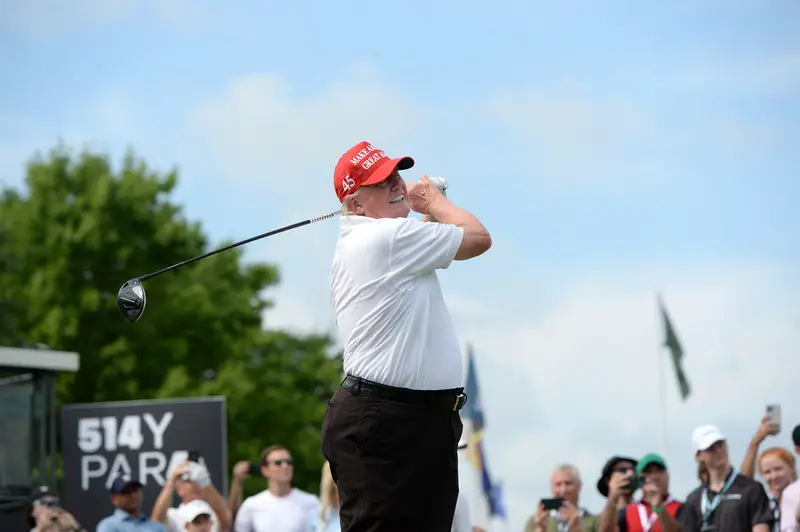
President Trump stumbled into a fresh political storm on Wednesday, May 27, 2026, after appearing to confuse Iran with Venezuela during a live-broadcast cabinet meeting at the Oval Office, an unscripted moment that reignited public anxiety over the almost 80-year-old president’s cognitive health.
The slip came as Trump discussed the ongoing U.S. conflict with Iran and the absence of a peace deal. “I don’t go into war, I go into conflict,” he told the room, before pivoting into territory that left viewers bewildered.
“Despite the conflict with Venezuela who no longer has a navy, no longer has an air force, no longer has a lot of people that were leading the country into very bad places,” Trump continued, plainly referring to the destruction the United States has inflicted on Iran — destruction he has repeatedly boasted about in recent weeks.
He did not flinch. He did not correct himself. Moments later, he resumed referring to Iran by name, telling reporters that Secretary of Defense Pete Hegseth would “finish them off.” Within hours, the clip had ricocheted across social platforms, with users branding the exchange “alarming” and pointing to it as the latest entry in a growing dossier of public stumbles.
A Pattern, Not an Isolated Slip
The Venezuela mix-up arrived only a week after Trump conflated Iran with Taiwan during another public appearance. He has also been caught dozing off during cabinet meetings on several occasions, prompting medical commentators to question whether chronic sleep deprivation may be compounding age-related decline.
On Tuesday, April 26, 2026, Trump visited Walter Reed National Military Medical Center for a health check-up — his fourth medical appointment in 13 months. He used Truth Social to declare himself in perfect shape, writing that “Everything checked out PERFECTLY” after what he described as a six-month physical.
That self-assessment has done little to quiet the speculation. Over recent weeks, commentators tracking Trump’s erratic behavior during the U.S. conflict with Iran have floated a range of possible explanations, including malignant narcissism, Alzheimer’s disease and frontotemporal dementia. The frontotemporal dementia theory, in particular, has gained traction among Trump critics, who argue it accounts for his escalating threats, profanities and tendency to ramble.
What the Science Actually Says
Frontotemporal dementia affects judgment, empathy, language skills and impulse control. Unlike Alzheimer’s, it rarely begins with memory loss. Its core features include disinhibition, apathy, loss of empathy, compulsive behavior, hyperorality and loss of executive functions — the cognitive abilities underpinning planning and decision-making.
The condition is rare. Each year, just two or three out of 100,000 people are diagnosed worldwide, with roughly nine out of 100,000 living with it at any time. Clinicians caution against diagnosing any public figure from afar, noting that even a “possible” diagnosis requires three of six core features, neurological examination, brain imaging, and clear evidence of progression.
Still, the speculation has not abated. More than three thousand medical professionals have signed a petition warning about Trump’s mental state.
Experts Weigh in on the Speech Patterns
Harry Segal, a senior lecturer in Cornell’s Psychology Department and at Weill Cornell Medicine, has tracked what he calls accelerating decline. He pointed to Trump’s answer about childcare to the Economic Club of New York that was so incoherent even his supporters voiced concern, and to a rally last year when the president got cognitively lost talking about the “eight circles” that Joe Biden had supposedly filled with journalists — a reference no staffer could explain.
Segal also flagged Trump’s impromptu DJ set during a town hall event in Philadelphia in October 2024, when the candidate swayed silently to music on stage for nearly 40 minutes. He called the episode another sign of accelerating cognitive decline, citing Trump’s refusal of a second presidential debate and his abrupt cancellation of a “60 Minutes” interview as evidence the president is avoiding settings that require coherent, spontaneous responses.
Clinical psychologist Dr. Ben Michaelis, who analyzed Trump’s speech complexity for STAT News in 2019, told PBS NewsHour on October 24, 2024, that the shift since 2016 is less about vocabulary than about thought structure — Trump is moving away from linearity toward tangential, then circumstantial speech. Dr. John Gartner, founder of Duty to Warn and a contributor to Bandy X. Lee’s anthology “The Dangerous Case of Donald Trump,” has been more blunt. In an April 1, 2025 interview with Diana Hembree, Gartner argued that mainstream press coverage has “sanewashed” the president’s condition.
The White House Pushes Back
Not every specialist shares the alarm. Dr. Jamie Reilly sees Trump’s speech patterns and behavior differently, arguing they do not necessarily suggest cognitive decline. Trump himself has consistently dismissed the speculation, framing his digressions — Venezuelans and mental hospitals, sharks and batteries, the late, great Hannibal Lecter — as a deliberate weaving together of disparate topics that his supporters understand.
Yet the political stakes keep rising. Vice President JD Vance has remained largely quiet on the matter, even as the cabinet meeting clip continues to circulate. With no peace deal with Iran in sight, and Trump’s confusion playing out on a live feed from the Oval Office itself, the question of who, exactly, is steering U.S. foreign policy at its most volatile moment has moved from cable-news commentary to the center of the national conversation.