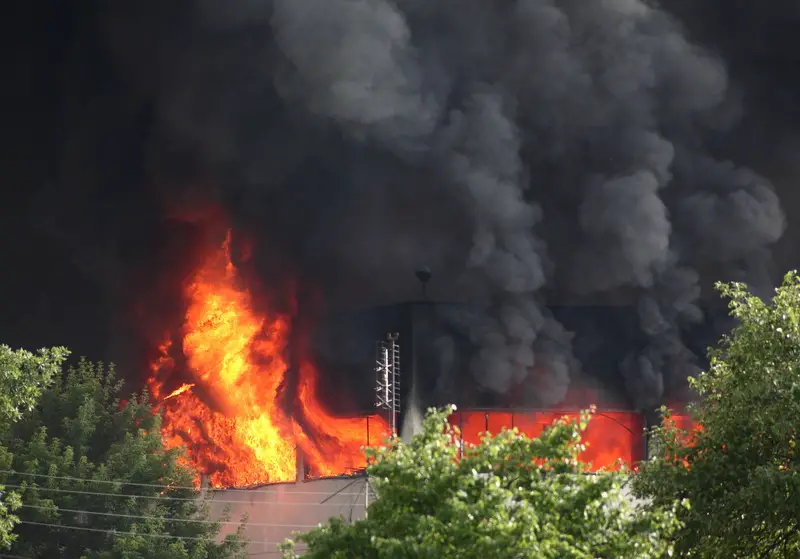
A fire ripped through a three-story commercial building in Lucknow, India, on Monday, June 22, 2026, killing at least 14 people — most of them students — and sending terrified occupants leaping from upper-floor windows as thick smoke swallowed the stairwells and hallways below.
The blaze broke out in the Aliganj neighborhood, a residential district of Uttar Pradesh’s capital city, in a building that served a strikingly varied range of tenants. A pet shop and veterinary clinic occupied the lower floors; above them sat a coaching center for college students, a library, a computer graphics section, and an animation studio. The fire ignited on the middle floor before climbing to the levels above, trapping those who had no clear way out.
Uttar Pradesh Deputy Chief Minister Brajesh Pathak confirmed the death toll, saying 14 bodies had been recovered at the site. Four people sustained injuries in the incident. It remained unclear whether all of the dead were students, though officials acknowledged the majority were.
Students Jumped to Escape the Flames
The desperation of those trapped inside played out in harrowing detail across social media. Witnesses told reporters that multiple students, most aged between 16 and 18, hurled themselves from the upper level of the building onto the street below rather than face the advancing fire. One video that circulated widely appeared to show a man tumbling from an upper floor as he tried to escape; local media later reported he survived and was taken to a hospital. Other footage captured people scrambling through shattered windows, searching for any handhold that might slow their fall.
Mohammad Asin, an employee at the animation studio, described the terrifying speed with which conditions deteriorated. Workers had just come back from lunch when someone raised the alarm. “At first we thought it was a small fire,” Asin said. “By the time we tried to leave, smoke had filled the rooms and passageways.”
Smoke Forced Firefighters Through the Rear Wall
Dense smoke made a conventional rescue approach impossible. Firefighters ultimately broke through the rear wall of the building to gain entry, a measure that reflected how completely the interior had been compromised. Once inside, crews deployed exhaust fans to clear the toxic haze while emergency workers moved methodically through rooms and washrooms, searching for anyone still alive. Indian television broadcast images of orange flames tearing through the front facade of the building as the operation unfolded.
The cause of the fire was not immediately known. Investigators had not publicly identified a specific origin point as of Monday, though electrical short circuits — frequently the result of deteriorating wiring — rank among the leading causes of fatal fires across India. Building safety regulations are routinely ignored in the country, and many commercial structures lack adequate firefighting equipment, conditions that transform containable incidents into mass-casualty events.
A Pattern of Deadly Fires Across India
The Lucknow disaster arrives at a particularly grim moment in India’s recent fire history. The blaze came about two weeks after a hotel fire in New Delhi left 21 people dead. Before that, in March, 10 patients in critical condition lost their lives when fire engulfed a state-operated medical facility in the country’s eastern region. In 2019, 43 factory workers perished when flames swept through a building in Delhi’s old quarter while they slept inside.
Prime Minister Narendra Modi said through his office that he was anguished by the loss of life. His office announced financial relief of more than $2,300 for each affected family. Deputy Chief Minister Pathak, who visited the scene, warned that accountability would follow. “Stern action will be taken against those found responsible,” he said.
Calls for Accountability After the Tragedy
The broader question hanging over the rubble in Aliganj is a familiar one in India: how a building hosting dozens of students, workers, and visitors could leave so little margin for survival once a fire took hold. The coaching center above the pet shop, the animation studio beside the library, the winding passageways now blackened with soot — each detail points toward the kind of mixed-use, densely occupied structure that safety inspectors and fire codes are meant to scrutinize closely, and that too often escapes meaningful review until disaster forces the issue.
Authorities said the investigation into the fire’s origin was ongoing. Families of the victims awaited word on the official findings, while the survivors who leaped from windows and the man who fell from an upper floor and lived face an uncertain recovery in hospitals across the city.