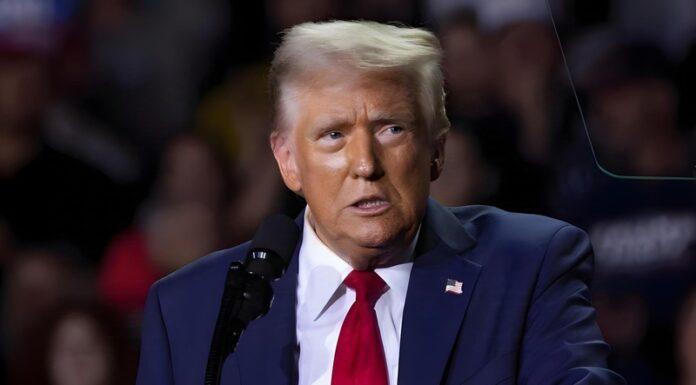
A bombshell book published on June 23, 2026, by New York Times reporters is sending shockwaves through Washington, pulling back the curtain on President Donald Trump’s health, his war with Iran and the dangerously small circle of advisers who made decisions affecting the entire world.
“Regime Change: Inside the Imperial Presidency of Donald Trump,” co-authored by Maggie Haberman and Jonathan Swan, was published on June 23, 2026, and reveals an administration that has perfected the art of concealment. The two journalists describe the effort in stark terms, saying they “nearly killed ourselves” to bring the story to light. The book sold 150,000 copies on its first day of release, prompting Simon & Schuster to order an additional 150,000 copies to meet demand.
A Presidency Shrouded in Secrecy
The book presents a detailed examination of an 80-year-old president whose medical status remains largely concealed from Americans. According to Haberman, observers have noted Trump’s slurred speech, unsteady movement on stairs, visible bruising on his hands and swelling around his ankles, and his falling asleep in meetings. The White House has confirmed Trump’s consultations with 22 specialists at Walter Reed but refuses to name them. The last credible health disclosure came in 2018, Haberman reported, and Trump’s serious 2020 COVID-19 infection was never honestly revealed to the public.
“His health has always been a very specific lockbox for him, going back decades,” Haberman said, noting that Trump views sickness as a sign of weakness and his staff respects this concern. Additional health revelations seem doubtful before his term concludes, she observed.
The book also discloses that Trump’s hearing has deteriorated to the point where joint press conferences with visiting heads of state, traditionally held in the larger East Room, are now routinely moved to the more intimate Oval Office. Behind closed doors, staff deal with a different kind of disorder: Trump has been found in the Oval Office attempting to affix gold decorative appliques to the marble fireplace mantel himself, and he discards White House sterling silver utensils. His private quarters are often strewn with empty potato chip bags, Starbucks wrappers, and ice cream cartons.
The Iran War and Its Hidden Decision-Makers
A significant section of the book centers on Trump’s war with Iran, a 108-day conflict that cost an estimated $113 billion, killed 13 Americans, and wounded hundreds more. The closure of the Strait of Hormuz sent global oil prices skyrocketing and triggered widespread supply shortages. A memorandum of understanding with Iran was signed on June 17, drawing the conflict to a close.
The book reconstructs the final White House Situation Room meeting before the U.S.-Israeli bombing of Iran began, held on February 26. Vice President JD Vance attended along with Trump’s top advisers, including Chief of Staff Susie Wiles, CIA Director John Ratcliffe, White House Counsel David Warrington, Communications Director Steven Cheung, Press Secretary Karoline Leavitt, Defense Secretary Pete Hegseth, Secretary of State Marco Rubio, and Chairman of the Joint Chiefs of Staff Gen. Dan Caine.
Swan told MS NOW’s Lawrence O’Donnell that the war revealed just how concentrated power has become. “Take the war, for example,” Swan said. “You have a tiny group of people that are running this country, five or six people and Donald Trump.” He added that Treasury Secretary Scott Bessent and Energy Secretary Chris Wright, the two officials who would have had to manage the fallout from a catastrophic oil supply disruption, were not in the room and were not part of the meetings. Director of National Intelligence Tulsi Gabbard, who has since been replaced by acting director Bill Pulte, was also excluded.
Loyalty, January 6, and the Epstein Fallout
The book chronicles how Trump built his second administration around a single loyalty test: January 6. Anyone seeking proximity to power had to affirm that the Capitol rioters were patriots later mistreated by the Biden administration, a demand that required prospective staffers to publicly abandon their integrity before walking through the door.
The result is an administration that operates as a feedback loop of sycophancy, with rare exceptions. Treasury Secretary Scott Bessent urged Trump to publicly commit to keeping Federal Reserve Chair Jerome Powell in place to calm rattled markets. Then-Deputy Attorney General Todd Blanche told Trump there was no legal basis to indict New York Attorney General Letitia James, a warning Trump ignored. The indictment proceeded and quickly collapsed. The book reveals that Situation Room discussions were consumed at times by efforts to manage the scandal surrounding Jeffrey Epstein, and that some of the book’s reporting drew on secretly recorded and leaked audio of those meetings.
In the book’s concluding interview with Trump, the president recounted how someone he described as “a historian,” who turned out to be golfer Gary Player’s caddie, drew favorable comparisons between Trump and a series of historical military conquerors and dictators spanning from antiquity through the 20th century. Trump relayed the comparison approvingly.
What the Book Means for Trump’s Second Term
What emerges is not simply a portrait of a chaotic president but something more unsettling: an administration engineered to amplify Trump’s worst instincts, with aides who either share those instincts or have learned that dissent is pointless. The sending of National Guard troops into American cities to enforce immigration law and Trump’s suggestion that the United States take possession of Gaza complete a picture of a presidency operating with few institutional guardrails. According to the book, Trump’s aides largely supported deploying the National Guard without objection.
For an administration that has repeatedly claimed to be the most transparent in American history, the picture Haberman and Swan paint is one of extraordinary opacity. Swan explained that despite Trump’s claims, this White House is “incredibly good at keeping secrets.” He told MS NOW there’s a reason inside-the-room reporting has been scarce: “It’s because it’s really **** hard. This is a tiny group of people running the government.”