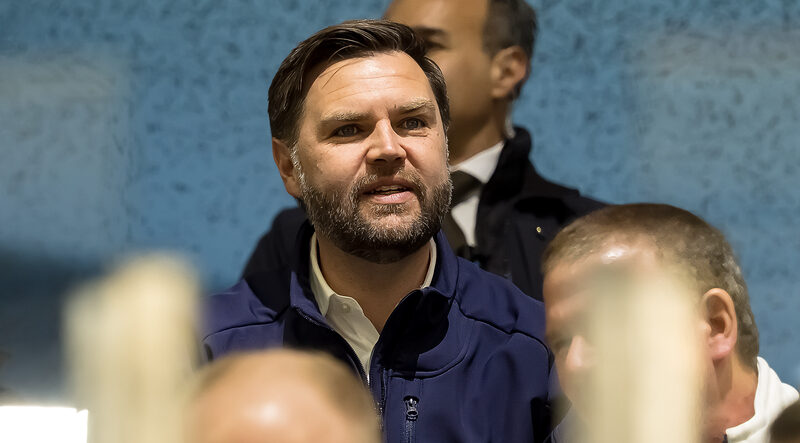
Vice President JD Vance found himself at the center of two separate storms of online criticism in mid-June — one sparked by a seemingly innocent anniversary message to his wife, and another revived by remarks he made about her Hindu faith at a high-profile conservative event last year.
The Anniversary Post That Raised Eyebrows
On June 14, Vance marked 12 years of marriage to Usha Vance with a celebratory post on X. The message was warm and upbeat — but a single phrase quickly drew scrutiny from critics across the political spectrum. “Happy Anniversary to our lovely Second Lady. 12 years and almost 4 kids later, and we’re still going strong. Love you Usha!” Vance wrote.
The sticking point was the phrase “almost 4 kids,” which referenced Usha Vance’s current pregnancy with the couple’s fourth child, a boy due in July. Critics argued the language sat uneasily with Vance’s anti-abortion record, which has included a 2022 statement that he would like abortion to be illegal nationally and past criticism of rape and incest exceptions — positions he has since moderated to align with President Donald Trump’s states-should-decide framing.
The reaction was swift and pointed. “Bro forgot that he’s supposed to believe life starts at conception,” one commenter wrote. Many wondered whether Vance’s informal phrasing inadvertently suggested an unborn baby isn’t yet a person — a notion that would clash with his stated beliefs.
Faith Comments Return to the Spotlight
The anniversary backlash reignited attention on a months-old controversy. At an October 2025 Turning Point USA event at the University of Mississippi, Vance had told an audience he estimated at around 10,000 people that he hoped Usha, a Hindu, would one day convert to Christianity — the faith he embraced when he became a Catholic in 2019. “Do I hope that eventually she is somehow moved by what I was moved by in church? Yeah, honestly, I do wish that,” he said at the time, adding that “God says everybody has free will, and so that doesn’t cause a problem for me.”
The remarks drew sharp criticism, including from the Hindu American Foundation and Indian American Rep. Raja Krishnamoorthi, who said it was troubling to raise the subject at a time when Hindu and Indian American communities were facing rising prejudice. By June 2026, those comments were back in circulation as Vance promoted his memoir, “Communion: Finding My Way Back to Faith,” which chronicles his conversion to Catholicism.
Vance Softens His Stance
In a May 26 interview with NBC News tied to the book’s release, Vance reframed his earlier remarks, describing his hope for Usha’s conversion as a “pretty simple observation” rooted in his Christian faith. He acknowledged she is unlikely to convert. “And I’m OK with that,” Vance said. “What I’d say about Usha is that one of the things I love about her is that she’s brilliant, but she’s also fiercely independent.” In defending the original comments, he had earlier written on X that his wife “is not a Christian and has no plans to convert, but like many people in an interfaith marriage — or any interfaith relationship — I hope she may one day see things as I do.”
Usha Speaks — and the Internet Listens
The faith debate took another turn when a clip from the couple’s June 14 CBS News interview — conducted with “CBS Sunday Morning” journalist Robert Costa as part of the memoir promotion — went viral on June 23. Asked how her own faith had evolved alongside her husband’s conversion to Catholicism, Usha Vance said: “I grew up in a household — a Hindu household, a very stable household — and I’ve not felt the same sense of need to seek something different that he has.” The remark spread rapidly on social media, with many interpreting it as an implicit contrast with Vance’s well-documented upbringing — marked by an absent father and a mother who struggled with addiction — which he has cited as a driving force behind his own spiritual search.
Usha Vance pushed back on the idea that her words were a swipe, telling CBS that her husband’s comments had been “misunderstood.” As she put it, “part of his faith is wanting to spread his faith. But it’s not like he’s proselytizing to me every day.”
A Rough Stretch for the Vice President
Taken together, the two flashpoints — the anniversary post and the resurfaced faith comments — painted a complicated picture for Vance, who has positioned himself as a defender of both family values and religious conviction. Vance has said he was surprised by the backlash, arguing it is “common sense” to want the people you love to share your faith. Critics countered that the reaction had less to do with his beliefs than with questions about consistency and respect — and, for now, what began as a wedding anniversary tribute has become another flashpoint over Vance’s public messaging and religious views.