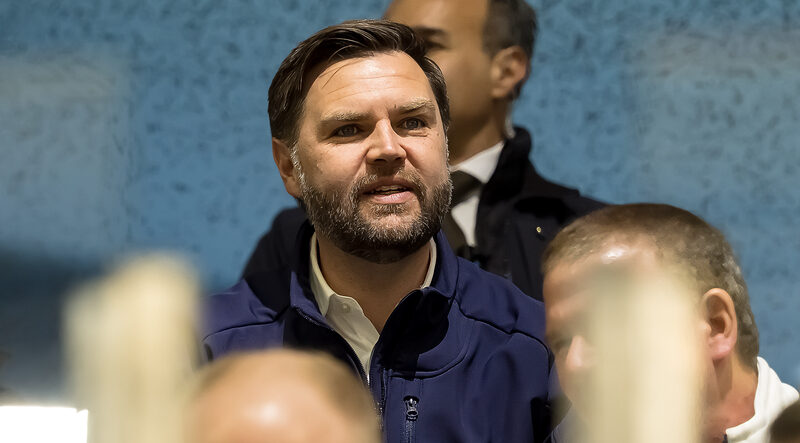
Vice President JD Vance traveled to Switzerland on Sunday, June 21, 2026, hoping to make diplomatic history at the Lake Lucerne Summit at the Bürgenstock resort — but the day got off to a rocky start when Qatar’s prime minister appeared to look right past him in the greeting line.
Vance, 41, was accompanied by Steve Witkoff and Jared Kushner for the high-stakes negotiations, which brought together the United States and Iran at a summit mediated by Pakistan and attended by Qatar as an interested party. The gathering had been eagerly anticipated as a potential turning point in U.S.-Iran relations, and Vance had positioned himself at the forefront of the American push for a peaceful resolution.
The Snub Seen Around the World
Things took an uncomfortable turn almost immediately upon the arrival of Sheikh Mohammed bin Abdulrahman Al Thani, who serves as Qatar’s prime minister. With Vance standing at the front of the receiving line, Sheikh Mohammed walked past the vice president and appeared to bypass him entirely, offering warm embraces and greetings to the Iranian and Pakistani diplomats instead. Video footage of the moment showed Vance appearing to reach toward Sheikh Mohammed in an effort to catch his attention, only to receive what looked like a fleeting acknowledgment before the Qatari leader moved on.
The clip quickly made the rounds online, with many commenters concluding that the slight was deliberate — though diplomatic body language is notoriously difficult to read with certainty. Either way, the optics were less than ideal for a vice president arriving to champion American diplomacy on the world stage.
The White House pushed back hard on that interpretation. A U.S. official dismissed the snub narrative as “complete nonsense,” telling Fox News that the delegation “had just spent hours with the Qataris, and there was no need to re-greet someone after having just spent hours with him.” The official’s point — that the moment captured on video was a passed-over re-greeting rather than a cold shoulder — was bolstered by Sheikh Mohammed himself, who posted warmly on X that same day: “Live from Lucerne, work continues with @VP & @jaredkushner,” alongside an image of Vance and Kushner working through late-night talks. By Sunday night, the two delegations were reportedly still negotiating past 1 a.m., complicating the read that the Qatari leader had frozen Vance out.
Iran’s Delegation Keeps Its Distance
The awkward dynamic did not end with Sheikh Mohammed. Iranian Foreign Minister Abbas Araghchi also kept Vance at arm’s length throughout the day. While the U.S. delegation and Qatari ministers stepped forward to address the press following the meeting, Araghchi remained in the room but declined to participate in the joint statements or appear alongside Vance in a photo. Despite the chilly reception from Iran’s side, Vance publicly described the summit’s developments as “historic.”
The Iranian delegation’s response was restrained, though some observers viewed their mere presence at the talks as a step forward despite the absence of any visible displays of cordiality.
A Diplomatic Stumble Before the Summit Even Began
Vance’s day at Lake Lucerne was made more complicated by a misstep that had occurred before he even set foot in the summit room. During a Fox News appearance, when he was asked about the Strait of Hormuz, Vance said he was not seeing evidence that the Iranians were still closing down the strait, and that it would take time to clear the mines. The problem: Iranian naval forces from the Revolutionary Guard shut down the waterway even as Vance was making those remarks on television.
The timing was notable, to say the least, and it added to what had already been a bumpy lead-up to the negotiations. Vance had also canceled an earlier planned trip to Switzerland — a postponed journey that drew attention when it was reported on June 19, 2026, coming shortly after President Donald Trump signed a preliminary deal that could help end the war.
Trump’s Father’s Day Threats Undercut the Peace Pitch
As if the optics in Switzerland were not complicated enough, Vance’s message of diplomacy was running directly counter to what President Trump was broadcasting back home on Father’s Day. While the vice president advocated for peace talks as the path forward with Iran, Trump called into Fox News in what the network described as an irate phone call — with hosts surmising that he was frustrated by the lack of visible progress. Trump threatened to seize control of the Strait and vowed to use overwhelming military force against Iran if necessary. He told Fox News’ Trey Yingst he warned Iranian officials overnight, “You close it and you won’t have a country… You won’t even make it back to your ****ing country,” and “We may take over the strait, if we have to. If they don’t make a deal, we’ll collect tolls. I’ll blow the **** out of them.”
The contrast between the two men’s tones — Vance pushing diplomacy from the shores of Lake Lucerne while Trump issued vulgar warnings from home — put the United States in the unusual position of apparently speaking out of both sides of its mouth at a delicate negotiating moment. Whether that mixed messaging affected the summit’s atmosphere is hard to say, but it certainly did not make Vance’s already awkward Sunday any easier.