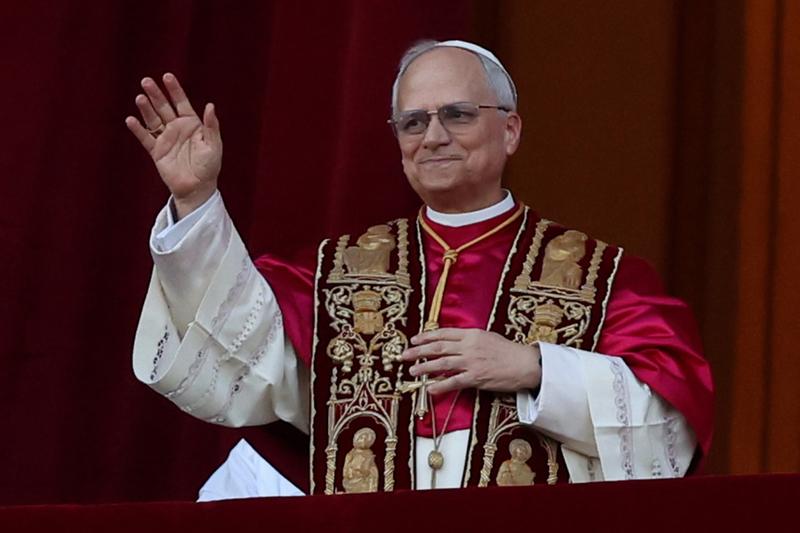
Pope Leo XIV, the first American to lead the Catholic Church, delivered a historic apology on May 25, 2026, when he released his first encyclical formally apologizing for the role medieval popes played in authorizing the enslavement of millions. The 70-year-old pontiff embedded the apology within a broader warning about artificial intelligence and what he describes as “new forms of slavery” emerging from digital technologies and the digital economy.
“It is impossible not to feel deep sorrow when contemplating the immense suffering and humiliation endured by so many in stark contrast to their immeasurable dignity as persons infinitely loved by the Lord,” Leo wrote, calling the Vatican’s record a “wound in Christian memory.” He added: “For this, in the name of the church, I sincerely ask for pardon.”
The encyclical, titled “Magnifica Humanitas,” or “Magnificent Humanity,” carries the subtitle “On Safeguarding the Human Person in the Time of Artificial Intelligence.” Vatican Secretary of State Cardinal Pietro Parolin presented the document alongside theologian Leocadie Lushombo, framing the apology not as an isolated gesture but as doctrinal teaching binding on the world’s roughly 1.4 billion Catholics.
Five Centuries of Papal Bulls
For generations, the Vatican insisted it had always upheld the dignity of every human being as a child of God. The historical record tells a more damning story. A series of 15th-century papal directives effectively wrote the theological permission slip for European colonization of Africa and the Americas.
Pope Nicholas V issued “Dum Diversas” in 1452, granting Portuguese sovereigns the right “to invade, conquer, fight and subjugate” “Saracens, and pagans, and other infidels, and enemies of the name of Christ” and “to reduce their persons to perpetual slavery.” He followed with “Romanus Pontifex.” Pope Callixtus III reaffirmed the directives in 1456, Pope Sixtus IV expanded them in 1481, and Pope Leo X extended them again in 1514. Together, those bulls form the backbone of what became known as the Doctrine of Discovery, the legal-theological framework that legitimized the colonial-era seizure of land across two continents.
Past pontiffs have expressed regret for the participation of individual Christians in the trade in human beings. None before had publicly admitted — much less expressed regret for — the part popes played in giving European monarchs explicit authority to subdue and enslave “infidels.” Leo did both.
A Personal History Behind the Apology
The apology lands with particular weight given Leo’s own ancestry. The U.S.-born pope’s family tree contains both enslaved people and slave owners, a detail that has shadowed his pontificate since his election. For Black American Catholics, activists and scholars who have spent decades pressing the Holy See to atone for its colonial-era conduct, the encyclical marks a turning point.
Shannen Dee Williams, a historian at the University of Dayton and author of the 2022 book “Subversive Habits,” a history of American Black Catholic nuns, welcomed the encyclical as a “monumental step toward the kind of essential truth-telling and reparation that many Catholics have prayed and worked to witness.” She added that “Black Catholics have waited a long time to hear the Vatican speak honestly about the church’s leading roles in the trans-Atlantic slave trade and chattel slavery — and thus by extension the enduring systems of anti-Black racism in the world today.”
Why AI Sits at the Center
Leo’s decision to bind the slavery apology to a treatise on artificial intelligence is not incidental. The pope argues that the same impulses that produced chattel slavery — the reduction of persons to commodities, the concentration of power, the moral blindness of those who profit — are reasserting themselves through algorithms and digital labor markets.
“This is why the memory of past complicity and blindness in the face of the injustice of slavery becomes a call to vigilance,” Leo wrote. “What we have learned, must be translated into discernment and responsibility in the present.”
The encyclical concedes that AI “can be a valuable tool” but warns that adopting it “rapidly and uncritically” exposes humanity to risks ranging from environmental damage to the warping of public discourse by “algorithms that … can magnify polarization and resentment.” The pope is most uncompromising on the battlefield, declaring that “it is not permissible to entrust lethal or otherwise irreversible decisions” to machines — a pointed observation given the Pentagon’s expanded use of AI tools.
“No algorithm can make war morally acceptable,” Leo wrote, arguing that automated systems “can only bring about conflict more quickly and render it more impersonal.”
He calls for “robust legal frameworks,” “independent oversight,” informed users and a political system that does not abdicate its responsibility, warning of advancements “concentrating wealth and power in the hands of a select few.” His prescription is blunt: “What is needed is a more active political involvement that is capable of slowing things down when everything is accelerating.”
By yoking that warning to an unprecedented reckoning with the church’s own past, Leo has signaled that his pontificate intends to measure the future against the failures of the past — and to name both without flinching.