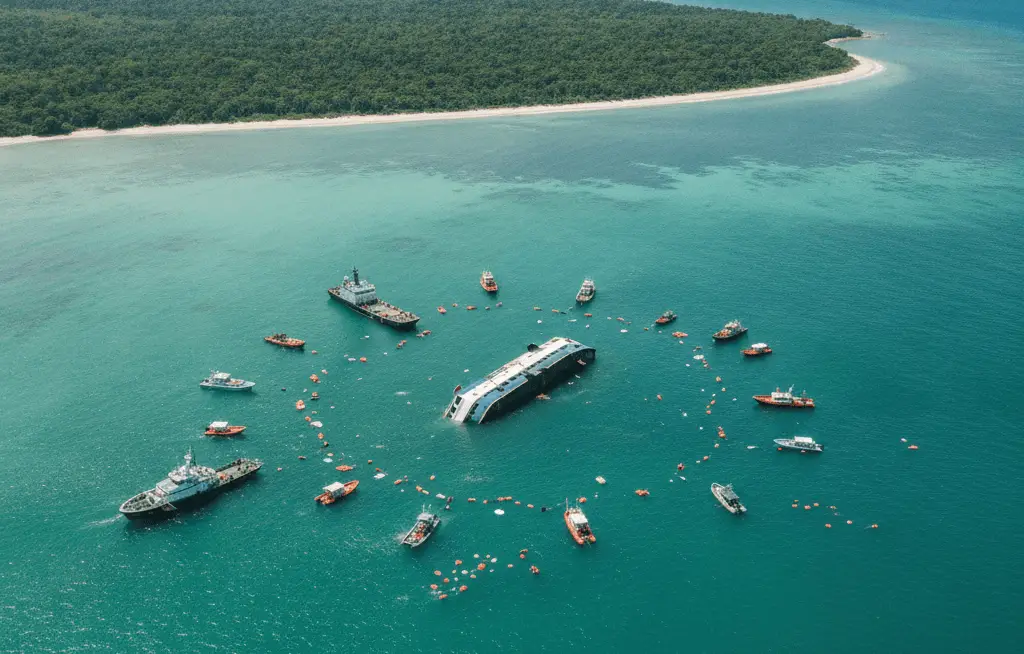
A total of 76 people survived after a passenger ferry went down in Guyanese waters on the night of July 18, authorities confirmed July 22. By the latest count, 73 bodies had been recovered — 65 of them identified — leaving dozens of people still unaccounted for. Prime Minister Mark Phillips placed the total number aboard the MV Barima at 179—significantly higher than official records indicated.
The manifest had documented only 133 individuals: 116 passengers and 17 crew. That gap between documented and actual occupancy has emerged as a key focus for investigators examining the catastrophe.
Officials revised fatality figures upward on July 21, jumping from 41 to 53. Prime Minister Mark Phillips announced a further increase to 65 deaths the following day. Recovery efforts involved 19 ships and three aircraft by July 23, supplemented by diving teams from Brazil, Trinidad and Tobago, and France, as well as local specialists. Private vessels played a vital role, retrieving survivors from the ocean.
Investigation and Arrests
Authorities have launched an inquiry into what triggered the sinking. Police detained the captain along with at least one other crew member after both tested positive for marijuana. Public Works Minister Juan Edghill expressed anger at a July 19 press conference, highlighting the government’s zero-tolerance stance on impaired operation and calling the captain’s drug test outcome especially troubling.
Phillips warned that “where negligence, misconduct or criminal wrongdoing is established, those responsible will face the full force of the law.”
Investigators are scrutinizing both the incomplete passenger roster and potential substance use among the crew as contributing elements.
A Survivor’s Account
Elena Moonsammy, who survived the disaster, described to Kiskadee Watch how a large wave struck the vessel, causing it to tilt sharply. Water flooded in within seconds, she recounted.
Moonsammy clung to a box floating amid wreckage. She had gripped her two-year-old child’s hand but lost hold during the turmoil. Despite that, she pulled another woman to safety, urging her to grab the same floating box.
French Guiana deployed resources including 12 divers, two medics, and a mechanic to aid the operation, with the French army coordinating the assistance.
A Crowded, Aging Vessel
The ship left Georgetown, Guyana’s capital, Saturday afternoon bound for Port Kaituma, a gold mining settlement located inland in the Essequibo region. Measuring 40 meters (131 feet), the vessel dated to 1939 based on VesselFinder’s shipping database—placing it at 87 years old when it capsized.
Vessels on that route typically navigate ocean waters before entering a river leading to Port Kaituma, situated within the country’s thick rainforest in the north. The emergency call came through at 11:01 p.m. local time (3:01 a.m. GMT the following day, July 19), prompting a response combining government resources and private watercraft.
Public Works Minister Juan Edghill labeled the incident Guyana’s worst maritime disaster in recent decades, adding that officials were pursuing every measure to find those still missing. Rescuers brought at least 15 children ashore.
The ship was traveling toward Essequibo, a region central to an ongoing territorial conflict between Guyana and Venezuela over oil-rich land. The small English-speaking nation in northeastern South America has repeatedly disputed its larger neighbor’s claims to Essequibo.
Relatives and friends of those missing have gathered near the coast, waiting anxiously for news. With 73 bodies recovered — 65 identified — and 76 rescued from an estimated 179 on board, dozens remain unaccounted for—and hopes for locating survivors diminish with each passing day.
No further bodies have been recovered since July 24, and officials say conditions inside the wreck have made continued diving too dangerous.