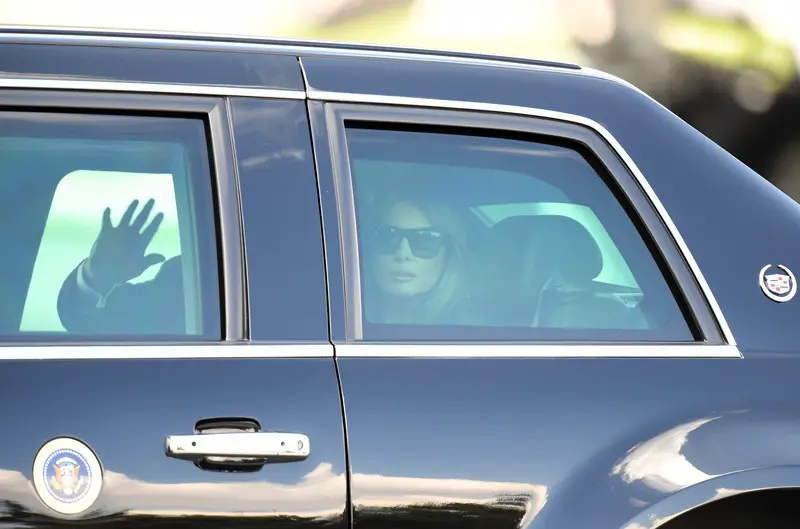
First Lady Melania Trump did not attend the Friday rescheduled White House Correspondents’ Association Dinner, where her husband spoke, becoming the most prominent of several MAGA no-shows at an event that unfolded under extraordinary security after an assassination attempt against President Donald Trump during the last event.
The dinner, held Friday, July 24, 2026, was a do-over of the April gathering that ended in chaos when an armed suspect stormed the Washington Hilton. That night, the president, Vice President JD Vance, and members of the Cabinet were hustled out of the ballroom as a gunman opened fire in a nearby hallway, and journalists and other guests dove for cover beneath their tables.
Cole Tomas Allen, the alleged shooter, never made it into the room. But he came perilously close before he was brought down. Allen, accused of rushing past Secret Service agents with loaded firearms and knives, has pleaded not guilty to four charges.
A Smaller Room, a Longer Guest List of Absences
The rescheduled event moved to the Waldorf Astoria in Washington, formerly the Trump International Hotel, into a smaller ballroom that seats roughly 680 people — a fraction of the 2,600 guests who packed the April dinner. The intimacy was by design, part of a broader effort to lock down an event that turned into a national security scare.
Melania Trump was not the only high-profile absence. Vance and Secretary of State Marco Rubio, both present in April, also skipped Friday’s dinner. A White House spokesperson said their absences were due to prior commitments, though the spokesperson did not specify what those engagements were. Usha Vance, the vice president’s wife, welcomed her fourth child, Alec, last Sunday, July 19.
The absence was notable given the first lady’s recent public schedule. She joined her husband at the World Cup final, seated alongside a roster of world leaders that included Canadian Prime Minister Mark Carney, Mexican President Claudia Sheinbaum and FIFA President Gianni Infantino. She also stood beside the president during his weather-delayed Fourth of July address on the National Mall. After April’s incident, a senior adviser to the first lady told People in May that she would not be deterred from appearing at public events, pushing back on the president’s claim that the ordeal had frightened her.
The Speech, Three Months Late
Trump, 80, finally took the podium at the Waldorf to deliver the address April’s chaos had denied him — an hour-long set he framed as a toned-down version of his original remarks, though it still turned heavily on grievance and insult. “As I said three months ago, the show must go on,” he told the room, referring to what he called “the attempted mass murder” that emptied the ballroom in the spring.
The address had been billed in advance as a “revenge” speech aimed at the press and the outlets Trump accuses of covering him unfavorably, including their reporting on his ongoing war with Iran. What the audience got leaned closer to a roast of his political enemies. He mocked Jane Fonda, Bruce Springsteen and “Barack Hussein Obama,” swiped at late-night hosts Jimmy Fallon and Jimmy Kimmel, and jabbed at Rep. Ilhan Omar, Gov. Gavin Newsom and former Gov. Chris Christie — some of it veering into what critics called racist territory. He paused, too, to admire the venue, the former Trump hotel: “It’s great to be back at a place that I know very well, because I built it.”
Inevitably, he circled back to his own future. “Just like my presidency, the second time is always better. And the third time will be better yet,” he said, before adding, “I’m only kidding” — then pulling on a “Trump 2028” cap. The war with Iran, once expected to anchor the night, drew only a passing mention.
The room cooled as the evening wore on. Early, friendly laughter gave way to scattered titters as the insults piled up, and much of the next-day coverage judged the performance a flop — one that, critics argued, only underscored the association’s point about the president and the press.
WHCA President Weijia Jiang — the CBS News reporter seated at the president’s table when gunfire erupted in April — set the tone earlier in the evening. Welcoming guests, she joked that reporters “always have a follow-up,” then turned serious. “We are back,” she said. “We will not be intimidated. We refuse to let an act of violence have the final word.”
Locking Down the Waldorf
Friday’s security far exceeded April’s. Multiple agencies — the Secret Service, hotel security, local police and a private firm — coordinated to guard the event. Where April had relied on paper tickets, every guest Friday cleared advance screening and received an individual QR code to enter the ballroom through a dedicated door. Guests met a heavy police presence around the hotel and expanded traffic closures, a Secret Service spokesperson had said, given the venue’s proximity to major thoroughfares. The precautions held: the night went off without a repeat of the violence that scattered the room in the spring.
The association’s decision to stage a second dinner had been deliberate. On June 2, 2026, the organization announced the do-over with upgraded security protocols, and in a letter to members, Jiang stressed that going ahead was a conscious choice, not an inevitability. The group raised funds to cover the costs of members who had already bought tickets and extended support to scholarship winners returning to Washington to be honored. Trump, for his part, had cast the do-over as a refusal to be cowed, saying after the announcement that extremists should not be allowed to disrupt American traditions.
The dinner unfolded amid ongoing friction between the administration and the press corps. In the run-up, hundreds of former journalists and press-freedom groups had written to the correspondents’ association, pressing it to defend press freedom to the president’s face and to challenge what they see as the administration’s hostility toward free expression. For Jiang, the gathering was itself the message — that violence has no place in American life, and that a free press will not be intimidated into silence.