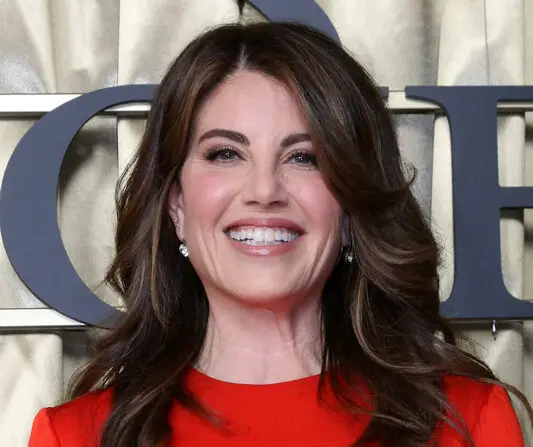
Nearly three decades after her name became shorthand for scandal, Monica Lewinsky is charting the long, deliberate road she walked out of in what she calls her “dark decade.” In a recent episode of her podcast, “Reclaiming with Monica Lewinsky,” the 53-year-old activist told actress Jamie-Lynn Sigler that self-acceptance was not a single moment of relief but the product of sustained, difficult work.
The conversation centered on Sigler’s memoir, “And So It Is…: A Memoir of Acceptance and Hope,” a title Lewinsky said struck a personal chord. For a woman who spent years being defined by other people’s judgment, the word “acceptance” carries a specific weight.
“It’s such a big part of reclaiming, actually. You really can’t move through all the steps until you’ve had acceptance,” Lewinsky said on the podcast.
Learning to Integrate Two Selves
Much of Lewinsky’s healing, she explained, came from refusing to leave her younger self behind. She could not simply abandon the 22-year-old White House intern she had been in the mid-1990s and pretend that person no longer existed. Instead, she had to find a way to carry that version of herself forward without shame — a process she described as integration, which she said becomes possible only after acceptance takes hold.
She was candid about how much effort that demanded. There was “so much work,” she said, involved in reconciling the two versions of herself and quieting the internal criticism she still feels. Her framing of the challenge was almost startlingly practical: the world outside is hard enough, so she asked herself how to make things less punishing within.
Lewinsky entered public life in 1998, when it was revealed she had a sexual relationship with the president of the United States at the time, Bill Clinton, while she was a young intern at the White House. What followed was years of intense media scrutiny and public ridicule that unfolded on a scale few people have ever endured. Clinton was later impeached, and Lewinsky’s name was tied to a national political spectacle she never chose.
The Weight of a “Dark Decade”
Lewinsky has returned repeatedly this year to the period she calls her dark decade, and her reflections have grown more layered with each retelling. Earlier, she spoke about surviving the judgment of strangers — a public reckoning that played out in front of what felt like an audience of billions. In another discussion, she acknowledged that a desire to feel special had fueled bad decisions during her time in Washington.
What set the dark decade apart, she said, was its relentlessness. It was not a difficult stretch punctuated by relief, where a good thing eventually arrived to break the gloom. It simply felt like everything stayed bad, she recalled, and each time she believed the situation could not deteriorate further, it did.
Survival, in those years, came partly from a psychological defense mechanism. Lewinsky noted that her ability to dissociate helped her get through the worst of the scandal, allowing her to create distance from an experience that would have been otherwise unbearable. Looking back now, she said the fact that she made it through at all still strikes her as pretty miraculous.
A New Definition of Power
The years of hard interior work have reshaped more than Lewinsky’s relationship with her past. They have altered how she understands power itself. Her personal definition of the word has evolved, moving away from the conventional markers of influence toward something quieter and more relational.
That shift shows up in how she now regards her friendships. Having spent so long feeling like a burden — an object of ridicule rather than a person worthy of connection — she said she can genuinely appreciate when the people close to her come to her in a state of distress. When friends need to be heard, or need connection during a hard moment, she does not experience it as a weight. She receives it as a form of trust.
It is a striking inversion for someone whose most public chapter was defined by isolation and humiliation. Where she once absorbed the harshest possible judgment, Lewinsky has built a life organized around empathy, and she has done it deliberately, one step at a time.
Her podcast has become the vehicle for that message, offering conversations with guests like Sigler who understand what it means to rebuild an identity after a public rupture. In talking through Sigler’s memoir, Lewinsky returned to the idea at the core of her own recovery: that acceptance is the door everything else must pass through first. Only after making peace with who she was, she suggested, could she stop being ashamed of her — and finally bring her along.