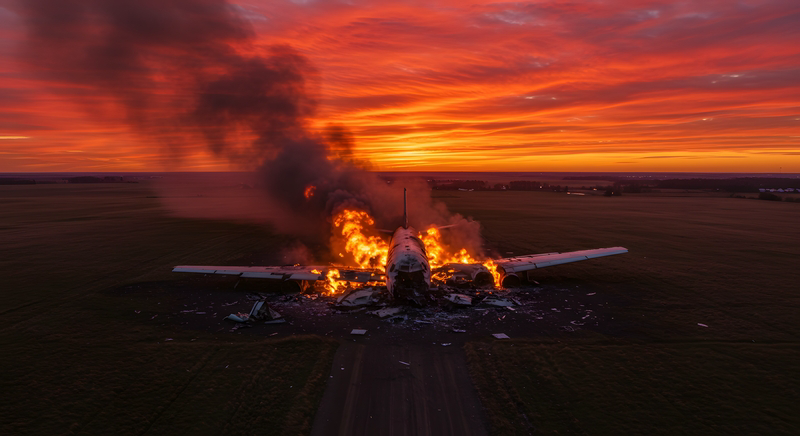
A small plane carrying eight people crashed Thursday, August 20, 2026, in western Alaska while bound for a remote military radar station, killing everyone on board, the U.S. military said. The aircraft, chartered by the U.S. Army Corps of Engineers, went down near Cape Newenham Long Range Radar Site Airport, roughly 450 miles west of Anchorage.
The twin-engine Cessna 441 had departed Ted Stevens Anchorage International Airport and was scheduled to land at the radar site when the crash occurred, the Federal Aviation Administration said Friday, August 21. The disaster ranks among the deadliest aviation incidents in the state in recent memory, striking a workforce that keeps watch over some of the most isolated terrain in the country.
According to Clint Johnson, who leads the National Transportation Safety Board’s Alaska region, two pilots and six passengers were aboard the flight. The U.S. Army Corps of Engineers confirmed that two of its employees were among the dead. Officials did not release the identities of those killed or specify the exact work the passengers had been assigned to perform at the site.
A Mission in a Demanding Environment
Lt. Gen. Robert Davis, who heads Alaskan Command along with the Alaskan North American Aerospace Defense Command Region and Eleventh Air Force, called the crash a heavy blow to the military community. “This is a devastating loss for our military family and the communities we serve,” Davis said in a statement.
Davis characterized those aboard the flight as committed professionals who were fulfilling an essential mission under challenging conditions. He said the military’s foremost concern was supporting the families, friends and teammates of the victims, and he praised the speed of the search and recovery effort that followed the crash.
The airport is a private military facility, and the Pacific Air Forces Regional Support Center oversees operations at the radar site. According to Alaskan Command, it belongs to a network of remote installations that track aircraft moving through Alaska’s airspace and along its borders — a system that stitches together surveillance across a vast and often inhospitable frontier.
Foggy Conditions at Time of Crash
The plane went down in foggy weather, according to information from a service affiliated with the nonprofit Flight Safety Foundation. Johnson said the pilots were flying solely by instruments in conditions that gave them no view of the ground, and that Anchorage Center lost contact with the airplane after a second missed approach. Low visibility is a persistent hazard in that stretch of Alaska, where weather can shift quickly and small aircraft serve as lifelines to communities and outposts unreachable by road.
The NTSB and FAA are both investigating. According to NTSB spokesman Peter Knudson, five investigators from the agency were en route to the crash site Friday morning, August 21. Investigators plan to document the wreckage before moving it to a secure facility for a closer examination, a process that can take months before a probable cause is determined. The Cessna was operated by Security Aviation, an Anchorage-based air charter company, the NTSB said.
A range of agencies responded after the plane was reported down, including the U.S. Coast Guard, Alaska State Troopers and the Rescue Coordination Center. Their coordinated push into the remote area underscored the logistical challenge of reaching a crash hundreds of miles from the nearest city.
Condolences From Alaska’s Delegation
Alaska Sen. Lisa Murkowski offered condolences Thursday night, August 20, saying she had flown extensively with Security Aviation across the state and had come to know many of its experienced pilots. She thanked the responding agencies and said the state was praying for those on board, their loved ones and the charter company’s staff. Murkowski posted the message as details of the crash spread across the state.
Officials have not said what specific project or maintenance task drew the passengers to the radar site.
A Cold War Outpost’s Legacy
Cape Newenham has served a defense role for more than 70 years. Construction of a continental defense radar station began there in 1950, one of the ten original Aircraft Control and Warning sites built to give Alaska a permanent air defense network against potential Soviet attack during the Cold War. The station became operational in April 1954. Few traces of that original installation survive, but the site’s modern successor continues the same fundamental task of watching the northern skies.
The Army Corps of Engineers, whose stated mission is to deliver engineering solutions that support national security and reduce disaster risk, maintains a wide-ranging presence in Alaska, from flood mitigation projects to work at far-flung military facilities. For the families of the eight who died, the investigation now underway offers little immediate comfort — only the promise of answers that will not come quickly.
Investigators had not released a preliminary account of what caused the crash as of Friday, August 21. The examination of the wreckage, once relocated, is expected to guide the NTSB’s search for a probable cause.