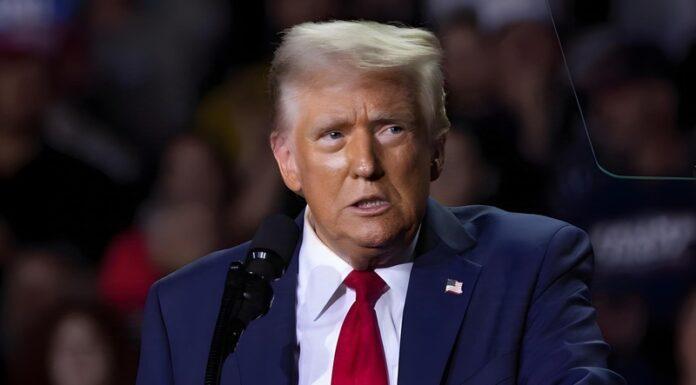
A former U.S. ambassador has described his first and only face-to-face meeting with Donald Trump in June 2017 — a brief encounter that, he says, left him questioning whether he could continue serving the administration. John Feeley, who spent 28 years at the State Department and served as U.S. ambassador to Panama, recounted the exchange on the August 7, 2026, episode of The Guardian’s “Stateside with Kai and Carter” podcast, explaining to host Kai Wright that Trump’s opening question caught him completely off guard.
The moment Feeley walked in, Trump turned to him and said: “So you’re my ambassador in Panama. What do we get from Panama?”
Feeley said that as a former Marine officer and helicopter pilot, he quickly assessed the situation and changed tactics, abandoning typical diplomatic briefing language for concrete examples Trump might appreciate, such as affordable shipping rates for iPhones and televisions traveling from Asia through the Panama Canal to America’s East Coast. According to Feeley, Trump’s response was simply: “Huh, who knew?”
“I kid you not, man. That’s what he said, ‘Who knew?’” Feeley said, prompting laughter from both men on the podcast.
A Career Diplomat’s Growing Unease
Feeley’s account carries weight given the depth of his experience. Over the course of his State Department tenure, he held positions including ambassador to Panama, deputy chief of mission and chargé d’affaires in Mexico City, principal deputy assistant secretary for the Bureau of Western Hemisphere Affairs, and deputy executive secretary under Secretaries Colin Powell and Condoleezza Rice. He was nominated to the Panama ambassadorship by President Barack Obama in 2015 and remained in the post into the Trump administration — a reflection of his reputation as a career professional who served under both Republican and Democratic administrations without regard to party.
That nonpartisan record made his eventual departure all the more striking. Feeley said the meeting, and what it revealed about Trump’s worldview, contributed to what he described as his “unease about continuing to be his personal representative.” He went on to characterize the administration’s approach toward Latin America — a region he said he had devoted roughly 30 years of his professional life to — as fundamentally shallow, driven less by strategic thinking than by a transactional calculus of immediate returns.
Feeley submitted his resignation letter to the White House on December 27, 2017, roughly six months after the Oval Office encounter. He had intended to go quietly; the letter was leaked to Reuters and became public on January 12, 2018, and he formally left his post on March 9, 2018. His resignation letter, as reported at the time, said he felt “honor bound to resign.”
What a Country of 4.5 Million People Means
According to Feeley, Trump’s question revealed a profound imbalance in how the president understood bilateral relations — the United States with its vast economy and military might versus Panama, a nation of 4.5 million without armed forces. Feeley said the “What do we get?” question about a country hosting such a critical global waterway exemplified a fundamental misunderstanding of U.S. interests in the Western Hemisphere.
Juan S. Gonzalez, a former member of then-Vice President Joe Biden’s national security team, wrote in Americas Quarterly days after the resignation became public that the ambassador was among the State Department’s most talented and effective Latin America specialists. Gonzalez recalled how Feeley worked behind the scenes during Biden’s March 2-3, 2015, trip to Guatemala City, securing key commitments from Central American delegations. Gonzalez also recorded the call sign Feeley’s fellow Marines gave him: “Touchy” — as in Touchy Feeley.
Life After the State Department
Since leaving government, Feeley has remained active in hemispheric affairs. He currently serves as executive director of the Center for Media Integrity of the Americas, a nonprofit that promotes quality journalism and freedom of expression throughout the Western Hemisphere. He also serves on the board of directors of Envoy Global, a corporate immigration services firm, and is a member of the Inter-American Dialogue. He has worked as a political consultant for the Spanish-language network Univision. Feeley earned his degree from Georgetown University’s School of Foreign Service and also attended the National War College, where he was a distinguished graduate.
His appearance on “Stateside” — a podcast hosted by Kai Wright for The Guardian — marked one of the more candid public reflections by a career diplomat on the experience of serving under Trump. The account was notable not for partisan score-settling but for its specificity: a single exchange, in a single room, that crystallized for a seasoned professional that something was fundamentally different about how this president viewed America’s relationships with its neighbors.
The Question That Defined a Presidency’s Approach
Feeley, careful in his phrasing but pointed in his conclusion, described the meeting as revealing not merely ignorance on Trump’s part but a surrounding policy environment he found equally troubling — advisers who were not uninformed, he said, but who nonetheless approached the region with what he viewed as a reflexively transactional and superficial lens. The throughline, he suggested, was always the same question, however it was dressed up: what do we get from these people?
For a diplomat who spent nearly three decades working to build durable partnerships across Latin America and the Caribbean, the answer to that question was never simple — and the fact that it was treated as though it were, he said, was ultimately something he could not abide.