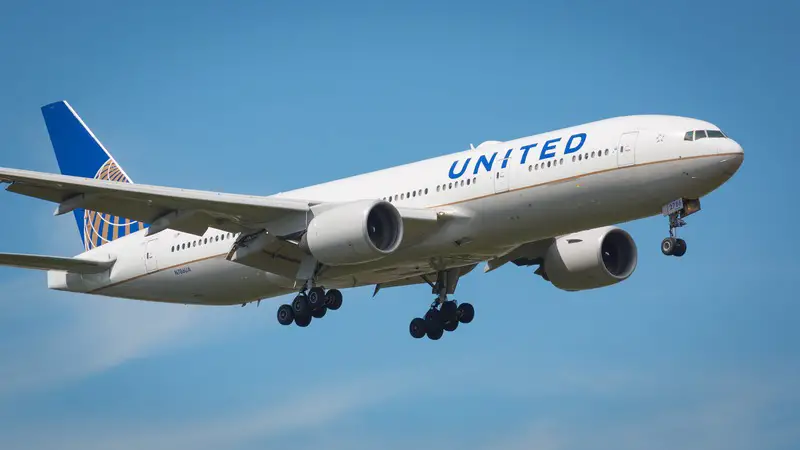
Passengers on a packed Boeing 777 bound for Los Angeles were watching movies and settling in for the descent when the floor dropped out from under them.
The Federal Aviation Administration (FAA) has confirmed an investigation into the severe turbulence that injured four flight attendants aboard United Airlines Flight 1157 on the night of Wednesday, Oct. 21, 2026, as the jet descended toward Los Angeles International Airport after leaving Honolulu’s Daniel K. Inouye International Airport. The flight carried 190 passengers and 10 crew members and landed safely.
The aircraft departed Honolulu just after 1 p.m. HST and touched down at LAX around 9 p.m., 20 minutes late, according to flight-tracking data, which identified the plane as a Boeing 777-200 with the registration N769UA, and the turbulence hit during descent, reportedly at around 27,000 feet.
A Loud Bang, Then Falling
Passenger Coral Pena heard a loud bang when it struck. “We just started falling, and I was like, ‘Oh my God,’” Pena said.
Marly Wadlington, a San Diego resident aboard the flight, said she was watching a movie when the jet fell, and the drop felt long to her. The cabin shook and people were yelling, she said, and fear ran through the cabin.
Lake Havasu resident Tami Dandoy, who was on board, said the jolt lifted her and others clear of their seats. A small bump sent them flying, said fellow passenger Melinda Sabosky, who added that she could not tell how far the plane dropped. One passenger described a travel companion’s head coming close to striking the cabin ceiling.
Another passenger reported seeing blood on a flight attendant’s head and leg. At least two of the injured crew members suffered neck and back injuries. In-flight communications indicated the two are women, ages 62 and 58.
The Plunge the Pilot Called Brief
The 31-year-old Boeing 777 lost as much as 3,675 feet in a single minute, according to flight data covering roughly the last 20 minutes of the trip. The altitude loss cannot be attributed entirely to turbulence: the aircraft was already descending, and the roughly 3,675-foot change over one minute does not by itself show an uncontrolled fall. The precise cause has not been confirmed. Two minutes and 30 seconds carried the jet from 22,800 feet down to 14,000 feet, after which it pressed on toward Los Angeles at a more conservative rate.
A prior United flight on the same Honolulu-to-Los Angeles run never descended at a rate steeper than 2,725 feet per minute, and even that held only briefly.
Flight audio gave an indication that the crew had run into wake turbulence. “It only lasted a couple of seconds, it felt like wake turbulence, but we’re smooth now,” the pilot said in a radio call to air traffic control.
Injured Crew Still Waiting for a Gate
The plane sat on the tarmac for at least 30 minutes with the injured flight attendants still on board, waiting to reach a gate.
United said four flight attendants were seen by medical personnel after the landing, and at least one crew member was taken to a hospital for further treatment. The airline said no customers were injured and that the flight encountered the turbulence as it descended.
Why Cabin Crews Get Hurt
The FAA describes wake turbulence as “two counter-rotating vortices” generated by one aircraft and flown into by another. Those vortices can cause injuries and can roll a plane harder than its own controls can counter, according to the agency.
Flight attendants accounted for about 85% of serious turbulence injuries aboard commercial airlines from 2019 to 2024. FAA statistics for that period count 71 crew members and 13 passengers seriously injured.