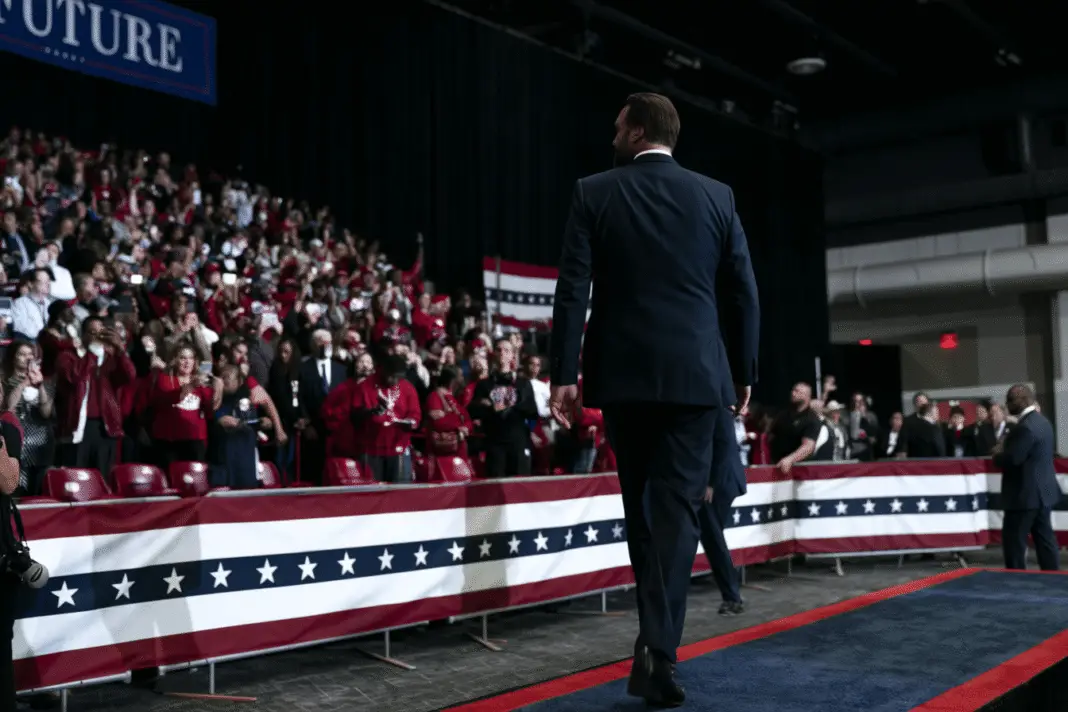
The vice president nearly everyone assumes is next in line has chosen to keep the country guessing for months.
JD Vance, the 42-year-old vice president, told Fox News host Laura Ingraham on Monday, Nov. 16, 2026, that his mind is not made up about a 2028 presidential run and that a decision is coming “sometime next year,” in his first TV interview since the midterms.
Reports that surfaced Sunday, Nov. 15, said Vance will make no final decision until after the new year, and may wait until late spring to announce one. The reason cited: wariness that an early launch could alienate President Donald Trump.
Republicans were still sorting through the wreckage of the midterms when that calculation landed. The Nov. 3 results stripped the party of its majorities in the House and the Senate.
Told to Stand Down on Iran
Vance himself set the delay in motion with a post on X, where he blamed the defeat on the war in Iran waged by the 80-year-old president. “The real reason we lost is obvious to almost everyone,” he wrote. “The reason we lost is the war.”
Vance used the same post to invite anyone who considered the war worth losing the Senate for six years to make that argument, and he said no honest conversation about where the party goes next can begin anywhere else.
Trump has spent the days since trying to shrink the rift. He said publicly that “a lot of people didn’t like his comments,” while insisting his relationship with his vice president is still solid.
Trump told reporters that Vance’s analysis was correct, but that the vice president “should have made one other statement … If you had it to do again, would you do it again? The answer is yes.”
Behind the scenes, sources familiar with the president’s thinking said he was angry about the remarks. Trump has since instructed Vance to stand down from further negotiations to end the war and to give his full attention to tackling domestic corruption of Democrats instead.
The United States and Israel launched the war on Feb. 28, and officials at the time said it would be wrapped up within weeks.
Vance made his own gap-closing move in the Ingraham interview, saying there is “no daylight” between him and Trump on the war and pledging that the administration would not let the conflict become “even a two-year commitment.” He added of 2028: “When I make a decision, Laura, I will be all in on whatever that decision is.”
The Voters Republicans Couldn’t Reach
Democrats flipped nine GOP-held Senate seats, and the full scale of the loss is still coming into focus.
Many Republicans walked into Election Day braced for a tough night, not a wipeout. Ronna McDaniel, the former Republican National Committee (RNC) chair, told ABC News she had not expected Democrats to compete in South Carolina, Kansas or Texas. “I thought that we were going to keep the Senate,” she said.
More than a dozen Republican donors and operatives said the party remains in shock. Their diagnosis: a message built on culture wars never reached voters squeezed by costs tied to the Iran war, and the Latino coalition slipped away.
Democratic House candidates carried Latino voters nationally by a 30-point margin in 2026, up from 13 points in 2024. Trump acknowledged in a post-midterm interview that his mass-deportation policies may have been “too tough.” Mike Madrid, a GOP consultant, told ABC News that “there is no question that the ICE stuff and deportations played a role.”
The party failed to speak to pocketbook issues, said Sarah Chamberlain, president and CEO of the Republican Main Street Partnership, which raises money for moderate Republicans. T.W. Arrighi, a strategist on the Senate campaign of Republican Darline Graham, said Democrats discussed affordability in far more concrete terms and that Republicans had conservative answers they never delivered.
The turnout operation will likely absorb much of the blame, according to a GOP strategist involved in many 2026 races, who said Republican voters failed to turn out in the numbers the party needed. Early voting in Texas and Georgia pointed to greater Democratic enthusiasm before Election Day.
Vance rejected that explanation in another post. “Our voters did show up. In Florida, for example, the electorate was 9 points more Republican than Democrat, just a couple points worse than 2024. Undoubtedly there were places we could have done better on turnout. But the main problem is not turnout,” he wrote. The main problem, he said, is that voters who backed Trump and Vance in 2024 backed Democrats in 2026.
Trump said in a phone interview on election night that the results left him somewhat surprised. He posted afterward that Republicans would have fared better had he been on the ballot.
Davis Ingle, a White House spokesman, pointed to what the administration has delivered: the largest working-class tax cuts in history, a secured border, lower prescription drug costs, more than one million private-sector jobs and nearly 20 trade deals. No president in the country’s history, he said, has been more consequential or more successful than Trump. Natalie Baldassarre, the RNC’s national press secretary, said the committee raised $130 million, more than $60 million of which went directly to Republican campaigns.
Rubio Looks More Viable to Some
Some of those donors and operatives said the presumptive 2028 nominee may no longer be Vance, and Secretary of State Marco Rubio now strikes some Republicans as the stronger bet. Rubio has said he has no plans to run in 2028 and would back Vance if he ran.
Polls are mixed. A post-midterm Economist/YouGov survey put Vance ahead of Rubio, 40 percent to 33 percent, among Americans who intend to vote in the 2028 Republican primaries.
Vance’s political advisers sound far less hesitant. They still expect him to run, pointing to a donor network and name recognition already in place, with one caveat — his role in the current administration could make the path to victory harder.
The midterm defeat has registered widely among Republicans as a fracturing of the MAGA movement that carried Trump and Vance to power in 2024, and some party officials are weighing a different direction with a post-Trump 2028 coming into view. Vance is still widely considered Trump’s most likely successor on the Republican ticket.